
These Nativity activities for kids give little hands something to do while little ears listen. With a Bible, three slips of paper, and a few crayons, you can help children tell the Christmas story in their own words. The plan works for Sunday school or Christian homeschool, and you can shorten it to a few minutes around the kitchen table.
Start with three moments children can picture: the journey to Bethlehem, Jesus in the manger, and the shepherds coming to see him. Use the same three pictures when you read, play, and wrap up. If you’d like to revisit the story in small pieces throughout December, TuideriCreative’s Nativity Scene Advent Calendar gives you a short illustrated Scripture reading to come back to each day.
A 25-Minute Nativity Lesson for Sunday School or Homeschool
Gather a Bible, scrap paper, crayons, and a few blocks or large toy figures if you have them. Before children arrive, sketch a road, a manger, and a shepherd on three separate pieces of paper. A manger is a feeding trough for animals; a small open box can help children picture one. Keep the same pictures on the table from start to finish, so late arrivals can join in.
1. Read and listen for three clues (6 minutes)
Read Luke 2:1–20 in three parts: verses 1–5 for the journey, 6–7 for the birth, and 8–20 for the shepherds. Pause at the end of each part and let a child set down the picture that goes with it. With preschoolers, tell each part briefly in your own words and read a short verse aloud. You might ask, “Where did Mary lay Jesus?” or “Who came to see him?” Give children a chance to point before anyone calls out the answer.
2. Mix up the pictures and retell the story (7 minutes)
Shuffle the three pictures. Ask a child to find the picture that belongs first. Let someone else place the next one and a third child finish the row. Then point to each picture and tell the story together: Mary and Joseph traveled to Bethlehem. Mary laid baby Jesus in a manger. The shepherds heard the news and went to see him.
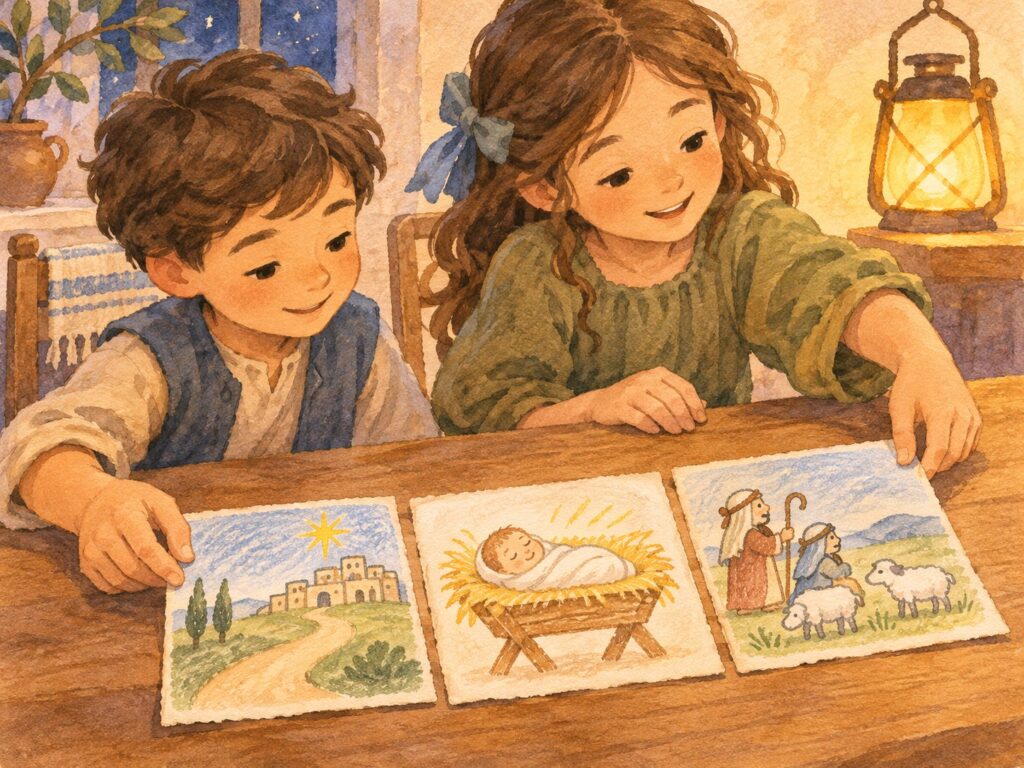
For a group, give each pair its own set of quick sketches or let one pair arrange the pictures while everyone else shows one, two, or three fingers. If the shepherd picture is tricky, ask whether the shepherds could visit the baby before he was born. Reread a line from Luke if the children want to check.
3. Make a folded story strip (9 minutes)
Fold a sheet of paper into thirds. Draw a road in the first panel, a manger in the second, and shepherds in the third. Young children can add a mark or color to each scene while an adult writes down their words. Older children can add one caption per panel, using first, next, and then. Leave the pictures open beside them so nobody has to remember how to draw a shepherd from scratch.
At home, set the strip next to the dinner plates and let the child tell one part to someone who missed the lesson. In Sunday school, write “Luke 2:1–20” on the back so families know where to find the story.
4. Close with one question (3 minutes)
Ask, “What did the shepherds do after they saw Jesus?” If children remember only the visit, reread verses 17–20 together and notice how the shepherds told others and praised God. Finish with a brief prayer if that’s part of your group’s routine.
Adapt the Christmas Story Activities for Your Group
Preschool and pre-K: Keep just two pictures if three feel like too many. Let a child carry the road picture across the room or rock a doll wrapped in a cloth. Pointing, moving a figure, or dictating a caption all count as retelling. If you have ten minutes, stop after the picture game and save the drawing for another day.
Kindergarten through grade 3: Invite children to add a fourth picture showing the shepherds sharing the news. For an older group, read Matthew 2:1–12 on another day. Ask children to find which visitors appear in each Gospel. Luke tells about the shepherds; Matthew tells about the Magi and describes them visiting Jesus in a house. Many Nativity displays bring the figures together, which gives children a reason to look back at both readings.
Use the Nativity Scene Advent Calendar to Revisit the Story
The printable Nativity Scene Advent Calendar has 25 numbered cards with watercolor illustrations and short Scripture excerpts. The US Letter design includes a white background and a vintage paper option, with four cards on most pages. The readings reach beyond the manger scene: they begin with Old Testament prophecies, move through Luke’s account, and include the Magi in Matthew. The final card draws on John 3:16.
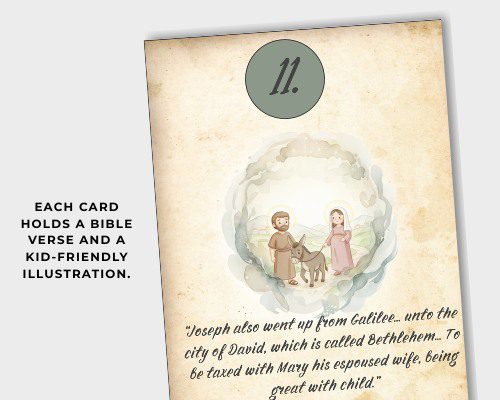
For a December 1–25 countdown, print one version and keep the cards in a small basket in number order. After breakfast or before bed, let a child find the day’s number. Read the verse, look at the picture, and ask one question: “Who is in this part of the story?” or “Which picture from our story strip belongs with today’s card?” The youngest children can point to an illustration; confident readers can look up the verse and read a little more around it. If you miss a day, pick up with the current card or go back to a favorite.
For a group that meets weekly, pull a few cards that match the lesson instead of trying to cover a week of readings at once. Cards 11 and 12 go with the journey and birth; cards 17 and 18 go with the shepherds setting out and finding Jesus. Keep the homemade picture cards for the sorting game and use the printed verse cards for reading aloud. If your church follows the liturgical year, Advent begins on Sunday, November 29, 2026. You can start the cards on December 1 as a countdown or begin a few days early with your church.
For more ways to set up a December routine, see these printable Advent calendar ideas. If you’re also planning a group celebration, choose one of these Christmas party games for kids to play after the story.
If your family or Sunday school group would enjoy a short reading to return to each day, you can find the Nativity Scene Advent Calendar on Etsy. Start with a card, a quiet moment, and time for one good question.
Leave a Reply
You must be logged in to post a comment.