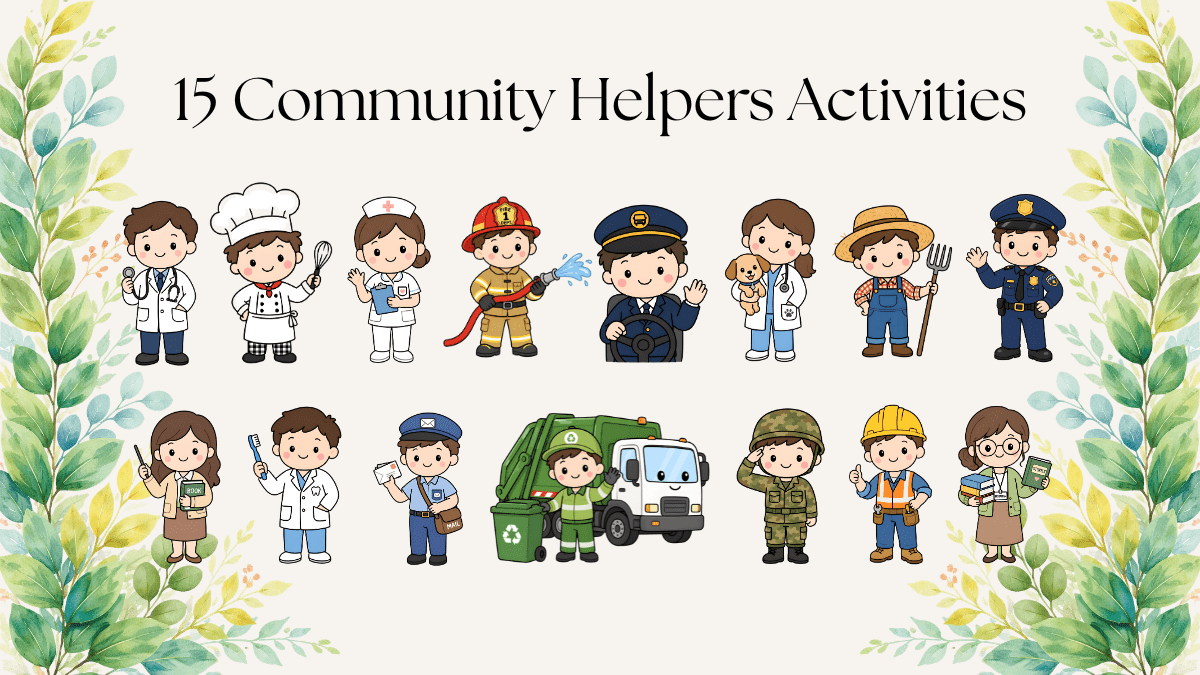
Help little learners explore the people who make our neighborhoods run — with hands-on activities that build reading, writing, math, and critical thinking skills.
Community helpers are one of the most beloved preschool and kindergarten themes for good reason. Young children are naturally curious about the adults they see every day — the firefighter driving the big red truck, the mail carrier at the door, the doctor at check-up time. A community helpers unit taps into that curiosity and turns it into rich learning. But finding quality community helper activities that go beyond a coloring sheet? That’s where most parents and teachers get stuck.
This post rounds up 15 community helpers activities for preschool and kindergarten — spanning literacy, math, hands-on play, and creative projects. Whether you’re a homeschool parent building a unit study, a classroom teacher looking for centers, or just a mom who wants to extend the theme, there’s something here for every learner. Let’s dig in!
Why Teach Community Helpers in Preschool & Kindergarten?
Before we get to the activities, let’s talk about why this theme matters so much at this age. Community helpers activities teach:
- Social awareness — Children learn that many different people work together to keep a community safe, healthy, and running smoothly.
- Vocabulary development — Words like veterinarian, construction worker, and librarian expand language in a meaningful, contextual way.
- Career awareness — Early exposure to diverse occupations plants seeds of possibility. Kids begin to imagine their own futures.
- Reading comprehension — Non-fiction texts about real-world helpers give young readers authentic, engaging content to work with.
- Writing motivation — Kids love writing about things that feel real. “What I want to be when I grow up” becomes a rich writing experience when they know their options! Now, on to the activities.
15 Low-prep Community Helpers Activities for Preschool & Kindergarten
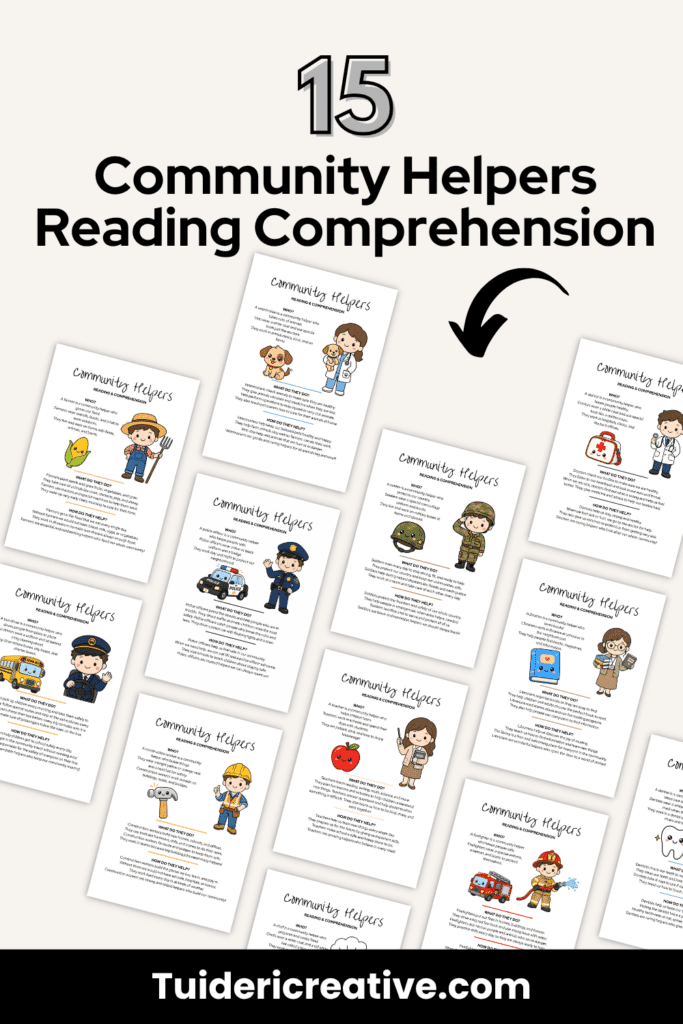
1. Community Helpers Reading & Comprehension Pages
Skills: Reading fluency, comprehension, vocabulary
Best for: Kindergarten, early 1st grade
Start your unit with structured reading pages for each community helper. A well-designed reading page covers three key areas: who the helper is, what they do, and how they help the community. For example, a firefighter reading page might explain that firefighters wear helmets and boots, drive red fire trucks, use water hoses, and practice drills every day so they’re always ready.
For example, a firefighter reading page might explain that firefighters wear helmets and boots, drive red fire trucks, use water hoses, and practice drills every day so they’re always ready.
After reading together as a class or in pairs, follow up with basic comprehension questions — “What vehicle does a firefighter drive?” or “Why do firefighters practice drills?” — to check for understanding. This approach mirrors what children will encounter on early reading assessments and builds strong habits of close reading.
📌 Pro tip: Use these pages as a read-aloud during morning circle time, then have students complete the comprehension work independently.
2. True or False Comprehension Activity
Skills: Reading comprehension, critical thinking, listening
Best for: Pre-K, Kindergarten
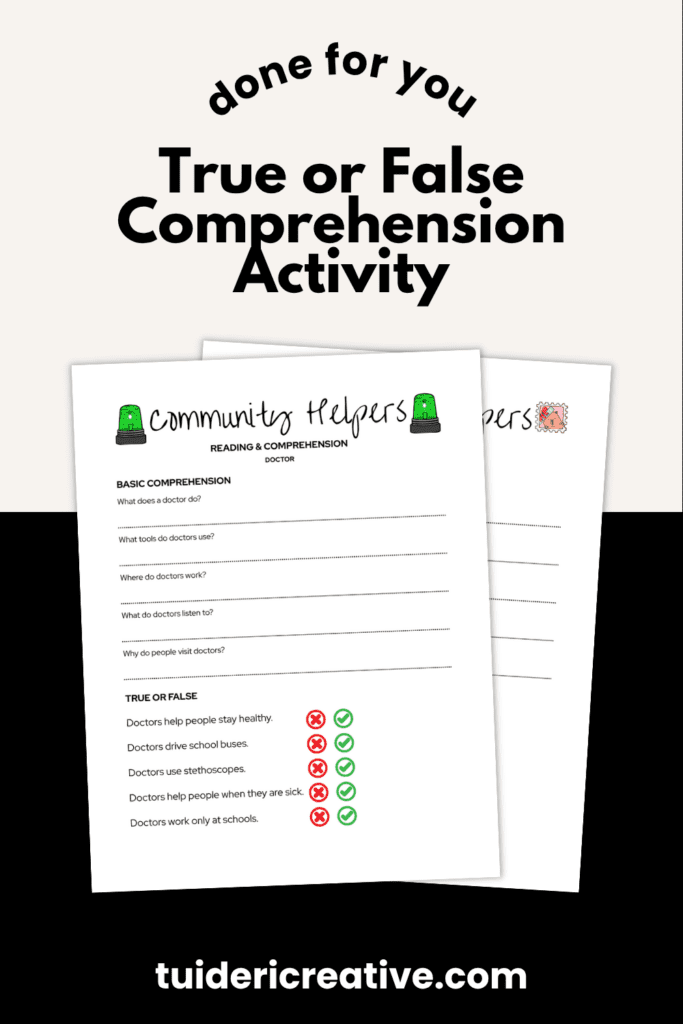
True/False activities are perfect for young learners who are still building stamina for written responses. After reading about a community helper, present statements like:
- “Firefighters help keep people safe.” (True)
- “Firefighters drive school buses.” (False)
- “A dentist works at a farm.” (False)
Children can respond by holding up true/false cards, moving to different sides of the room, or circling answers on a worksheet. This format builds active listening and early reading comprehension without the barrier of lengthy writing.
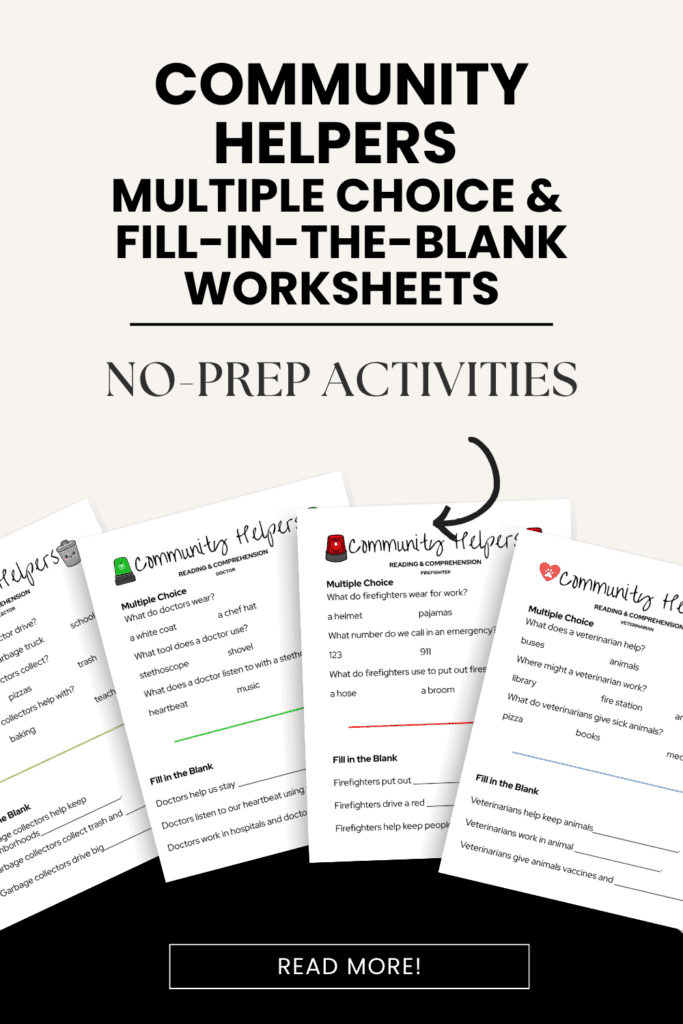
3. Funny Multiple Choice & Fill-in-the-Blank Worksheets
Skills: Reading, vocabulary, independent work habits
Best for: Kindergarten
Multiple choice questions give emergent readers a structured way to demonstrate comprehension while building familiarity with this common assessment format. Pair them with fill-in-the-blank sentences to reinforce vocabulary in context.
Example: What do firefighters use to put out fires?
a) a hose b) a broom c) a backpack
These pages work beautifully as independent practice after whole-group instruction or as a fast-finisher activity.
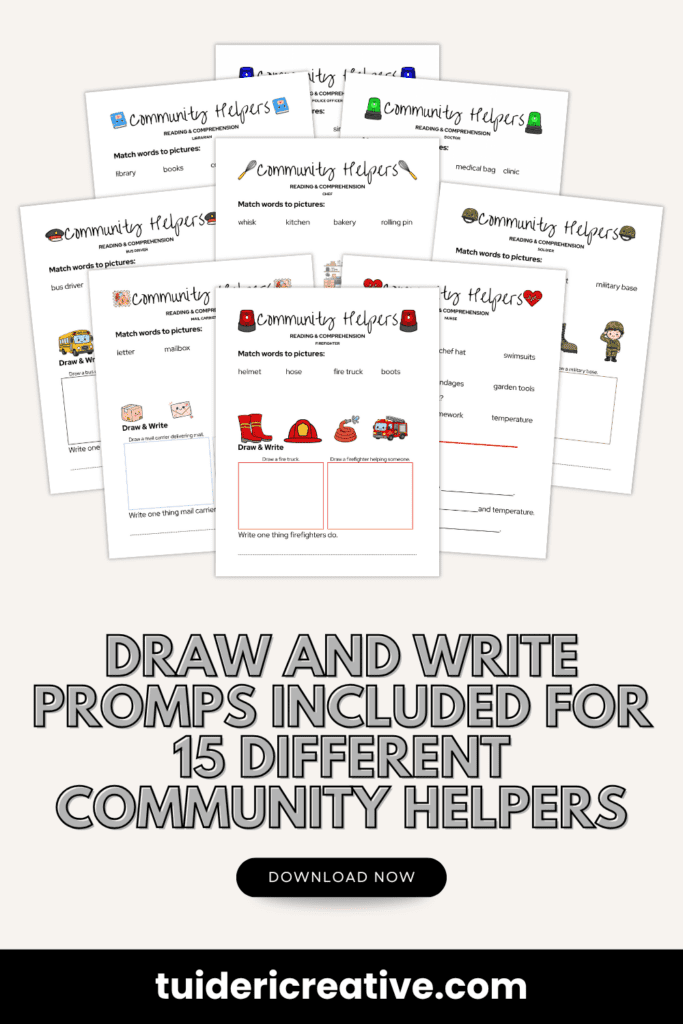
4. Match Words to Pictures Community Helpers Activities
Skills: Vocabulary, visual discrimination, word recognition
Best for: Pre-K, Kindergarten
Cut-and-paste or draw-and-match activities are a staple of early childhood learning — and for good reason. When children match a word like veterinarian to a picture of a vet caring for an animal, they’re building the visual-verbal connections that support reading comprehension and vocabulary retention. This activity works especially well as a literacy center or morning work station. It’s low-prep, self-checking (kids know when the picture and word don’t make sense together!), and highly engaging for hands-on learners.
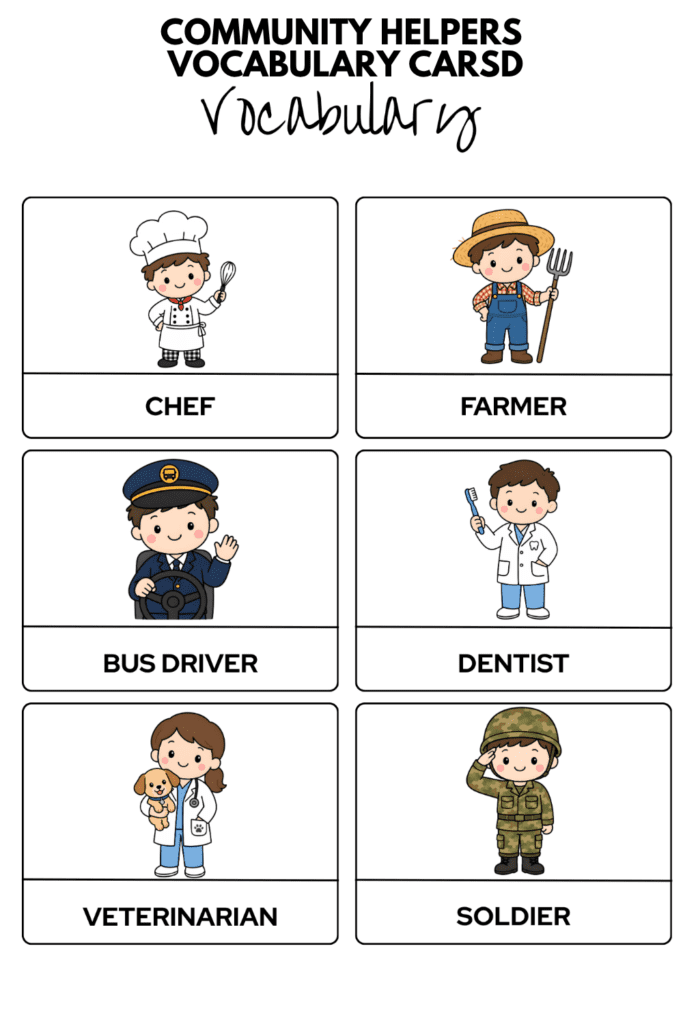
5. Community Helper Flashcards
Skills: Vocabulary, speaking and listening, memory
Best for: Pre-K, Kindergarten
Vocabulary cards featuring community helper occupations and their workplaces are incredibly versatile. Here are four ways to use them:
- Match the Worker to the Workplace: Place all cards face up and ask children to match each worker to the correct location — the chef goes to the restaurant, the librarian goes to the library, the soldier goes to the military base.
- Memory Game: Print two copies and play a classic memory matching game. Children flip cards to find occupation and workplace pairs.
- Guess the Job from Clues: Give verbal clues and let children find the matching card. “This person helps sick animals.” — Who is it? The veterinarian!
- Conversation Starters: Use cards to prompt speaking practice. “Where does a mail carrier work?” “What tools does a dentist use?”
Laminate your vocabulary cards for durability and you’ll get years of use out of them.
6. Draw and Write Pages
Skills: Writing, illustration, fine motor skills
Best for: Pre-K, Kindergarten
Draw-and-write pages invite children to illustrate a community helper and write (or dictate) a sentence about them. This format honors different developmental stages — a pre-writer can draw and narrate, while a more advanced student can write multiple sentences. Encourage children to include details:
- What is the helper wearing?
- What tools are they using?
- Who are they helping?
These pages double as beautiful additions to a community helpers lapbook or portfolio.
7. Critical Thinking Discussion Questions
Skills: Speaking, listening, reasoning, empathy
Best for: Kindergarten, 1st grade
Don’t underestimate the power of a great discussion question with young learners. After exploring each community helper, pose a critical thinking prompt like:
- “Why is it important that we have firefighters in our neighborhood?”
- “What would happen if there were no garbage collectors?”
- “How does a farmer help people who live in a city?”
Use these as morning meeting discussion starters, partner talk prompts, or writing jumpstarts. Children who can articulate why a community helper matters have moved beyond memorization into genuine understanding.
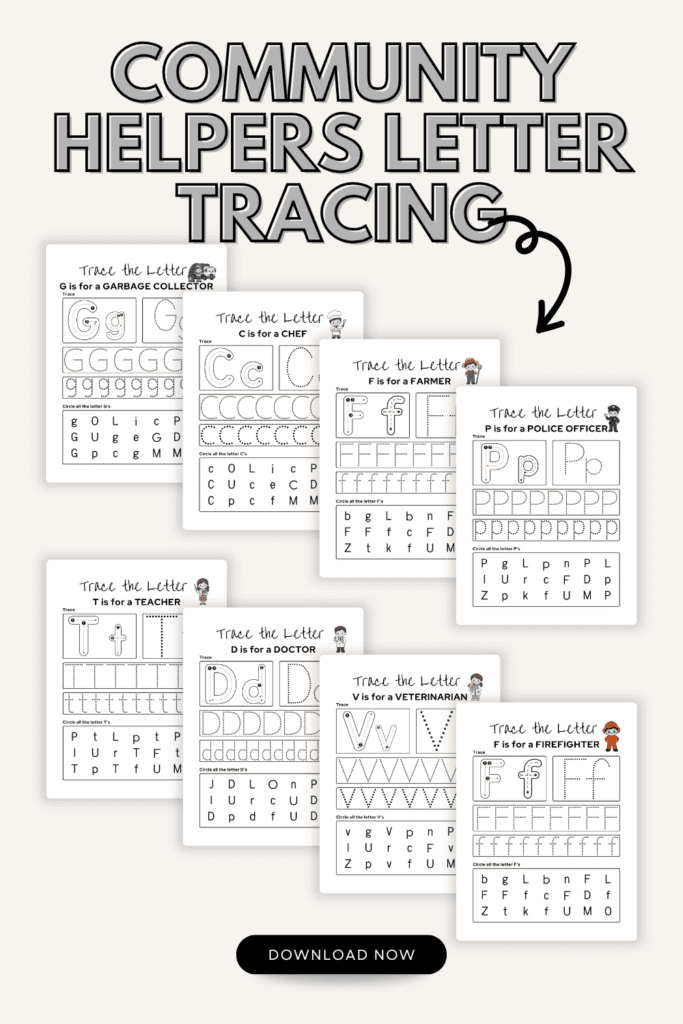
8. Letter Tracing Pages
Skills: Letter recognition, fine motor skills, phonics
Best for: Pre-K, Kindergarten
Weave in foundational literacy skills with alphabet pages tied to community helpers. B is for Bus Driver. C is for Chef. F is for Firefighter. Letter tracing pages reinforce letter formation while keeping the theme alive. These are perfect as:
- A literacy warm-up at the start of the lesson
- An early finisher task
- Homework that reinforces both handwriting and community helper vocabulary
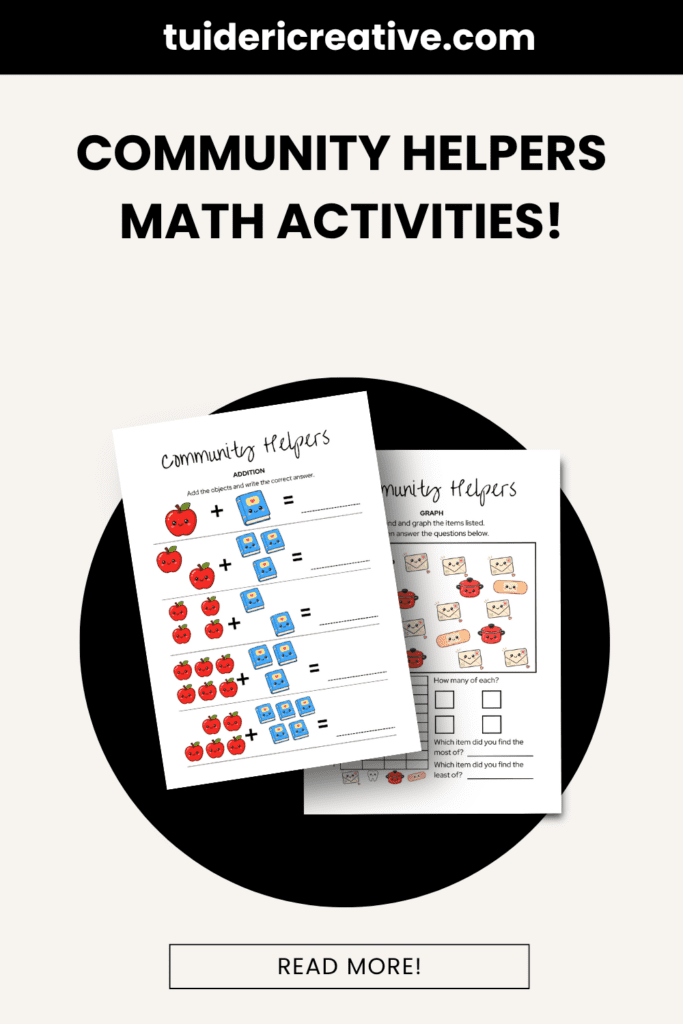
9. Community Helpers Math Activities
Skills: Addition, subtraction, patterns, graphing, sorting & classifying
Best for: Pre-K, Kindergarten
A strong community helpers unit goes beyond literacy — it integrates math in meaningful ways! Look for opportunities like:
- Addition and subtraction story problems using community helper scenarios (“The firefighter rescued 3 cats and 2 dogs. How many animals were rescued in all?”)
- Sorting and classifying community helper tools or equipment
- Graphing — “Which community helper would you most like to be?” and create a class bar graph
- Patterning using community helper icons or colors Math is so much more engaging when it has a real-world hook, and community helpers provide the perfect context.
10. Community Helper Badges (Dramatic Play)
Skills: Imaginative play, social-emotional learning, vocabulary
Best for: Pre-K, Kindergarten
Print, color, and wear community helper badges to transform dramatic play! When children wear a “Firefighter” or “Nurse” badge, they naturally begin to role-play the vocabulary and concepts they’ve been learning. Set up simple dramatic play stations:
- Fire Station: toy hose, helmet, boots, rescue animals
- Doctor’s Office: stethoscope, bandages, clipboard
- Post Office: envelopes, stamps, mail carrier bag
Dramatic play deepens learning by letting children inhabit the roles. It also builds social skills, language development, and empathy. This community helpers activity is something you can easily craft on your own with the children.
11. Paper Crowns for Each Community Helper
Skills: Fine motor skills, creative expression, dramatic play
Best for: Pre-K, Kindergarten
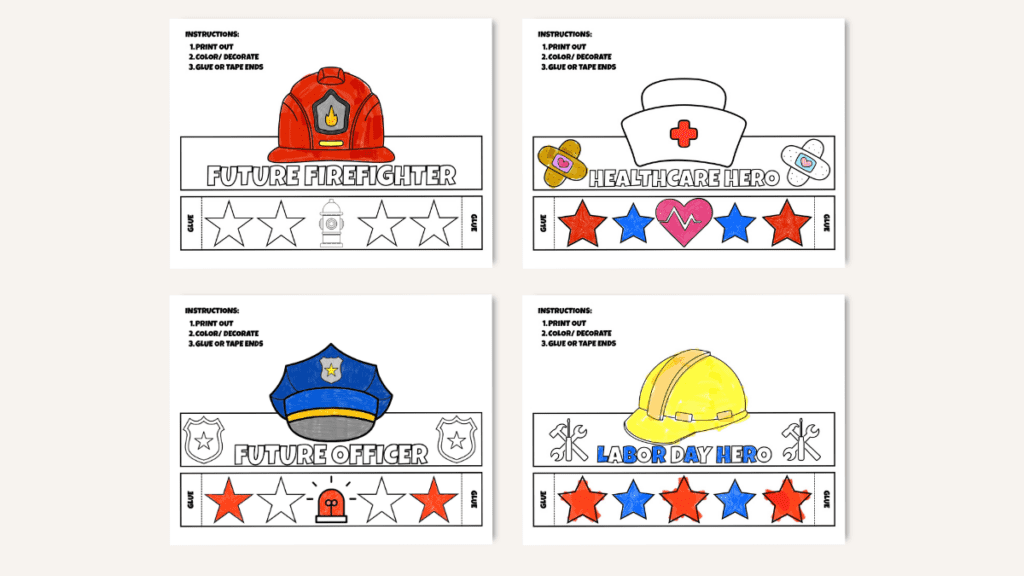
Paper crowns are a delightful way to make community helpers feel real and important. Create a firefighter crown, a police officer crown, a nurse’s cap, construction worker helmet — and let children wear them during discussions, role play, or a community helpers “parade.” You can:
- Color and decorate crowns to match each helper
- Write the helper’s name on the crown for a literacy connection
- Send crowns home for families to use in extended play. Children absolutely beam when they get to wear their crown and tell their family, “I’m a veterinarian!”
12. Accordion Books for Each Community Helper
Skills: Writing, sequencing, book-making, reading fluency
Best for: Kindergarten, 1st grade
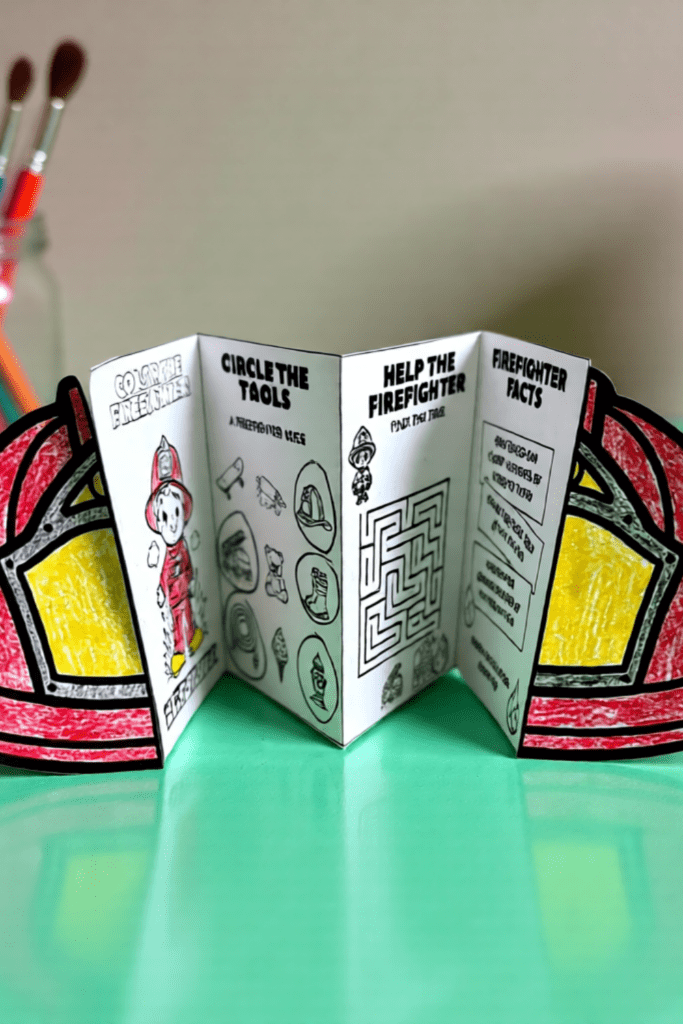
Accordion books (also called zigzag books) are one of the most satisfying projects for young learners — they feel like real books. For a community helpers unit, children can create a mini accordion book for their favorite helper including:
- Page 1: Illustrate the helper and write their name
- Page 2: Where do they work?
- Page 3: What tools do they use?
- Page 4: How do they help our community?
- Page 5: I want to be a because…
Accordion books make wonderful take-home projects that parents love and children are proud of. They also serve as a powerful reading fluency tool — children can “read” their own books to partners or family members repeatedly, building confidence and fluency.
13. Community Helper Writing Letters
Skills: Writing, empathy, letter format
Best for: Kindergarten, 1st grade
A meaningful writing project for any community helpers unit: have children write a letter to a community helper. Provide sentence starters to scaffold the writing:
- “Thank you for helping people every day.”
- “I think your job is special because…”
- “I learned that you…”
- “I would like to ask you…”
This project integrates social-emotional learning — gratitude, empathy, civic appreciation — with authentic writing practice. As an extension activity, actually mail the letters to a local fire station, police department, or school staff members!
14. “When I Grow Up” Writing & Drawing Pages
Skills: Writing, creative expression, self-awareness
Best for: Pre-K, Kindergarten, 1st grade
Cap off your community helpers unit with a “When I Grow Up” page. Children illustrate themselves in their chosen community helper role and complete sentence frames:
- “When I grow up, I want to be a ______.”
- “I will help people by ___.”
- “I will work at ___.”
These pages are pure gold for classroom displays, portfolios, and end-of-unit celebrations. There is something genuinely moving about a kindergartner who confidently writes, “I will be a veterinarian because I love animals.”
15. Community Helpers Unit Study (Complete Curriculum)
Skills: Reading, writing, math, critical thinking, vocabulary — all of it!
Best for: Pre-K through 1st grade, homeschool and classroom use
If you want everything in one place a comprehensive community helpers unit study is the way to go. A complete unit covers all 15 community helpers (Firefighter, Police Officer, Doctor, Nurse, Teacher, Librarian, Construction Worker, Chef, Farmer, Bus Driver, Dentist, Veterinarian, Soldier, Garbage Collector, and Mail Carrier) with 6 activity pages per helper.
What to look for in a quality unit study:
✅ Reading pages with who, what, how structure
✅ Comprehension activities at varied levels
✅ Vocabulary cards with occupations and workplaces
✅ Math integration (addition, subtraction, graphing, sorting)
✅ Writing pages including letters and creative writing
✅ Letter tracing and literacy warm-ups
✅ Critical thinking questions for discussion
✅ Flexible pacing (1 helper/day for 3 weeks OR 1 helper every 2 days for 6 weeks)
A print-and-go unit study saves hours of prep and ensures skills are scaffolded appropriately across the entire theme.
How to Structure a Community Helpers Unit
Not sure how to sequence all of these activities? Here’s a simple framework: Daily Lesson Flow (Per Helper):
- Read the reading page together
- Complete basic comprehension
- Work through multiple choice and fill-in-the-blank independently
- Do the hands-on match or draw-and-write activity
- Discussion: critical thinking question
- Warm-up or wrap-up: letter tracing
Suggested Pacing:
- 3-week unit: One helper per day (great for classroom use)
- 6-week unit: One helper every two days (ideal for homeschool or deeper exploration)
- Pick and choose: Select individual helpers to match your current curriculum theme
Tips for Getting the Most Out of Your Community Helpers Unit
Bring it to life outside the classroom. Point out community helpers in real life — wave to the mail carrier, say thank you to the librarian, talk about the construction workers you drive past.
Invite a guest speaker. Even a 10-minute visit or video call from a local firefighter, nurse, or police officer will be the highlight of the whole unit.
Create a word wall. Post community helper vocabulary where children can see it all month. Refer back to it constantly.
Use vocabulary cards for morning meeting. Start each day by featuring the day’s community helper on the board, reviewing vocabulary, and posing a discussion question.
Send home paper crowns and accordion books. Parent involvement deepens learning. When a child explains their accordion book to a parent, they’re retelling, synthesizing, and reading — all at once.
Frequently Asked Questions
What age is a community helpers unit appropriate for?
Community helpers activities are ideal for ages 3–6, spanning Pre-K through Kindergarten and early 1st grade. Activities can be easily differentiated — provide more scaffolding (sentence starters, picture supports) for younger learners and more independence and extended writing for older students.
How long should a community helpers unit last?
A thorough community helpers unit typically spans 3–6 weeks, covering one helper per day or every two days. However, you can also weave community helper activities throughout the year as a recurring theme.
What subjects can a community helpers unit cover?
A well-designed unit integrates reading and literacy, writing, math, science (community systems), social studies, social-emotional learning, art, and dramatic play — making it one of the most cross-curricular themes in early childhood education.
Can I use community helper activities for homeschool?
Absolutely. Community helpers is a classic homeschool theme that works beautifully for one child or a small group. The flexible pacing and variety of activity types make it easy to adapt for your child’s pace and learning style.
Ready to Dive In?
A community helpers unit is one of those themes that children remember. Years later, they’ll recall the day they wore the firefighter crown, or the accordion book they made about the veterinarian, or the letter they wrote to thank the school nurse. That’s the magic of hands-on, theme-based learning in early childhood. Whether you build your own activities from this list or grab a complete done-for-you unit study, your little learners are going to love exploring the helpers who make their community run.
Save this post for your next community helpers unit — and share it with a fellow teacher or homeschool parent who would love it!
Supplies You May Want for These Activities
- Scissors
- Glue sticks
- Laminator
- Cardstock
- Crayons or markers
- Velcro dots
- Pocket chart
Looking for a complete, print-and-go Community Helpers Unit Study? Check out our shop for a full 15-helper curriculum with 6 activity pages per helper, vocabulary cards, math activities. Please note that paper crowns and accordion books are sold separately and you can read more from here!
Leave a Reply
You must be logged in to post a comment.