
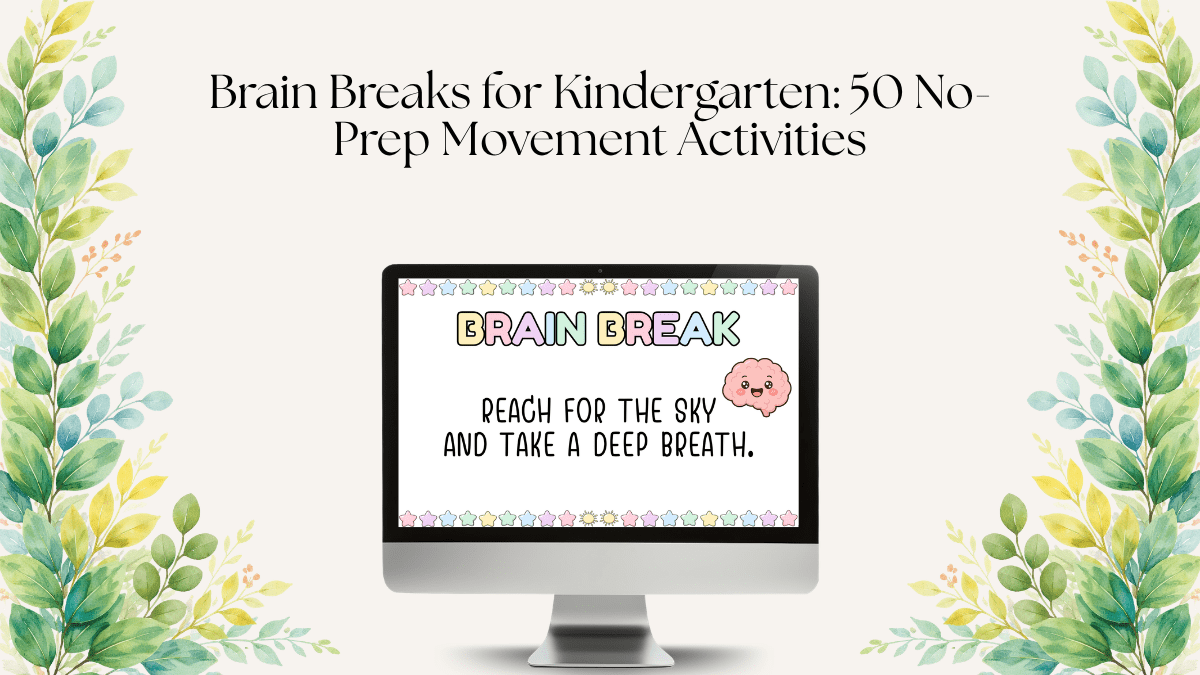
Young children aren’t built to sit still for long stretches — their bodies need to move in order for their brains to stay engaged. When kindergarteners are asked to sit through circle time, a read-aloud, and a math lesson back to back, focus naturally starts to slip, and behavior often follows. Brain breaks for kindergarten solve this problem in just a minute or two, giving students a chance to move, reset, and come back ready to learn. This guide covers everything you need to know, plus 50 no-prep movement activities you can start using tomorrow.
Table of Contents
- What Are Brain Breaks for Kindergarten?
- Benefits of Brain Breaks for Kindergarten
- When Should You Use Brain Breaks?
- How Long Should Brain Breaks Be?
- What Are the Best Brain Breaks for Kindergarten?
- 50 No-Prep Brain Breaks for Kindergarten
- Brain Breaks During Indoor Recess
- Easy Ways to Use Brain Breaks
- Brain Break Cards and Slides
- Tips for Success
- Frequently Asked Questions
What Are Brain Breaks for Kindergarten?
Brain breaks are short bursts of movement or mindfulness that help young students reset between activities. They’re built directly into the flow of the school day — not an add-on, and not a reward for good behavior.
It helps to know the difference between a brain break and recess:
- Recess is longer, unstructured, and usually happens outdoors.
- A brain break is short (1–3 minutes), teacher-led, and can happen right at the carpet or next to a desk.
Because they require no transition to another space, brain breaks fit naturally into kindergarten classroom routines. You can use one between subjects, during a transition, or the moment you sense the room’s energy shifting — all without losing instructional time.
Benefits of Brain Breaks for Kindergarten
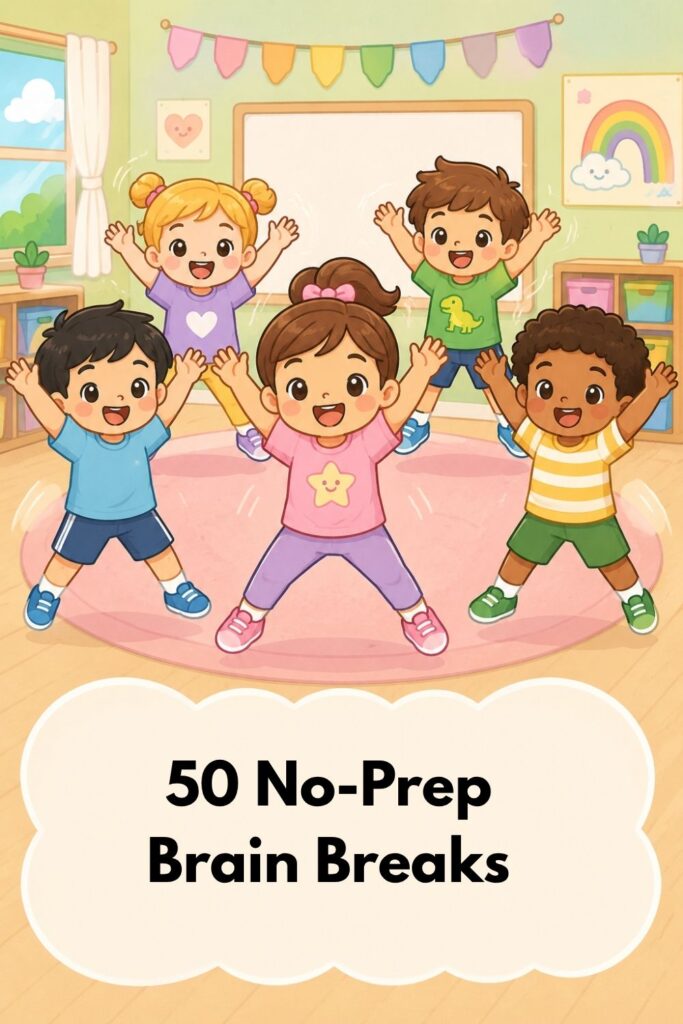
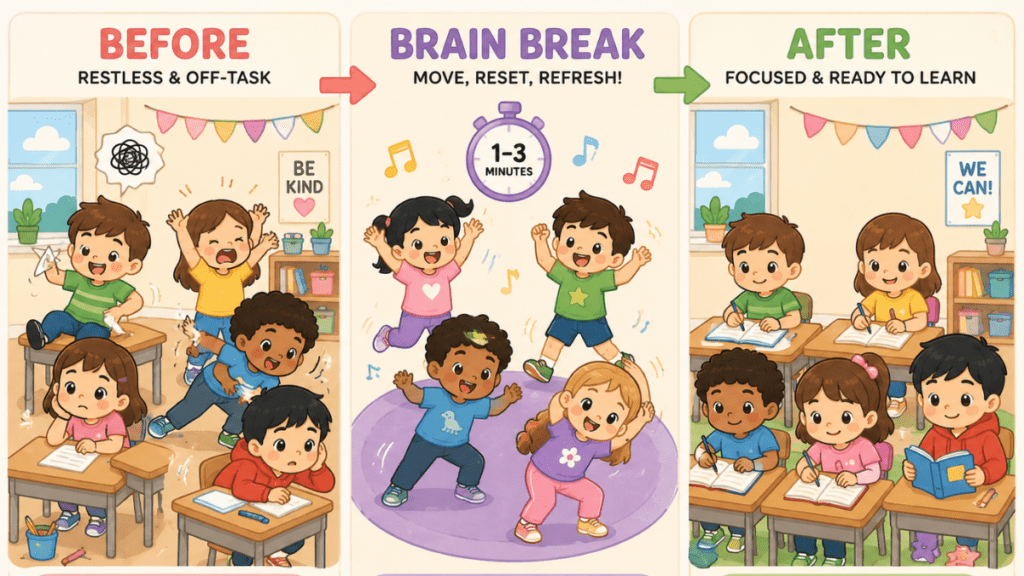
A well-timed brain break does more than burn off energy. Regular movement breaks can:
- Improve focus by giving the brain a short reset before the next task
- Reduce restlessness that builds up during long periods of sitting
- Support self-regulation, especially for students still learning to manage big feelings and energy
- Increase engagement with the lesson that follows
- Improve transitions between activities, subjects, or parts of the day
- Support classroom management by heading off restlessness before it turns into disruption
- Improve readiness to learn by helping students settle back in with a clearer, calmer mind
When Should You Use Brain Breaks in Kindergarten?
Brain breaks work best when used proactively, before the class gets too wiggly to refocus easily. Common moments include:
- After sitting for a long time, like circle time or a read-aloud
- Before literacy instruction, to prime attention for focused work
- Before math, especially if it follows another seated activity
- During transitions between activities or subjects
- After recess, to help students shift back into indoor focus
- Before dismissal, as a positive way to end the day
- Whenever the class feels restless — trust that instinct
How Long Should a Kindergarten Brain Break Be?
The ideal brain break lasts 1 to 3 minutes. A few things to keep in mind:
- It should require no equipment — just voices and bodies
- It should be simple enough to do right where students are standing or sitting
- It should be short enough to repeat several times throughout the day without cutting into instructional time
If a brain break starts running past three minutes, it’s probably becoming its own activity rather than a quick reset.
What Are the Best Brain Breaks for Kindergarten?
The best brain breaks for kindergarten include jumping jacks, animal walks, stretching, freeze dance, high knees, breathing exercises, pretend play activities, and silly movement games.
What makes these especially effective is that they share four key qualities. The best brain breaks are:
- Short — one to three minutes, no more
- Active — they get bodies moving, not just sitting differently
- Easy to lead — no special training or script required
- No-prep — no materials, setup, or planning needed
50 No-Prep Brain Breaks for Kindergarten
Here are 50 simple movement activities for kindergarten and first-grade classrooms, organized by category so you can quickly grab the right one for the moment.
Jumping and Movement Activities
- Do 10 jumping jacks.
- Hop on one foot 10 times.
- Stretch as high as you can.
- Touch your toes 10 times.
- Spin around 5 times.
- Wiggle like a worm.
- March in place for 30 seconds.
- Pretend to be a robot.
- Dance for 30 seconds.
- Freeze like an ice statue.
Animal Brain Breaks
- Roar like a lion.
- Flap your arms like a bird.
- Pretend to swim.
- Tiptoe around your spot.
- Do 10 bunny hops.
- Reach for the sky and take a deep breath.
- Pretend to climb a mountain.
- Stomp like a dinosaur.
- Walk like a crab.
- Make your silliest face.
Stretching and Balance Activities
- Balance on one foot for 10 seconds.
- Pretend to be a frog and jump 10 times.
- Do 5 slow-motion jumps.
- Act like your favorite animal.
- Shake your hands and feet.
- Pretend to ride a bicycle.
- Do 10 arm circles.
- Reach left, then right.
- Pretend to juggle.
- Do a slow-motion race.
Pretend Play Activities
- Stretch like a cat.
- Pretend to fly like a superhero.
- Make a heart shape with your arms.
- Walk in place backwards.
- Pretend to make popcorn and pop!
- Take three deep breaths.
- Pretend to shovel snow.
- Build an invisible snowman.
- Pretend to plant a flower.
- Sway like a tree in the wind.
Calming and Mindfulness Activities
- Make raindrop sounds with your fingers.
- Pretend to row a boat.
- Jump over an imaginary puddle.
- Do 10 high knees.
- Pretend to be a race car.
- Make silly dance moves.
- Stretch your arms like a starfish.
- Pretend you’re walking on the moon.
- Give yourself a big hug.
- Shine bright like a star and strike a pose!
Brain Breaks for Kindergarten During Indoor Recess
Brain breaks aren’t just for quick resets between lessons — they’re also a great tool for longer stretches of indoor time, like:
- Rainy days, when outdoor recess isn’t possible
- Snow days or extreme weather that keeps the whole class inside
- Canceled recess, whether due to scheduling or building use
- Small classroom spaces, where a full recess-style activity isn’t practical
On days like these, chain a few brain breaks together, mix in some music, or let students take turns calling out their favorite movement. Used this way, brain breaks double as simple indoor recess activities for kindergarten that keep the energy positive even when the class can’t go outside.
Easy Ways to Use Brain Breaks in the Classroom
You don’t need a special time slot — brain breaks fit naturally into moments you already have:
- Between lessons, as a quick reset before switching gears
- During morning meeting, to start the day with energy
- After calendar time, once students have been sitting a while
- During indoor recess, when outdoor play isn’t an option
- At transition times, moving between activities or centers
- Anytime students need a reset — trust your read of the room
Brain Break Cards and Slides for Kindergarten
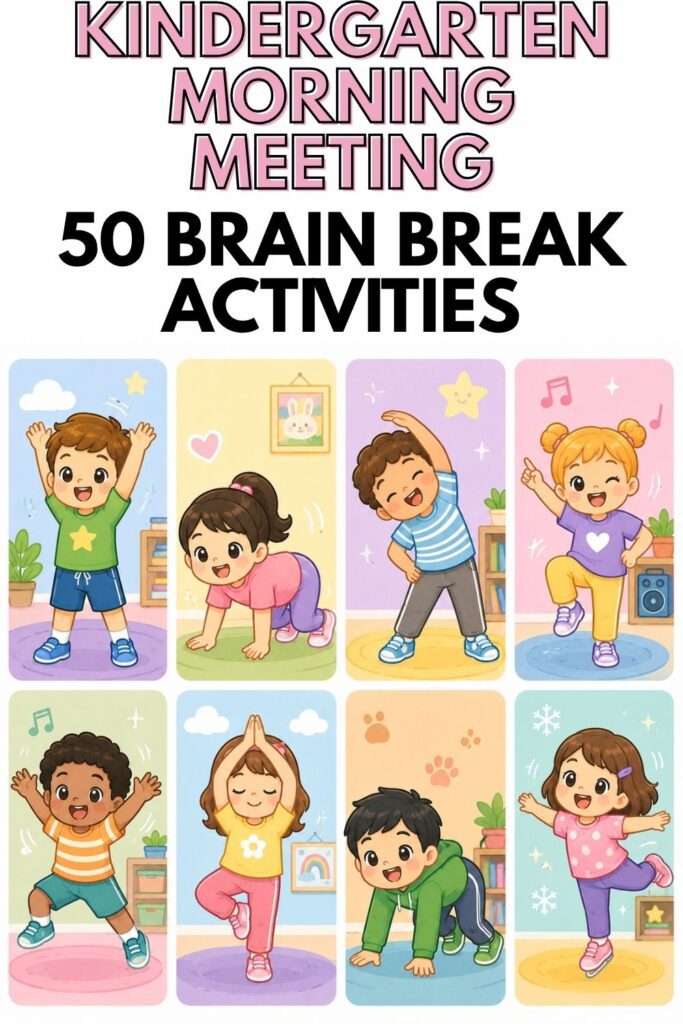
Calling out brain breaks from memory works, but on a busy day it’s easy to lean on the same three activities every time — or forget to use them at all. Brain break cards and slides solve that by putting all 50 activities right at your fingertips.
Using visual brain break cards or slides can:
- Save time, since you don’t have to think of an activity on the spot
- Reduce decision fatigue, especially on high-energy days
- Help young learners follow directions, since they can see the movement, not just hear it
- Provide visual support for students who need extra structure
- Make movement activities easy to implement, even for a substitute teacher
Looking for a low-prep way to add movement to your day? My Brain Break Morning Meeting Slides for Kindergarten include 50 simple movement activities that are easy to use during morning meeting, transitions, or any time your class needs a reset.
Tips for Making Brain Breaks Work Smoothly
A few small habits make a big difference in how well brain breaks work in your classroom:
- Teach expectations first. Model what a brain break looks and sounds like before making it a regular routine.
- Keep activities short. One to three minutes keeps energy positive without losing control of the room.
- Use a clear start and stop signal. A chime, clap pattern, or phrase helps students know exactly when to begin and stop.
- Choose safe movements. Make sure activities fit your classroom’s space and furniture layout.
- Repeat favorite activities. Kindergarteners love routine, and favorites will get requested again and again.
- Use visuals for young learners. Picture cards or slides help non-readers follow along independently.
Frequently Asked Questions
What are good brain breaks for kindergarten?
Simple, no-prep movement activities work best — things like jumping jacks, animal walks, stretching, and freeze dance. They should be easy to demonstrate and require no equipment.
How often should kindergarten students have brain breaks?
Most teachers use several short brain breaks throughout the day, especially during transitions, after long periods of sitting, and before focus-heavy lessons like literacy or math.
How long should a brain break be?
Aim for 1 to 3 minutes. Brain breaks are meant to be quick resets, not extended activity time.
Can brain breaks help with classroom management?
Yes. Regular movement breaks can reduce restlessness and off-task behavior, making transitions smoother and lessons easier to manage.
Are brain break cards worth using?
For many teachers, yes. Brain break cards or slides save time by removing the guesswork, and the visual format helps young students follow along independently.
Conclusion
Brain breaks for kindergarten don’t need to be complicated. A handful of short, simple, no-prep movement activities — used consistently throughout the day — can help students refocus, transition smoothly, and feel ready to learn. If all 50 activities feel like a lot to start with, pick just three or four favorites and build from there. Your class (and your classroom management) will thank you.
Leave a Reply
You must be logged in to post a comment.