
If you’ve ever wondered about the difference between Back to School Night and Open House, you’re not alone. Schools often use these terms interchangeably, even though they can refer to very different events. Parents get confused. New teachers get confused. Even experienced educators sometimes prepare for the wrong type of event.
In this guide, we’ll break down the difference between Back to School Night and Open House, explain the key differences, and help you decide what to prepare for each event.
What Is Back to School Night?
Back to School Night (also called Curriculum Night or Meet the Teacher Night in some schools) typically happens in the first two to three weeks of school. The students are not there — it’s an adult-only event. Parents come to meet the teacher, learn about the year ahead, and understand classroom expectations.
The primary goal is information sharing and relationship building. You are the presenter. Parents are the audience.
A typical Back to School Night looks like this:
- Parents sit in their child’s seat (or in chairs set up around the room)
- The teacher presents a prepared slideshow covering classroom routines, curriculum, policies, and how to communicate
- There’s a brief Q&A at the end
- The whole thing wraps up in 20–30 minutes so parents can visit multiple classrooms
Back to School Night sets the tone for your relationship with families for the entire year. A well-run, organized presentation signals: This teacher has a plan, and my child is in good hands.
What Is an Open House?
Open House usually happens before school starts — or sometimes at the end of the year. The key difference: students come too. Open House is a community event, often more casual, where families tour the building, drop off supplies, meet the teacher briefly, and help their child feel comfortable before the first day.
Open House is much less structured. There’s no formal presentation. You might stand near your classroom door and greet families as they come in, show students where to put their backpack, and let them explore their new space.
Because it’s student-facing, the tone at Open House is warmer and more playful. Kids are nervous, and your job is partly to make them feel safe and excited.
Key Differences at a Glance
| Questions | Back to School Night | Open Night |
|---|---|---|
| When | First few weeks of the school | Before the school starts, or end of year |
| Who Attends | Parents / Guardians | Families including students |
| Format | Structured presentation | Casual drop-in |
| Your Role | Presenter | Host / Greeter |
| Primary Goal | Share information, build trust | Ease student anxiety, build community |
| Slides Needed | Yes, always | Optional |
| Q&A | Usually a brief window | Informal, one-to-one |
Back to School Night vs Open House: Which One Requires a Presentation?
The biggest difference between Back to School Night and Open House is the level of structure.
Back to School Night almost always includes a presentation or slideshow. Teachers explain classroom expectations, curriculum, communication methods, and important procedures.
Open House is usually much more informal. Families explore the classroom, students meet their teacher, and conversations happen naturally rather than through a formal presentation.
If you’re wondering whether you need slides, the answer is simple: Back to School Night usually requires them. Open House usually doesn’t.
Does Every School Have Both?
Not always. Some schools combine them into a single event where students attend the first part and then parents stay for a presentation. Some schools only hold one or the other. A few do a “New Family Orientation” that blends both purposes.
When you’re new to a school, it’s worth asking your admin: Is this a presentation night, or are students coming too? The answer completely changes what you prepare.
Why the Confusion Exists
Part of the reason these terms get mixed up is regional — what’s called “Open House” in one district is called “Back to School Night” in another, and they might mean the same thing. The internet doesn’t help either, because teachers searching for resources get results from every state and every variation.
The practical test: Will students be there? If no → prepare a formal presentation. If yes → prepare something more visual and interactive, and keep formal content minimal.
What to Prepare for Each
For Back to School Night:
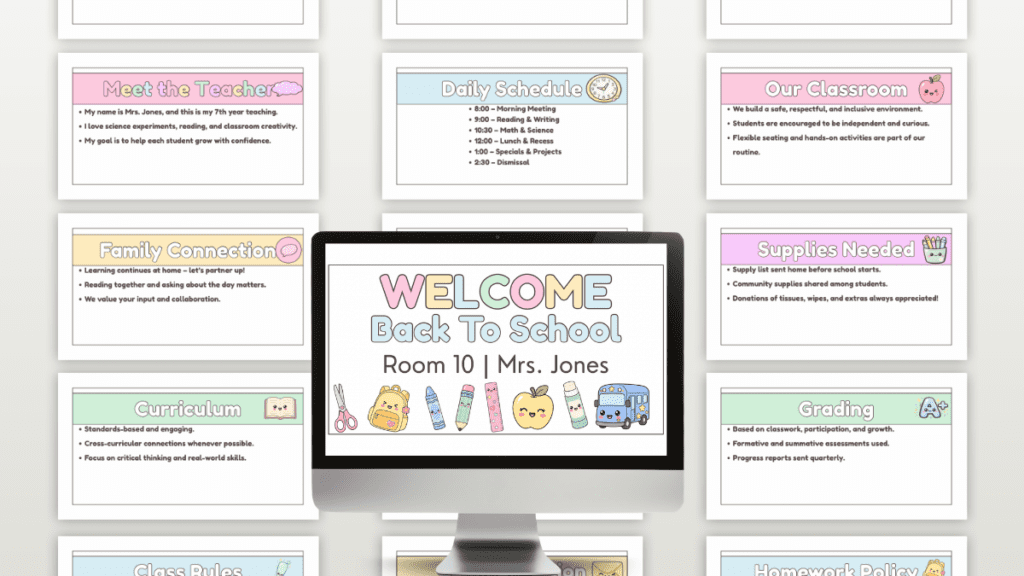
You need a proper slideshow. Covering your classroom policies, daily schedule, curriculum, communication methods, homework expectations, behavior system, and more. Ideally 15–25 slides. Something you can walk through in 20–25 minutes while families follow along.
This is exactly what my Back to School Night Presentation Template was designed for — a 23-slide Canva template with every key section already built in, from the Welcome slide through to the Thank You. It uses a kawaii pastel aesthetic that’s cheerful and professional, and everything is editable in Canva so you can personalize it in under 30 minutes.
For Open House:
You don’t need a formal slide deck. A simple welcome sign at the door, name tags, labeled areas of the classroom, and a printed one-page “What to know before the first day” sheet are all you really need. The goal is atmosphere, not information.
Can I Use the Same Template for Both?
If your school combines them into one event, the answer is: partially. You’d use the presentation slides for the parent portion, and you might skip a few policy-heavy slides in favor of a warmer, more visual intro if students are present at the start.
The Canva template is fully editable, so you can always hide or reorder slides to fit your school’s format.
Frequently Asked Questions
Is Back to School Night the same as Open House?
No. Back to School Night is usually a parent-focused presentation event, while Open House is typically a more casual event where students attend with their families. So there is a clear diffrence between Back to School Night and Open House.
Do students attend Back to School Night?
In most schools, students do not attend Back to School Night. However, some schools combine Back to School Night and Open House into a single event.
Do I need a slideshow for Open House?
Usually not. Most Open House events focus on classroom tours and informal conversations rather than formal presentations.
What should I include in a Back to School Night presentation?
Most presentations include classroom expectations, communication policies, curriculum information, daily schedules, homework expectations, and opportunities for family involvement.
The Bottom Line
Back to School Night and Open House are different events with different purposes, different audiences, and different preparation needs. Knowing which one you’re running — and preparing accordingly — makes a real difference in how the night goes.
Back to School Night calls for a confident, organized slideshow. Open House calls for a warm, welcoming space. Both call for a teacher who’s clearly ready for the year ahead.
Leave a Reply
You must be logged in to post a comment.