
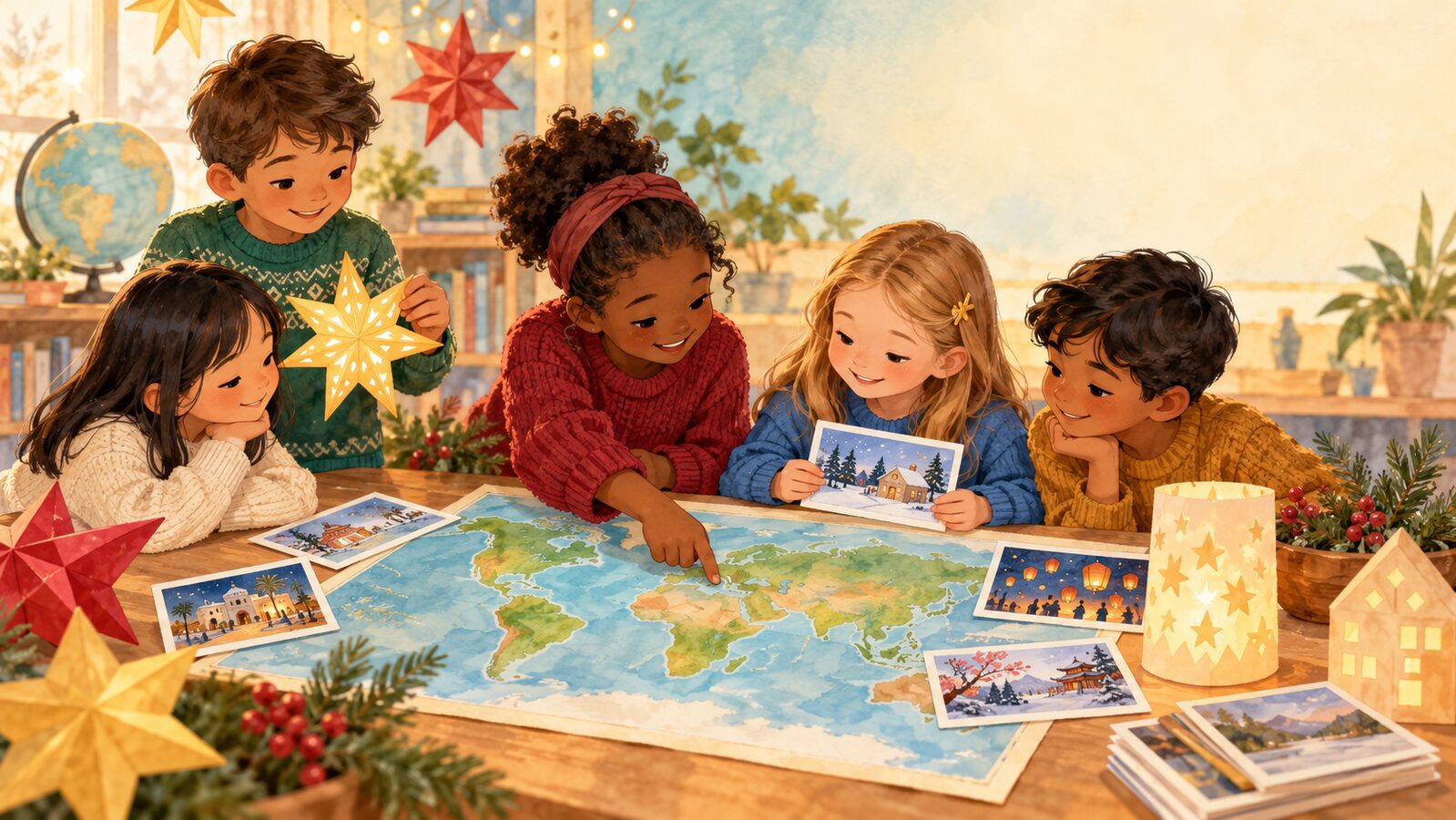
Christmas around the world activities can turn a busy December week into a meaningful geography and social studies mini unit—without requiring elaborate decorations or a suitcase full of supplies. With a map, a few picture cards, paper, and crayons, children can explore how three communities mark the season and practice noticing both differences and shared ideas.
This three-day plan is designed for kindergarten through third grade, but it is easy to simplify for preschool or extend for older learners. Each lesson takes about 25–35 minutes. The goal is not to make children memorize a list of “fun facts.” It is to help them ask respectful questions, compare traditions, and understand that no single custom represents every family in a country.
Before You Begin: Teach Traditions with Care
Start with one useful sentence: Some families celebrate this way, and some do not. Countries contain many regions, religions, languages, and family traditions. A child in Sweden, Mexico, or Germany may celebrate differently from the examples in a book—or may not celebrate Christmas at all.
Use photos and information from museums, cultural organizations, libraries, or official tourism and government sources whenever possible. Avoid asking children to “dress up as” a culture. Instead, invite them to locate places, observe images, listen to music from a reliable source, make comparisons, and connect big ideas such as light, welcome, waiting, and community.
Simple Materials for the Mini Unit
- A world map or globe
- Sticky notes or small paper arrows
- Construction paper, crayons, child-safe scissors, and glue
- Three sheets of chart paper labeled Mexico, Sweden, and Germany
- Optional battery-operated tea lights—never open flames
- Library books or printed photographs from reliable sources
Day 1: Map the Journey and Practice Noticing
Begin by finding your own location on the map. Then locate Mexico, Sweden, and Germany. Add a sticky note to each place, but keep the first lesson light: children do not need to master continents, capitals, and customs all at once.
Show one carefully chosen image connected to each tradition: a Las Posadas procession or decorated doorway, a Lucia procession with lights, and a German Advent scene with a calendar, cookies, or handmade decorations. Ask children to complete two sentence stems: “I notice…” and “I wonder…” Record observations without rushing to correct every question. This gives you a natural starting point for the next two lessons.
For younger learners, let children point to a picture and name a color, object, or shape. Older children can write one question on a sticky note and place it beside the matching country.
Day 2: Explore Three Christmas Traditions
Mexico: Las Posadas and the Idea of Welcome
Las Posadas is observed in many Mexican communities from December 16 through December 24. The tradition recalls Mary and Joseph searching for lodging and often includes a procession, song, a request for shelter, and a gathering. Mexico’s National Commission of Natural Protected Areas describes the nine-day timing, while the Library of Congress explains the processional folk-play tradition.
For a respectful, low-prep activity, give children four blank cards. Ask them to draw a simple sequence: journey, request, welcome, gathering. Mix the cards and have a partner put them in order, explaining the choice. Finish with a connection question: “What are kind ways we welcome someone at home or at school?” This keeps the focus on comprehension and community rather than copying a sacred observance.
Sweden: Lucia Day and Light in Winter
Lucia Day is celebrated in Sweden on December 13. Candlelit processions, white clothing, singing, gingerbread, and saffron buns are commonly associated with the day. Visit Sweden’s Lucia guide presents the celebration as a tradition of light during the dark winter season.
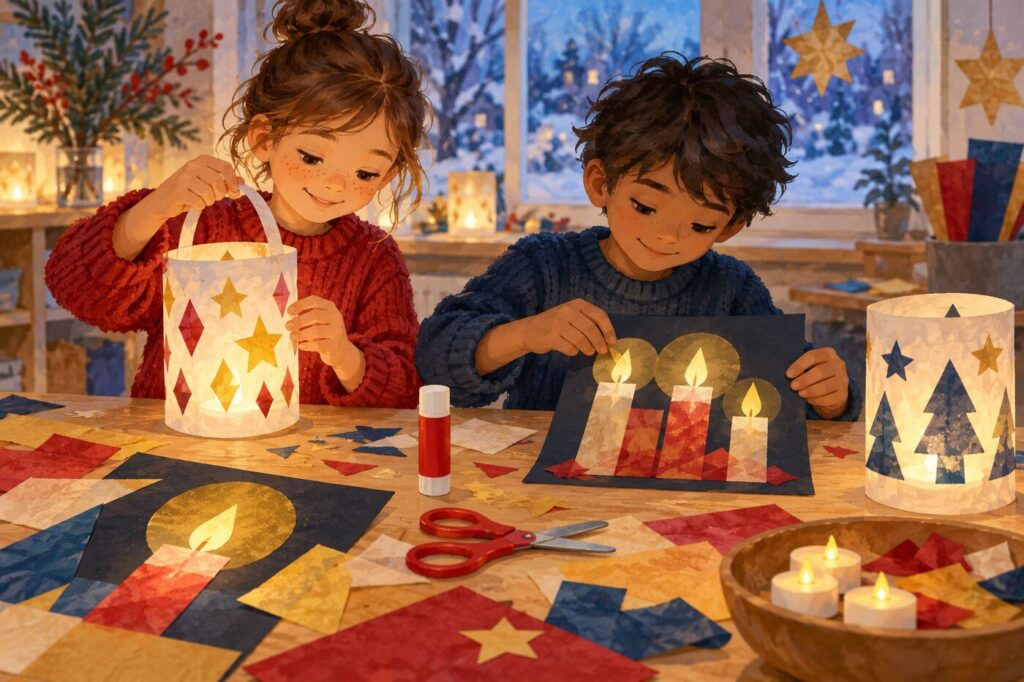
Make a no-flame light collage: cut a paper candle, add a yellow paper flame, and surround it with strips of translucent tissue paper or lightly colored paper. As children work, discuss why light can feel comforting during a dark season. If you have battery-operated tea lights, compare how one light and several lights change a dim space. Keep the investigation observational rather than turning it into a formal experiment.
Germany: Advent as a Time of Waiting and Making
Advent traditions vary across Germany, but the weeks before Christmas often include baking cookies, making decorations, singing, and using Advent calendars. The official Germany Travel guide to Advent highlights these family activities and the sense of anticipation leading to Christmas Eve.
Create a short paper countdown chain. Instead of using candy or prizes, ask each child to draw or dictate one small December action on a strip: read together, help set the table, notice winter birds, make a card, or call someone you love. Join the strips into a chain. Families can remove one link on selected days rather than trying to complete a long daily schedule.
If you want more formats for a countdown, the guide to printable Advent calendar ideas compares activity cards, coloring countdowns, Nativity cards, and matchbox-style calendars.
Day 3: Compare, Sort, and Reflect
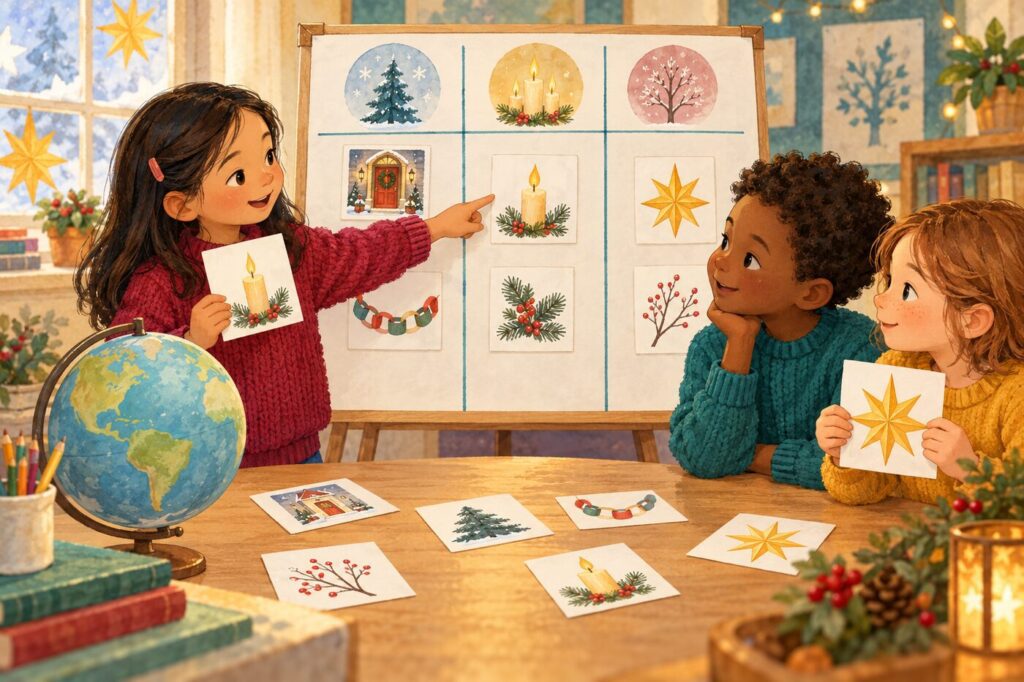
Return to the three chart papers. Invite children to add picture cards or drawings under the country they match. Useful images include a doorway, a paper candle, a calendar chain, people singing, food shared at a gathering, and a map marker. Then look for ideas that appear in more than one place: gathering, music, special foods, light, giving, waiting, and welcoming.
Close with a postcard-sized reflection. Younger children can draw one tradition and dictate a sentence. First graders can complete “One thing I learned…” and “One thing I still wonder…” Older students can write two similarities and one difference using complete sentences.
Want the ready-made version? My Christmas Around the World Unit Study (50 printable pages, K–2) takes children to 8 countries, including Mexico, Sweden, Germany and Finland, with a passport to stamp along the way.
A 45-Minute One-Day Version
| Time | Activity |
|---|---|
| 0–7 minutes | Find the three countries on a map |
| 7–17 minutes | View one image and hear a short explanation for each tradition |
| 17–30 minutes | Choose the Las Posadas sequence cards, light collage, or countdown chain |
| 30–40 minutes | Sort picture cards by country and look for shared themes |
| 40–45 minutes | Draw or write one learning reflection |
If December energy is high, keep the map talk brief and place the craft supplies in trays before children arrive. The most valuable part is the conversation, not finishing every activity.
Adaptations for Preschool Through Grade 3
- Preschool and kindergarten: Use three or four large picture cards, repeat country names, and let children respond by pointing, drawing, or dictating.
- First grade: Add beginning-middle-end sequencing and a simple same/different chart.
- Second and third grade: Let pairs read a short source paragraph, identify the source, and write a two-sentence comparison.
- Mixed-age homeschool: Study the same image together, then give each child a different response task based on reading and writing readiness.
Keep the Learning Going
Three traditions are enough for a focused first look. If children are curious, add a family interview that does not assume everyone celebrates Christmas: “Is there a winter tradition, food, song, or gathering that matters to our family?” Children may also bring an answer privately rather than feeling pressure to share personal beliefs with the group.
You can connect this mini unit to St. Nicholas Day activities for another December tradition, or use the cooperative ideas in simple Christmas party games for kids when you need a lighter end-of-unit celebration.
A thoughtful Christmas around the world lesson does not need dozens of countries or a perfectly decorated classroom. A map, three well-sourced examples, and time for children to notice, compare, and wonder can create a richer understanding of how traditions carry meaning for different families.
Leave a Reply
You must be logged in to post a comment.