
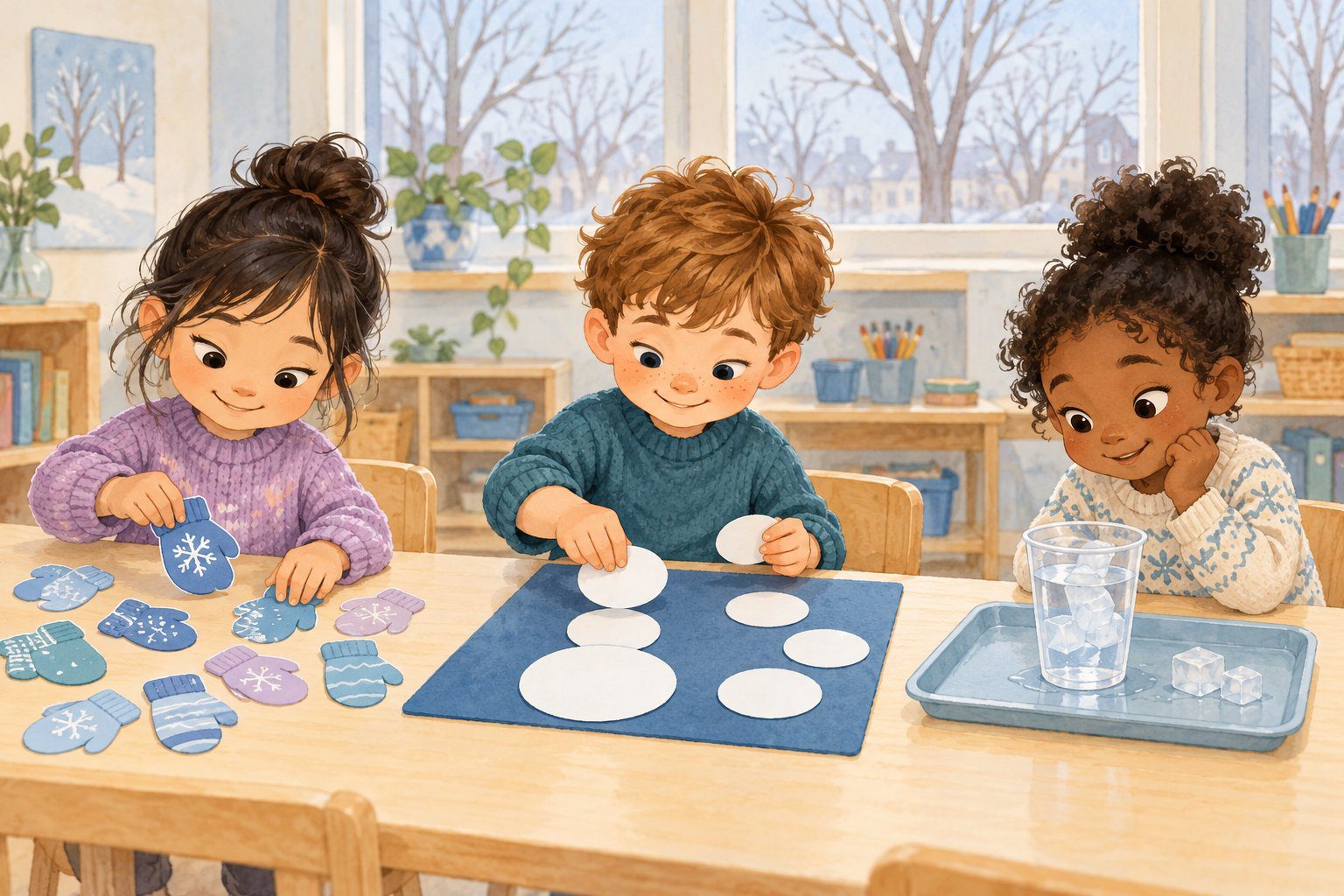
Winter has a way of shrinking the day. It gets dark early, recess moves indoors, and the energy that usually goes outside has to go somewhere. A few well-chosen activities can turn that restless stretch into some of the calmest, most curious learning time of the year.
These winter activities for kindergarten use simple materials you probably already have: paper, mittens, a few ice cubes and a timer. They work whether your winter brings deep snow or just means rain or cooler mornings, because each one starts from what children can see, touch and talk about.
Choose two or three ideas for a short lesson, or spread them across a week. Most suit children around ages 5–6, with simple adjustments for preschoolers and first graders. You can prepare everything yourself; printables are an optional way to save a little drawing and setup time.
What You Need for These Indoor Winter Activities
Gather plain and colored paper, crayons, child-safe scissors, glue, a pencil, a tray, two clear plastic cups, ice cubes, and a few pairs of mittens or socks. You will also need a timer and a small towel for the investigation. Large paper circles work well as counters, or you can use any counters your group already uses safely. Precut shapes for children who need help with scissors.
Set out only the materials for the activity you are doing. One small tray per group keeps the ice investigation manageable, and an envelope holds paper pieces between sessions.
Winter Math and Sorting Activities
1. Sort and Describe a Mitten Collection
Put real mittens or paper mitten shapes in a basket. Invite children to find a way to sort them: color, size, stripes, or another feature they notice. Ask, “How did you decide which ones belong together?” Then mix the collection and sort it a different way.
For an easier version, offer four items and match identical pairs. For a challenge, introduce two conditions, such as “blue and striped.” Children can also explain a rule while a partner guesses it. If mittens are unfamiliar to some children, briefly show how they are worn before you start sorting.
2. Build a Snowman with Shapes and Counting
Give each child three different-sized white paper circles, blue paper, and scraps for a hat, scarf, and nose. Arrange the circles from largest to smallest before gluing. Talk about circles, triangles, and rectangles as children add the details.
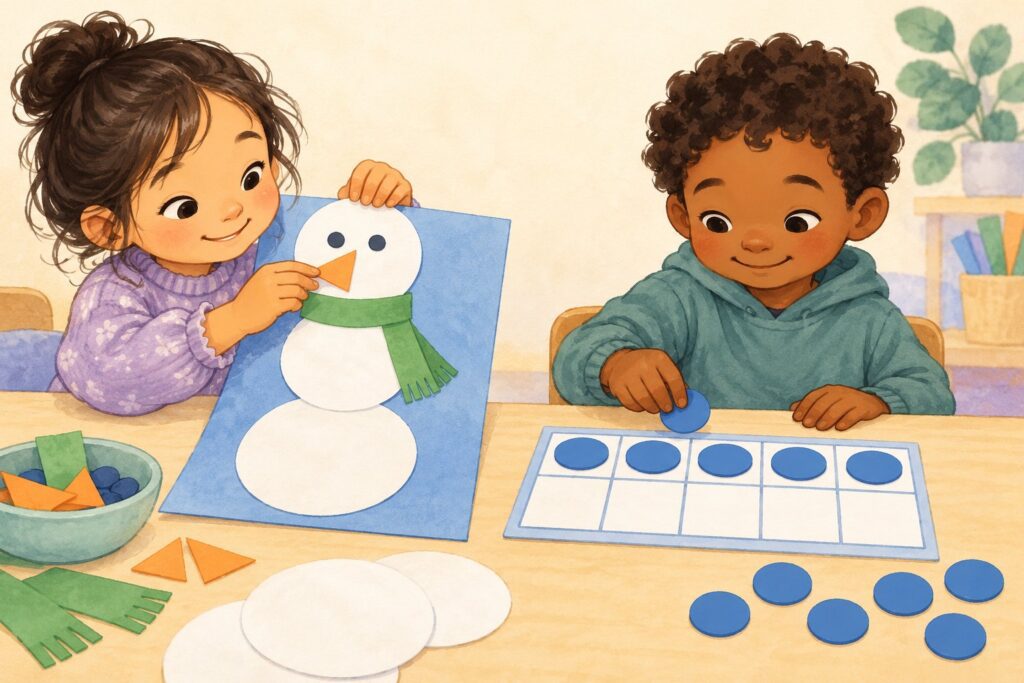
Then turn the picture into a small math task: “Your snowman has three buttons. Add two more. How many now?” Use large paper counters and a hand-drawn ten-frame to show the same amount. Preschoolers can count to three or match shapes; first graders can write an addition sentence.
Winter Science Activities
3. Investigate Which Ice Cube Melts First
Ask, “Will an ice cube melt at the same speed in cool water and slightly warm water?” Fill two matching cups with equal amounts of water, using cool water in one and comfortably lukewarm water in the other. Add one same-sized ice cube to each cup at the same time and keep the cups together on a tray.
Invite a prediction, then observe at regular intervals. Children can draw what they see at the beginning and again after a few minutes. Let the comparison continue while they do another activity, since melting time depends on your setup. Use adult-checked water, never hot water, supervise, and wipe spills promptly.
Keep the explanation concrete: ice is solid water, and melting changes it into liquid water. Ask which cube changed first and what evidence children noticed. For older students, NASA JPL’s Melting Ice Experiment offers a more detailed extension.
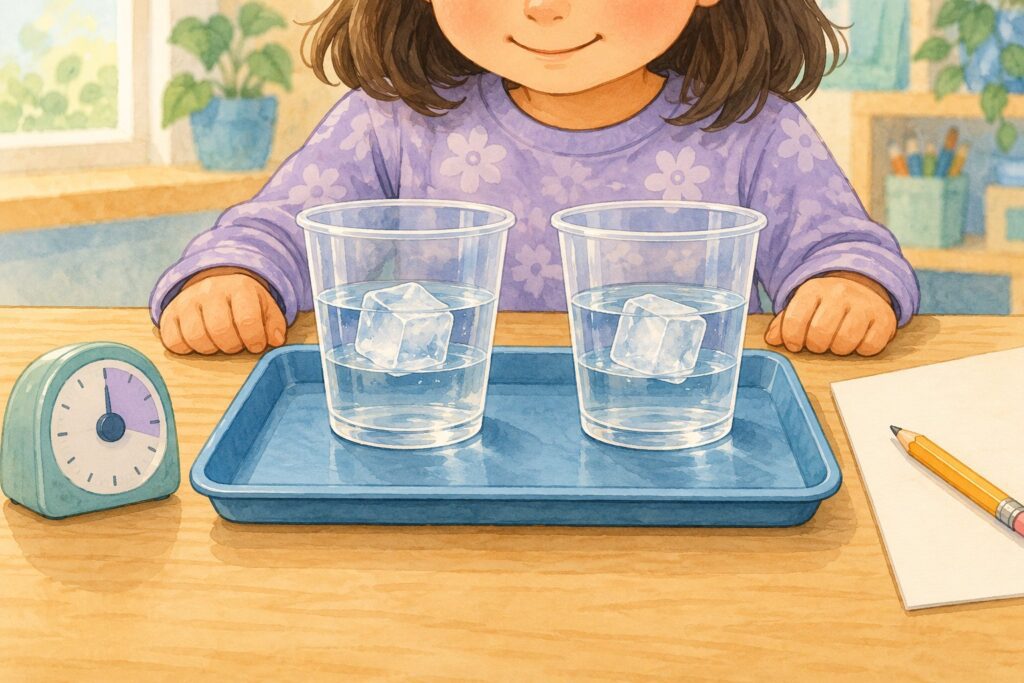
Compare equal-sized ice cubes in cool and lukewarm water, observing how they change.
4. Notice and Record Your Own Winter Weather
Look through a window or step outside briefly when conditions are suitable. Ask children what they actually notice: clouds, sunshine, wind moving branches, rain, or snow. Draw a simple daily weather record and revisit it across several days.
Keep observations separate from guesses. “The leaves are moving” is something a child can see; “It must be freezing” needs a temperature measurement. If you use a thermometer, read it together and name the scale. Comparing your local winter with a snowy picture book is a good way to show that winter looks different in different places.
5. Explore Symmetry with Snow Crystals and Paper Mittens
Show a close-up snow-crystal photograph from NOAA snowflake page URL. Many familiar snow crystals show sixfold symmetry, but real crystals come in varied shapes and can be irregular or broken. Describe what children see rather than insisting every snowflake looks like a perfect star.
For an art-and-math follow-up, fold a sheet of paper in half, draw half a simple mitten against the fold, and cut it out with help. Open it and compare the two sides. This shows mirror symmetry, which is a different idea from the way snow crystals grow, so keep the two separate when you talk about them.
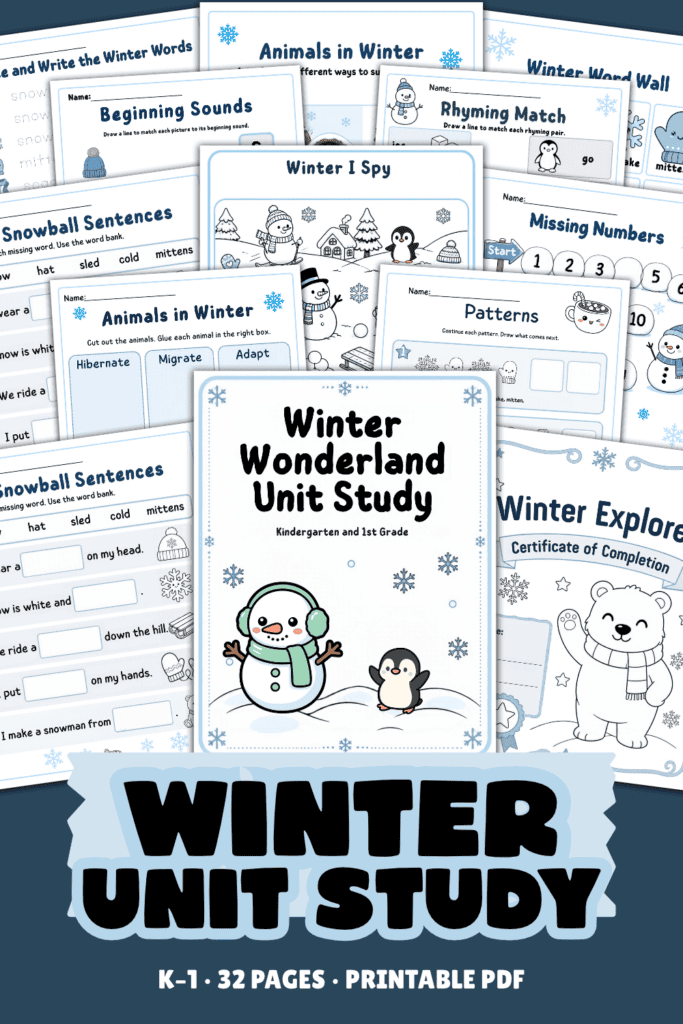
Want to keep winter prep simple? If you’d rather not draw ten-frames and word cards by hand, my Winter Wonderland Unit Study has printable pages ready for several of these activities.
Winter Literacy Activities
6. Take a Winter Word-and-Picture Walk
Draw or display four familiar pictures: a hat, a mitten, ice, and a sled. Place them around the room. Read each word together, then have children walk to the picture that matches your clue: “Find something you wear on your head.”
Add a literacy focus that matches your learners. Beginners can name the picture or listen for its first sound. Children ready to write can choose one word, label a drawing, and finish “I see a ___.” Introduce less familiar items, like a sled, through pictures first. Keep the walk slow, with plenty of room between stations.
7. Tell a Lost-Mitten Story
Begin with three spoken prompts: “A child loses a mitten. Someone finds it. What happens next?” Invite children to choose the setting and the helper. Draw three boxes for the beginning, middle, and end, then let them tell the story to a partner.
A child who is not yet writing can draw and dictate one sentence. A confident writer can add a problem-solving detail: where did the helper look, and what clue helped? Accept different endings, so the focus stays on organizing ideas rather than producing identical stories.
Winter Movement Break
8. Try a Winter Movement-and-Pattern Break
Create a short action pattern: reach up like a tall snowman, curl down small, then repeat. Let children predict the next movement. Change to a three-action pattern when they are ready, or invite a child to lead.
Keep feet on the floor and give seated options, such as reaching, tapping knees, and opening hands. Finish with one slow stretch before returning to the table.
A Simple 30-Minute Winter Lesson
- 5 minutes: Look at today’s weather and introduce two winter words.
- 5 minutes: Predict what will happen and start the ice comparison.
- 12 minutes: Build a shape snowman or sort the mitten collection.
- 5 minutes: Recheck the ice and draw one observation.
- 3 minutes: Share a discovery and finish with a movement pattern.
The ice may need more time. Leave the cups where an adult can supervise and return later rather than rushing children toward a result. Across a week, repeat familiar routines and change just one task each day.
Printable Winter Wonderland Unit Study
If you want prepared follow-up pages, my Winter Wonderland Unit Study includes winter vocabulary, counting and ten-frame activities, a short snowman story, build-a-snowman craft. Choose the pages that fit the skills you are teaching instead of working through the whole packet at once. It’s a digital download, so you can print just what you need, when you need it.
Frequently Asked Questions About Winter Activities for Kindergarten
What are good winter activities for kindergarten if it doesn’t snow?
Mitten sorting, shape snowmen, ice-melting comparisons and weather records all work without snow. Start from the weather children actually see and use pictures for the rest.
How long should a winter activity last for 5-year-olds?
Around 10–15 minutes per activity works for most kindergarten groups. Mixing a hands-on task with a short movement break helps keep attention steady.
Is the ice melting experiment safe for young children?
Yes, with adult-checked lukewarm water, never hot water, and close supervision. Keep the cups on a tray and a towel nearby for spills.
How can I adapt these activities for preschool or first grade?
Preschoolers can count to three, match pairs and name pictures. First graders can write addition sentences, label drawings and add details to their stories.
Can I do these winter activities at home?
Yes. Every activity uses everyday materials, and most work with one child as well as with a group.
Final Thoughts
Winter learning doesn’t need a big project or a perfect snowy day. A few familiar materials and one clear question are enough to begin, and children’s own observations will carry the rest.
Pick one or two ideas for this week, notice what your group enjoys, and build from there.
Looking for more seasonal ideas?
To see how a theme can stretch across a whole week of subjects, read how I built a low-prep Thanksgiving unit study.
If December also brings a class party, these Christmas party games for kids are simple to set up at home or in the classroom.
For a gentle early-December theme, try these St. Nicholas Day activities for kids.
Leave a Reply
You must be logged in to post a comment.