
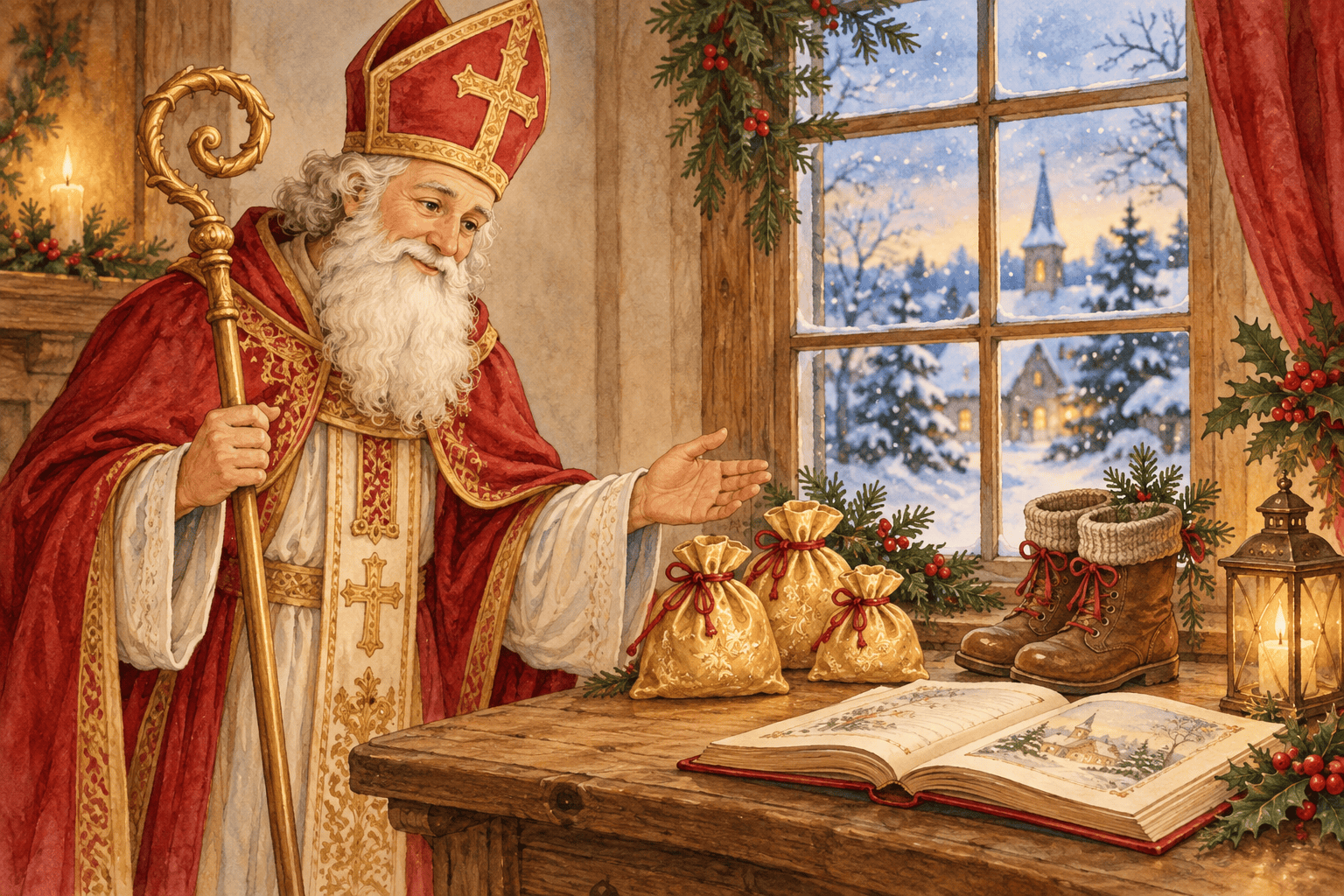
St. Nicholas Day can be a thoughtful pause in a busy December: a chance to explore a tradition, ask questions about the past, and notice ways to help other people. You do not need a full day of themed lessons to make it meaningful. A short reading, a paper shoe, and one small act of kindness give children plenty to talk about.
These St. Nicholas Day activities for kids are designed for roughly ages 5–9, with options for children who prefer drawing and those ready for more independent reading. You can use the ideas on their own or bring them together with my printable St. Nicholas Unit Study, which combines history, traditions, literacy, math, and kindness.
When Is St. Nicholas Day, and Who Was Nicholas?
December 6 is St. Nicholas’s feast day in many Christian traditions, with some celebrations taking place on the evening of December 5. Nicholas is traditionally identified as a fourth-century Christian bishop of Myra, an ancient city in what is now southern Turkey. Few reliable details about his life survive, so it helps to distinguish the historical person from the stories told about him later.
For young children, you might explain it this way: “Nicholas was a Christian leader remembered for generosity. People have told stories about him and celebrated his memory in different ways.” This introduces the religious background clearly while leaving room for families who have different beliefs or do not celebrate St. Nicholas Day.
1. Start with a Short Reading and a Map
Read a brief introduction together, then find Turkey and the Mediterranean Sea on a map or globe. Children can point to the area where Myra stood and compare it with where they live. Keep the map discussion simple: the purpose is to connect a person from the past with a real place.
Younger children can draw one thing they remember or tell you their answer. Older children can write two or three sentences: Who was Nicholas? Where did he live? Why is he remembered? The unit includes an easier reading, a longer reading, a report page, and a map activity, so you can choose the level that fits.
2. Explore History, Legend, and Tradition
One useful part of learning about St. Nicholas is practicing three different words. History involves studying the past using records and other evidence. A legend is a story passed down over time, with details that may not be verified. A tradition is a custom people repeat and share.
The story of Nicholas secretly leaving three gifts of gold for a struggling family is a legend. Introduce it as a traditional story rather than something we can prove happened exactly as told. Then ask what the story suggests about helping quietly, without needing praise.
Try sorting a few examples together: looking at old records belongs with history; retelling the three-gifts story belongs with legend; leaving shoes out each December belongs with tradition. For younger children, discuss the examples aloud. Older children can explain their choices and sequence the legend with cut-out story cards.
3. Compare St. Nicholas Traditions
Choose a few customs to compare rather than trying to cover every country. In the Netherlands, many families exchange Sinterklaas gifts on the evening of December 5. Some children in Germany clean a shoe or boot and leave it out that evening, hoping to find small gifts or treats on December 6. In Belgium, many children receive St. Nicholas gifts on December 6, and spiced cookies are associated with the celebration.
Present these as examples, since customs vary between regions and families. Ask children what the traditions share and what makes each example different. A simple three-column chart—country, date, and tradition—gives older children a purpose for reading. Younger children can draw a shoe, a gift, or a cookie to represent something they learned.
4. Make a Paper Shoe with a Kind Message
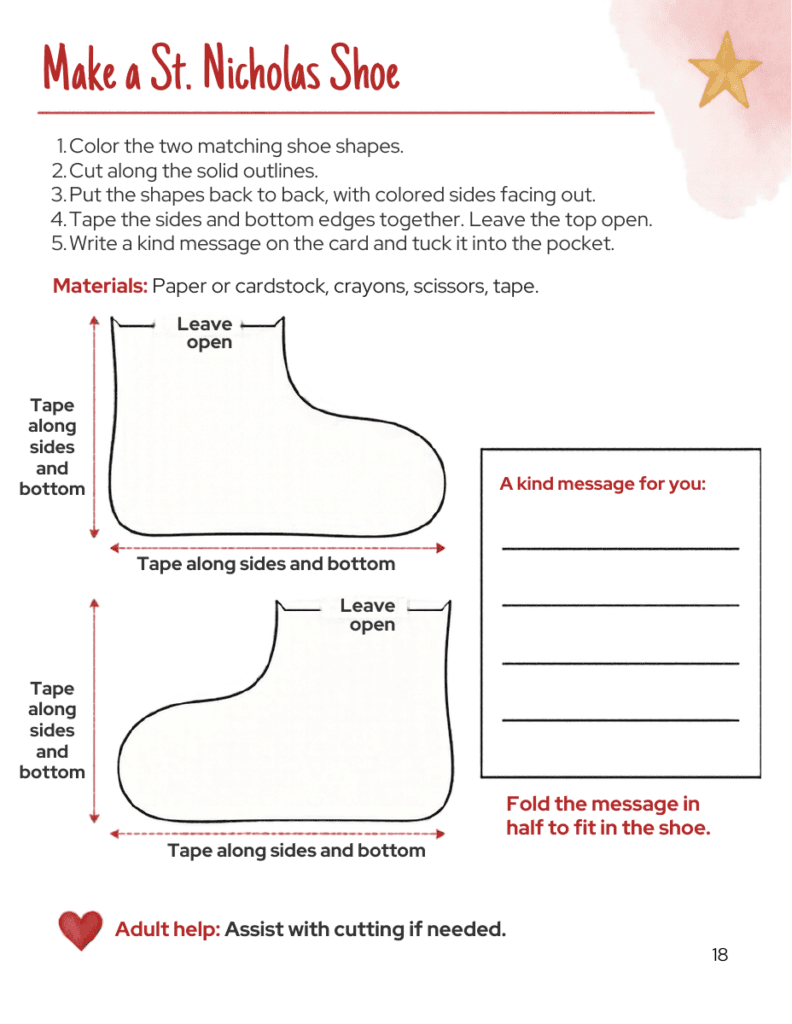
A paper shoe connects the traditions discussion with something children can make. You will need paper or cardstock, crayons, scissors, and tape. In the printable activity, children color and cut out two matching shoe shapes, place them back to back with the colored sides facing out, and tape the sides and bottom together. The top stays open to make a pocket.
Instead of filling it with treats, tuck a kind message inside. A child could draw a heart for a grandparent, dictate an encouraging sentence for a friend, or write a thank-you note to someone who helps them. Assist with cutting as needed; the message matters more than a neatly finished shoe.
5. Plan a Gift That Costs No Money
Bring the generosity theme into children’s own lives with a question: “What could you give someone without buying anything?” Help them think beyond objects. Inviting someone to play, helping put books away, reading with a younger sibling, or making an encouraging card can all be gifts of time and attention.
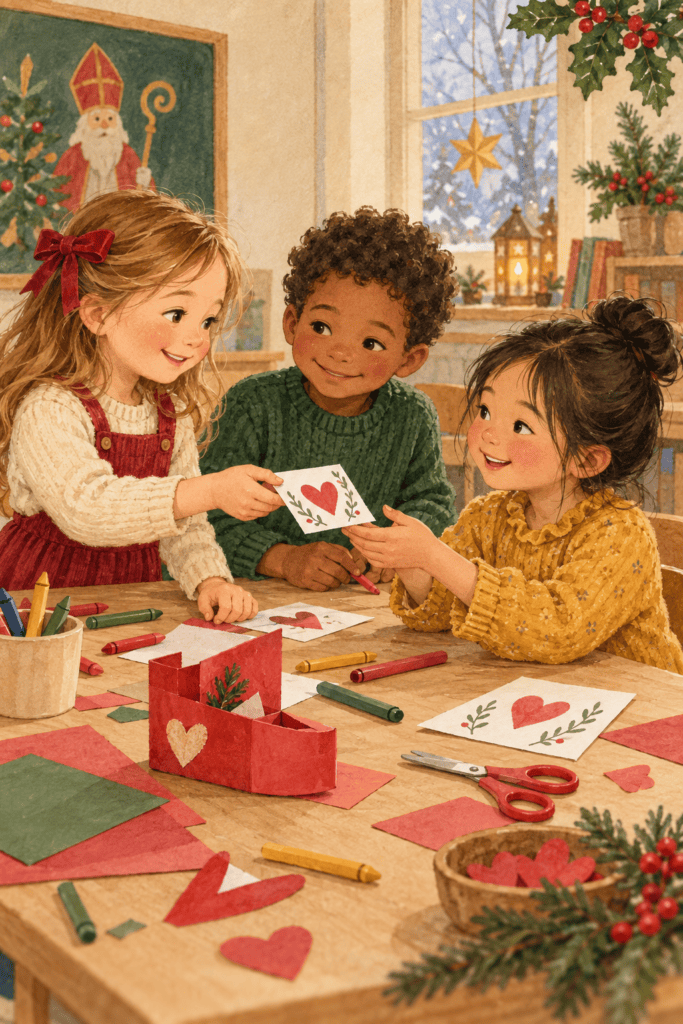
Make the plan small enough to carry out: choose a person, decide what to do, and pick a time. Afterward, invite children to share what happened. The aim is to notice another person’s needs, rather than compete to perform the most kind acts. My Kindness Plan and A Gift of Kindness pages offer drawing and writing space for this reflection.
If you would like to continue the conversation, these gratitude activities for kids offer more ways to notice and appreciate other people.
6. Add a Little Math and Word Work
For a longer lesson or a few days of learning, add one practice activity at a time. Children can count pictures and solve simple addition and subtraction problems, share eight books equally between two children, or build a bar graph showing a fictional class collection of books, toys, mittens, and pencils.
The literacy activities include vocabulary matching, sentence scrambles, and a word search with words running left to right. Select the tasks that suit your group: a beginning writer might explain a word aloud, while an older child writes a sentence using “generosity” or “tradition.” There is no need to complete every worksheet.
A Simple 30-Minute St. Nicholas Day Lesson
- 5 minutes: Read the short introduction and locate Turkey on a map.
- 5 minutes: Discuss one legend and one tradition, naming the difference.
- 15 minutes: Make the paper shoe and add a kind message.
- 5 minutes: Choose one realistic act of kindness to try.
Allow more time for cutting or split the lesson across two days. In a mixed-age homeschool group, everyone can join the reading and craft, with an optional report or comparison chart for older children.
What’s Included in the Printable St. Nicholas Unit Study?
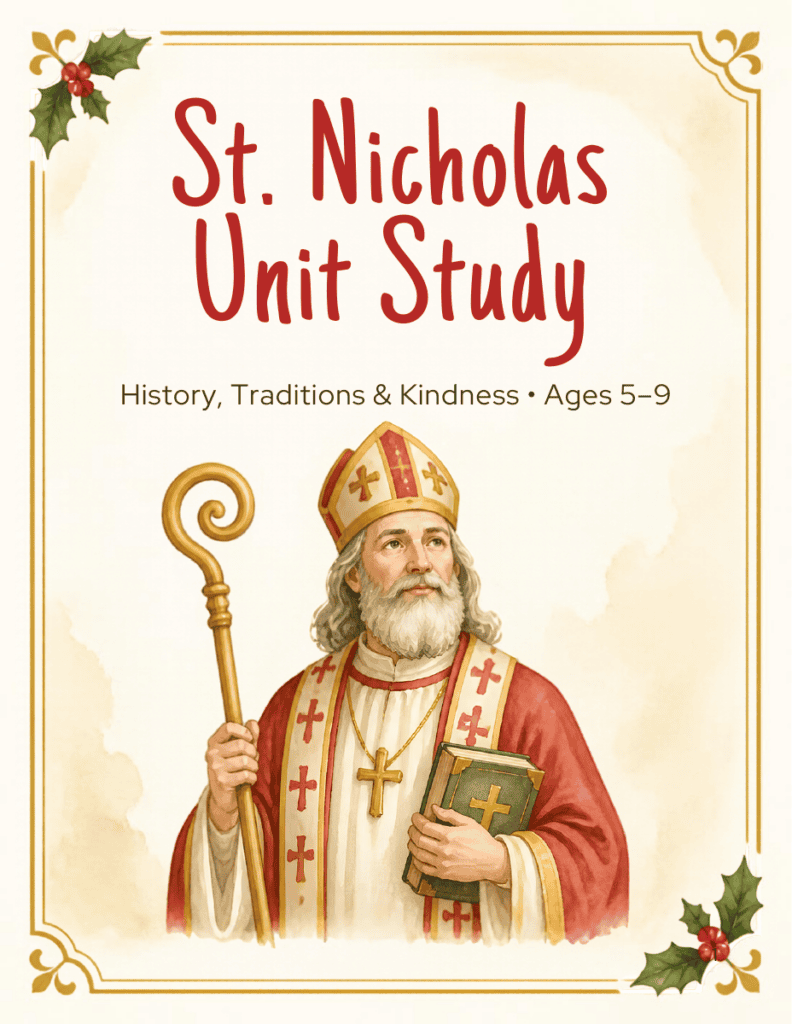
The printable PDF has 24 pages in total: a cover and learning guide, 18 learning and activity pages, three answer-key pages, and a teacher-notes and sources page. It is designed for ages 5–9 and includes Christian history and cultural traditions, so you can decide how it fits your classroom or family setting.
Alongside the readings, map, and tradition comparisons, you will find the three-gifts legend and sequencing cards, vocabulary practice, a short introduction to the connection between St. Nicholas, Sinterklaas, and Santa Claus, counting and graphing tasks, sentence scrambles, kindness planning pages, a shoe craft, and a word search. The format is US Letter.
Browse the St. Nicholas Unit Study and other seasonal printables in my Etsy shop.
For another way to carry small, thoughtful activities through December, take a look at these printable Advent calendar ideas. You can keep the learning brief and leave children time to put one kind idea into practice.
Sources and Further Reading
The St. Nicholas Center’s historical discussion provides background on Nicholas. Its pages on the Netherlands, Germany, and Belgium describe regional customs. This Christian educational resource includes traditional narratives as well as historical discussion; the unit keeps that distinction visible for children.
Leave a Reply
You must be logged in to post a comment.