You’re pulling a small group for guided reading when three hands shoot up.
I’m done! What do I do now?
Two more students finish within the next five minutes. Half the class still needs time to finish the assignment, and the kids in your small group are waiting on you.
Students don’t finish work at the same pace, and they never really will. Some need more support; others move through material quickly and are ready for something new. That gap is normal. What turns it into a disruption is not having a clear answer ready when a kid says “I’m done.”
A dependable set of early finisher activities gives students a next step they can start on their own, without a new explanation every single time. The best ones can be picked up independently, worked through quietly, and put away fast when the class needs to regroup.
Below you’ll find 35 literacy, math, creative, STEM, and partner activities, plus practical thoughts on early finisher worksheets, early finisher task cards, storage, and how to actually teach the routine so it sticks.
Read also about mustard, ketchup, mayo, and pickle blog post.
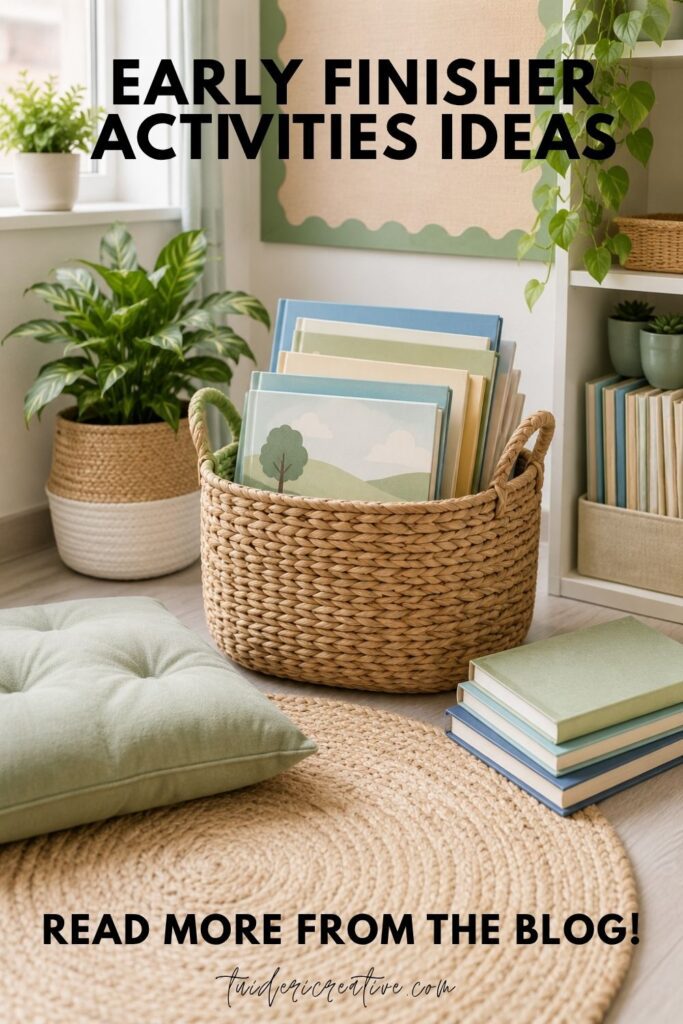
Table of Contents
- Quick Early Finisher Ideas
- What Makes a Good Early Finisher Activity?
- Literacy Early Finisher Activities
- Math Early Finisher Activities
- Creative Early Finisher Activities
- STEM Early Finisher Activities
- Quiet Partner Activities
- Early Finisher Worksheets
- Early Finisher Task Cards
- Early Finisher Activities for Kindergarten
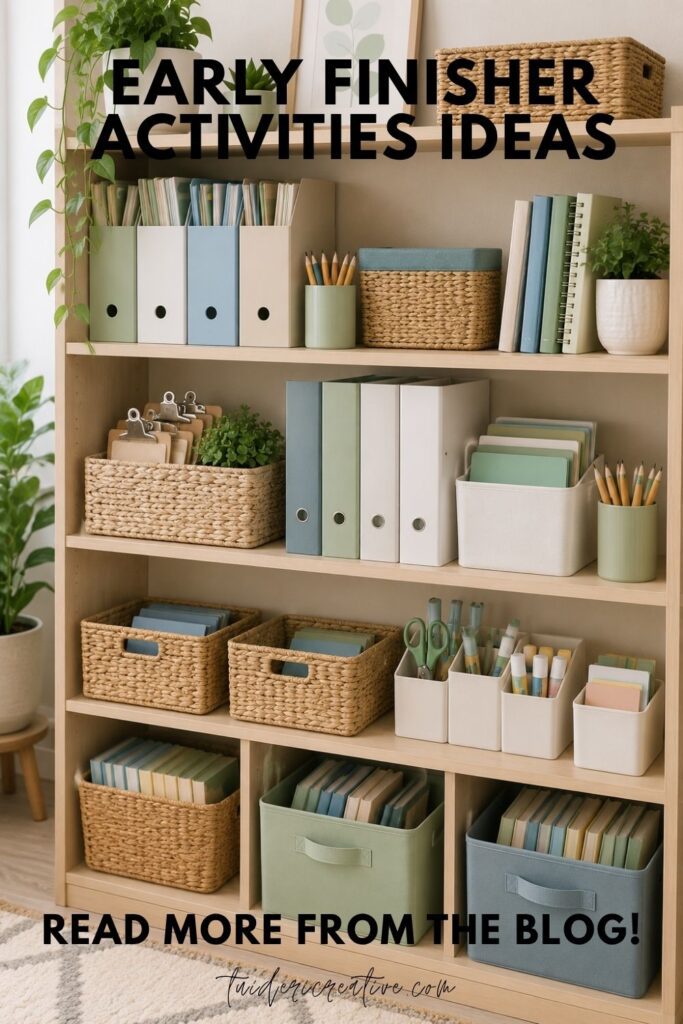
- How to Organize Early Finisher Activities
- How to Introduce the Routine
- Common Early Finisher Mistakes
- Frequently Asked Questions
Quick Early Finisher Ideas
If you just need a handful of options to get started today, begin with activities your students already understand. These take almost no explaining and can slot into your routine right away:
- Read a book independently
- Solve a logic puzzle
- Pick one writing prompt
- Practice with math fact cards
- Build a pattern block design
- Complete one task card
- Write or draw in a response journal
- Finish a directed drawing
- Practice vocabulary words
- Choose an activity from an early finisher board
A small, curated set is almost always easier to manage than a shelf crammed with dozens of choices. Once students are using the first few independently, you can add more.
What Makes a Good Early Finisher Activity?
Not every extra worksheet, game, or activity you own belongs in this rotation. Before you add something to the bin, ask yourself a few practical questions.
Can students do it without you?
A student should be able to find the materials, understand the task, and get started without waiting on you. If you find yourself explaining the same directions every time, it’s not really an early finisher activity — it’s just another thing on your plate.
Can it be done quietly?
Other students are still reading, writing, solving problems, or sitting in your small group. Activities with loud talking, constant movement, or noisy materials make it harder for everyone else to concentrate, not just the early finisher.
Does it actually accomplish something?
Early finisher work doesn’t need to feel like a formal assignment, but it shouldn’t just occupy time either. The good ones reinforce a skill students already know, spark some creativity, build problem-solving, or give kids meaningful independent reading time.
Is the prep realistic for you?
An elaborate activity might look great on Pinterest, but if it takes you twenty minutes to set up every week, you’ll quietly stop using it by October. Stick with things you can print, laminate, and reuse for months.
Can it stop and pack away fast?
A good early finisher activity should pause easily the moment the class needs to regroup. Big projects with lots of loose pieces work better for longer, dedicated work periods — not this.
Does it avoid piling onto your grading?
Most early finisher work shouldn’t need formal grading. Self-checking activities, journals you skim occasionally, and open-ended creative tasks keep this from turning into a second stack of papers.
Teacher Tip: Before you add something new to the rotation, hand it to one student and watch them try it without any help from you. Confusing directions or missing materials tend to show up immediately.
Literacy Early Finisher Activities
1. Independent Reading
A clearly labeled book bin might be the easiest early finisher option you’ll ever set up. Books can come from your classroom library, a themed basket, or a student’s own reading box.
You don’t need a written response every time — plenty of days, quiet reading is the whole point. Add a short response slip occasionally when you want something a bit more structured.
2. Reading Response Journal
Keep a small notebook in each desk or in the early finisher area. Simple prompts work best:
- What do you think will happen next?
- Which character would you want to meet?
- What was the most important part?
- Would you recommend this book?
One prompt is enough at a time. That keeps the activity manageable and stops independent reading from feeling like extra homework.
3. Word Ladders
In a word ladder, students change one letter at a time to build a new word — cat becomes cot, then dot, then dog. Laminate a set and store it with dry-erase markers, and you’ll get months of use out of it. Build separate sets for short vowels, long vowels, digraphs, or trickier spelling patterns depending on what your class needs.
4. Story Starter Cards
A basket of laminated story starters gives kids who love writing but hate the blank page somewhere to begin. They grab a card, clip it to a clipboard, and start writing. A few that work well:
- The tiny door appeared behind the bookshelf.
- When the box was opened, it began to glow.
- The class pet could suddenly talk.
- A mysterious map was found inside an old book.
5. Vocabulary Illustration Cards
Students pick a word from your current science, social studies, or literacy unit and illustrate it, adding a short definition or sentence underneath. This works especially well if you’re already using vocabulary cards during instruction — just drop the same cards into an early finisher basket instead of making a separate set.
6. Sentence Scramble Cards
Write the words of a sentence on separate cards and tuck them into a small envelope. Students rebuild the sentence, check it, and copy it onto paper or a whiteboard. Add capital letters and punctuation as extra clues for younger kids, or build sets that focus on adjectives, conjunctions, or specific sentence types for older ones.
7. Book Recommendation Slips
After finishing a book, students write a short recommendation for a classmate. Display the slips near your classroom library or tuck them inside the book cover. This gives the writing a real audience, and it helps other kids find books their friends already loved.
Math Early Finisher Activities
8. Open-Ended Number Prompts
Write an open-ended prompt on the board and let students answer it in a math journal. Unlike a page of repeated equations, these allow more than one right answer. Try:
- Show four ways to make 20.
- Write three equations with an answer of 36.
- Draw two different shapes with the same area.
- Explain which number doesn’t belong and why.
9. Math Puzzle Cards
Logic puzzles, number riddles, magic squares, and pattern challenges give kids more thinking to do instead of just more of the same problems. Mix a few easier and harder cards in the same set, and encourage students to pick something that actually challenges them instead of always grabbing the quickest option.
10. Math Fact Practice Cards
Print the answers on the back so students can check their own work. You don’t need to require a whole set be finished — a short timer or a small stack works just fine.
11. Pattern Challenges
Students extend or complete number, color, and shape patterns. Add a few blank cards so they can design their own patterns for classmates to solve later — a nice bridge between math practice and creative thinking.
12. Ten-Frame Activities
Kindergarten and first grade students use ten frames and counters to build numbers, spot missing amounts, or find different ways to make ten. Store the counters in small containers with a limited number in each one — it makes cleanup faster and keeps loose pieces from ending up all over the table.
13. Geometric Picture Challenges
Students build a picture using only certain shapes — an animal out of circles and triangles, a house from rectangles and trapezoids. Then they count and label the shapes they used. It feels like art, but it’s quietly reinforcing geometry vocabulary the whole time.
14. Roll-and-Solve Games
Pair a foam die with a reusable recording sheet. Students roll, then solve whatever problem or prompt matches the number. Foam dice are worth the extra dollar — they’re far quieter than plastic ones during independent work time.
Creative Early Finisher Activities
15. Directed Drawing
Store step-by-step drawing pages in page protectors or laminate them for repeat use. Students follow the visual steps, then add their own details at the end. Rotate seasonal drawings throughout the year and keep a small core set of animals, buildings, and everyday objects available all the time.
16. Comic Strip Templates
Blank comic strips let kids tell a story through pictures, speech bubbles, and short captions — great for students who have plenty of ideas but aren’t thrilled about writing a full page of text. Three panels is usually plenty for early finisher time; save the longer formats for students who consistently have more time on their hands.
17. Finish-the-Picture Prompts
Start a page with one incomplete shape, line, or object, and let students finish it however they want. A curved line might become a rainbow, a snake, a bridge, or part of a bigger scene. The open-ended format means you can reuse this idea over and over with new starting prompts.
18. Postcard Writing
Blank postcard templates work for writing to a family member, a fictional character, a historical figure, or even another class. Tie it to something you’re learning by asking students to describe what they discovered that week. They don’t need to actually be mailed to be worthwhile writing practice.
19. Design a Board Game
Keep blank grids, paper, pencils, and a simple planning sheet in a project folder. Students sketch a path, write rules, and create question cards over time. This one works best as an ongoing project rather than a single-sitting task — just have them return everything to the same folder each time.
20. Doodle Journals
A small doodle journal gives kids a genuinely quiet activity that needs zero help from you. Let it be free drawing, or pair it with a prompt like “draw a new kind of playground” or “invent a creature that lives underground.” Not every class needs this level of open-endedness, but for kids who need a short mental reset before diving into the next lesson, five quiet minutes of doodling can do a lot of good.
21. Simple Origami
Pair easy origami instruction cards with pre-cut paper squares — but only include folds students can finish on their own. Complicated designs usually end in a line of kids asking for help, so stick to beginner folds like a dog face, a boat, or a simple bookmark.
STEM Early Finisher Activities
22. Pattern Block Challenge Cards
Students recreate a picture shown on a challenge card using pattern blocks. It’s naturally self-checking since they can compare their finished design to the model. Throw in a few open-ended challenges too, like building a symmetrical picture or an animal using exactly twelve pieces.
23. Building Challenge Task Cards
Blocks, interlocking bricks, cups, or craft sticks paired with short engineering prompts keep free building purposeful. A few that work well:
- Build the tallest structure using ten pieces.
- Create a bridge that can hold a book.
- Design a chair for a small toy.
- Build something with a moving part.
Keep the materials limited so cleanup doesn’t become its own project.
24. Science Vocabulary Match
Match science words with definitions, pictures, or examples — using cards from whatever unit you’re already teaching. Include an answer card so students can check their own work without asking you.
25. Nature Observation Sheets
A classroom plant, a seasonal branch, a window view, or a small collection of natural objects gives students something real to observe and sketch, with a sentence or two describing what they notice. Since the object changes over time, this one doesn’t get old the way a static worksheet might.
26. Unplugged Coding Cards
Students move a character through a paper grid by arranging arrow cards in order — no devices required. Add obstacles for a tougher route. It’s a solid, low-tech way to build sequencing and debugging skills.
27. Simple Machines Sort
Sort picture cards — a ramp, a doorknob, scissors, a seesaw — by simple machine type. This works best after you’ve already taught the concept; early finisher time should reinforce familiar material, not introduce something brand new.
28. STEM Question Cards
Open-ended questions ask students to draw, label, or explain a solution, with no building materials needed at all. Try:
- How could a paper bridge be made stronger?
- How could water be moved without lifting the container?
- How would a shelter be designed for a very windy place?
- What could be invented to make classroom cleanup easier?
Quiet Partner Activities
Introduce partner options carefully — they work best once you’ve taught voice-level expectations, and only when two students finish around the same time.
29. Silent Conversation
Two students share a page and “talk” only by writing. Give them a topic — a shared book, a classroom question, a problem to solve together — so it stays purposeful and doesn’t turn into note-passing.
30. Partner Vocabulary Quiz
Students quiz each other quietly using vocabulary cards they already know well, practicing definitions, examples, or spelling. Keep the words familiar so no extra explaining is needed.
31. Buddy Reading
Two students read the same book together, alternate pages, or read quietly side by side. Set a clear voice level before this one hits the menu, or it tends to get loud fast.
32. Sign Language Practice
A laminated alphabet chart lets two students practice fingerspelling names, words, or short messages — a genuinely quiet partner activity that also teaches something useful.
33. Math Tic-Tac-Toe
Students have to solve a math problem correctly before placing a mark. Swap out the fact cards or question sheet to adjust the difficulty for different kids.
34. Draw and Guess
One student picks a word card and draws it on a small whiteboard while their partner guesses — without talking above a whisper. Pull vocabulary from your current science, social studies, or reading unit instead of random words.
35. Collaborative Story
Two students take turns adding one sentence to a shared story, passing the notebook back and forth until work time ends. A story starter at the top of the page keeps them from spending all their time deciding how to begin.
Early Finisher Worksheets
Early finisher worksheets can absolutely work, but they shouldn’t automatically mean more of the same. A student who’s already shown they understand a concept rarely needs twenty more nearly identical problems just because they finished quickly.
The worksheets worth keeping ask students to apply, explain, create, or reflect — not just repeat.
When Early Finisher Worksheets Work Well
A worksheet earns its spot when:
- students can follow the directions without help
- it only uses skills they already know
- more than one answer could be correct
- it can be picked up and set down flexibly
- it doesn’t need formal grading
- it’s easy to store and hand out
Useful Literacy Worksheets
Good literacy options include:
- open-ended reading responses
- character comparison charts
- story mapping
- vocabulary illustration pages
- sentence-building challenges
- creative writing prompts
- comic strip templates
- book recommendation forms
A prompt like “Describe your favorite character” tends to get a quick, shallow answer. A more specific one usually pulls out something better:
Choose one decision a character made. Would you have made the same one?
Useful Math Worksheets
Skip another page of routine equations and try:
- number riddles
- logic puzzles
- open-ended number challenges
- error analysis
- pattern completion
- shape-design tasks
- multiple-solution problems
- math coloring built around real problem-solving
Error analysis is worth trying if you haven’t already — show a completed problem with a deliberate mistake and ask students to find and fix it. It asks for more thinking than another round of near-identical questions.
Creative and Reflective Worksheets
Not every worksheet needs to target an academic skill directly. A few good alternatives:
- finish-the-picture pages
- design challenges
- goal-setting sheets
- weekly reflection prompts
- invent-a-creature pages
- draw-and-label activities
- gratitude or kindness prompts
When to Skip the Worksheet
A worksheet isn’t the right call if it needs a long explanation, introduces something new, creates a big grading pile, or only exists because a student finished fast.
Finishing early shouldn’t feel like a punishment. If you notice students slowing down on purpose to avoid extra pages, it’s worth rethinking the system.
Teacher Tip: Keep just a few worksheet choices out at once. Store the rest out of sight and rotate them in occasionally, rather than handing students an overstuffed folder.
Early Finisher Task Cards
Early finisher task cards are one of the simplest ways to offer variety without printing a fresh worksheet for every student. Each card holds one prompt, challenge, or short task. Students grab a card, work through it, and hand it back when they’re done.
Why Task Cards Work So Well
Task cards earn their shelf space because they:
- can be printed once and used all year
- take up almost no storage space
- hand students one manageable task at a time
- sort easily by subject or difficulty
- pair well with notebooks, whiteboards, or recording sheets
- are easy to swap in and out
One card usually feels a lot less overwhelming than a full worksheet, and it lets a student dig into something meaningful even with only a few minutes to spare.
Types of Task Cards Worth Making
You can build task cards for almost any subject you already teach:
- Literacy: story starters, reading responses, vocabulary challenges, grammar fixes
- Math: number riddles, open-ended equations, fact practice, geometry prompts
- STEM: building challenges, invention prompts, coding sequences
- Creative work: drawing prompts, design challenges, comic ideas
- Social-emotional learning: reflection questions, kindness challenges, problem-solving scenarios
Make Them Self-Checking
Whenever a card has one correct answer, print it on the back or keep a separate checking sheet nearby. Self-checking doesn’t mean students flip the card immediately — teach them to write their answer first, then check.
Where to Store Task Cards
A few storage options hold up well over a school year:
- photo storage boxes
- recipe boxes
- small labeled baskets
- zippered pencil pouches
- binder rings
- pocket charts
- index card boxes
Color-code by subject if it helps, but don’t overdo the categories — literacy, math, STEM, and creative is usually plenty.
Do You Need to Laminate Them?
Lamination is worth it for cards students handle daily or use with dry-erase markers, but it’s not required for every set. Cards on heavier cardstock, stored carefully, can hold up for a long time without it.
Try a new set before you commit to laminating the whole thing — it saves you from spending time and materials on cards that don’t end up getting used much.
How Often Should You Rotate Task Cards?
You don’t need to replace the whole set. Swap a handful of cards every few weeks or at the start of a new unit. Students need repetition to get comfortable with a system — changing everything too often just means more re-teaching and less independence.
What About Digital Task Cards?
Digital cards work well once devices are already part of your daily routine and students know how to pull up the right file without help. For younger kids, printed cards are usually easier — no login, no link, no troubleshooting.
Teacher Tip: Start with just four to six cards. Add more once students show they can pick one, finish it, and put it back without needing you.
Early Finisher Activities for Kindergarten
Early finisher activities for kindergarten need to lean more on pictures, familiar materials, and short directions. Even a strong kindergarten reader may not be ready to follow a multistep task card on their own.
Solid options for this age include:
- picture books
- alphabet or sound matching
- ten-frame activities
- pattern blocks
- simple puzzles
- directed drawing
- play dough letter building
- picture sorting
- finish-the-pattern cards
- simple listening activities
Practice each one with the whole class before you offer it as an independent choice, and keep the activity’s location consistent. A picture label on the bin usually works better than written words for this age group.
Two or three choices are plenty at the start of the year. Add more once students are comfortable with the routine and the materials.
How to Organize Early Finisher Activities
Even a great collection of activities falls apart if students can’t find the materials or don’t know what’s available that day.
Labeled Bins
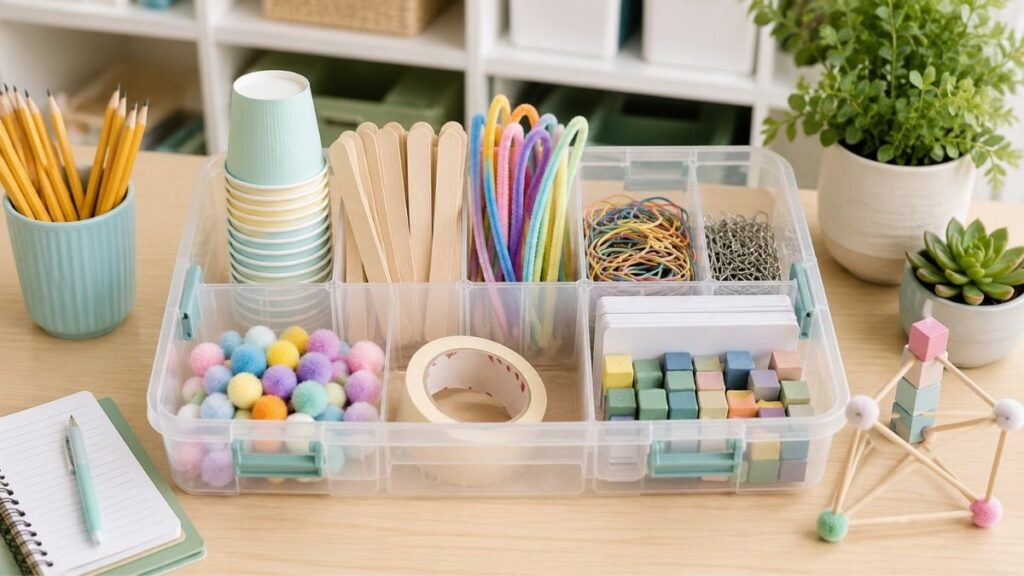
Bins work well for reusable materials — task cards, STEM supplies, puzzles, writing prompts. Make the labels big enough to read from the shelf, and add pictures for younger students.
Worksheet Folders
A small file box or a set of folders holds your print-and-go pages. Keep only a handful in each folder at a time — you can always refill it later.
Choice Boards
A choice board lays out several options in one visual grid, and students pick one after finishing their required work. Six to nine choices is usually the sweet spot — much more than that and kids spend more time deciding than doing.
Pocket Charts
A pocket chart is a great way to display task cards so students can see what’s available at a glance, and you can pull cards temporarily if you need to.
Student Folders or Binders
Older students can keep an ongoing project, an unfinished writing piece, or personal goal work in their own folder — a dependable go-to whenever they have extra time.
Must Do and May Do Routines
Early finisher choices work well folded into a bigger independent work routine: required work first, unfinished work checked next, then an optional activity once both are done. For a full walkthrough, check out Must Do, May Do, Catch Up, Pick: A Simple Classroom Routine That Helps Students Work More Independently.
How to Introduce the Routine
Teach an early finisher system the same way you’d teach any other classroom procedure. Setting new bins on a shelf and telling kids to “pick something” almost never leads to independent use on its own.
- Explain why it exists. Talk about why different students need different amounts of time.
- Show the choices. Start small — you can always add more later.
- Model how to get materials. Walk students through exactly where everything lives.
- Model the noise level. Show both what it should sound like and what it shouldn’t.
- Practice cleanup. Students should know exactly where every piece goes back.
- Give them a practice run. Rehearse the routine while you’re free to help troubleshoot.
- Reteach as needed. Revisit expectations after breaks or whenever you add something new.
Simple visual signals help here too. Classroom hand signs let a student ask for a pencil, a tissue, a restroom break, or your help without calling across the room and interrupting everyone else.
Common Early Finisher Mistakes
Offering Too Many Choices
A packed shelf sounds generous, but it usually leads to browsing, arguing, or students who just can’t decide. A smaller rotation is easier for everyone to manage — you included.
Turning Extra Work Into a Consequence
Don’t hand kids a heavier workload just because they finished efficiently. More practice makes sense when a skill genuinely needs reinforcing — it shouldn’t be the automatic reward for speed.
Picking Activities That Need Your Help
Complicated directions and unfamiliar materials tend to create more interruptions, not fewer. Try an activity out with the whole class before offering it independently.
Leaving Noise Expectations Vague
“Work quietly” means something different to every kid. Teach a specific voice level and clear partner rules instead of assuming everyone already knows.
Creating More Grading for Yourself
Early finisher work shouldn’t turn into a second stack of papers to assess. Occasional review, quick feedback, or self-checking cards usually cover it.
Rotating Materials Too Often
Kids need real repetition to get independent with a system. New activities feel exciting in the moment, but constant swaps mean you’re re-teaching directions over and over.
Skipping Cleanup
An activity isn’t truly independent if materials keep ending up on the wrong shelf or left on tables. Teach cleanup as part of the activity, not as a separate afterthought.
Frequently Asked Questions
What are early finisher activities?
They’re short, independent tasks students can turn to after finishing their required work — something meaningful to do while classmates keep going.
What are meaningful early finisher activities?
Ones that reinforce a skill students already have, encourage reading, spark creativity, or build problem-solving — not just something to fill the clock.
What are good early finisher worksheets?
Open-ended reading responses, logic puzzles, writing prompts, vocabulary challenges, error analysis, and creative design pages all work well. Skip anything that’s just more of the same practice a student already showed they’ve mastered.
Are early finisher task cards useful?
Yes — they’re reusable, take up little space, and give students one clear task at a time, especially when they’re self-checking.
How many early finisher activities should I offer?
Four to eight is plenty to start. You can always expand the menu later, but a huge selection isn’t necessary for the system to work.
Should early finishers help other students?
Sometimes, but it shouldn’t be the default expectation. A student still working might not want help, and it’s not an early finisher’s job to teach the lesson.
Should early finisher work be graded?
Usually not. Most of it is meant for independent practice or enrichment. Self-checking options and the occasional informal look-through are enough.
What can kindergarten early finishers do?
Picture books, pattern blocks, puzzles, ten frames, simple sorting, directed drawing, and familiar letter activities all work well. Visual directions and a consistent spot for materials matter a lot at this age.
How often should I change early finisher activities?
Rotate a few options every few weeks or whenever interest starts to fade. You don’t need to replace the whole collection at once.
Is there another name for early finisher activities?
You’ll also see them called fast finisher activities, “I’m done” activities, extension activities, challenge work, or independent work options.
Final Thoughts
A working early finisher system doesn’t start with dozens of worksheets, bins, and task cards. Five or six dependable options are enough to get the routine going.
Start with activities your students already understand. Teach them how to choose materials, how quiet the work needs to be, and where everything goes back. Once that’s running smoothly, you can add more.
A small collection students can actually use on their own beats a huge one that needs constant explaining. The goal isn’t keeping every kid busy every second — it’s giving them a clear, worthwhile next step while the rest of the class gets the time and support they still need.
Leave a Reply
You must be logged in to post a comment.