
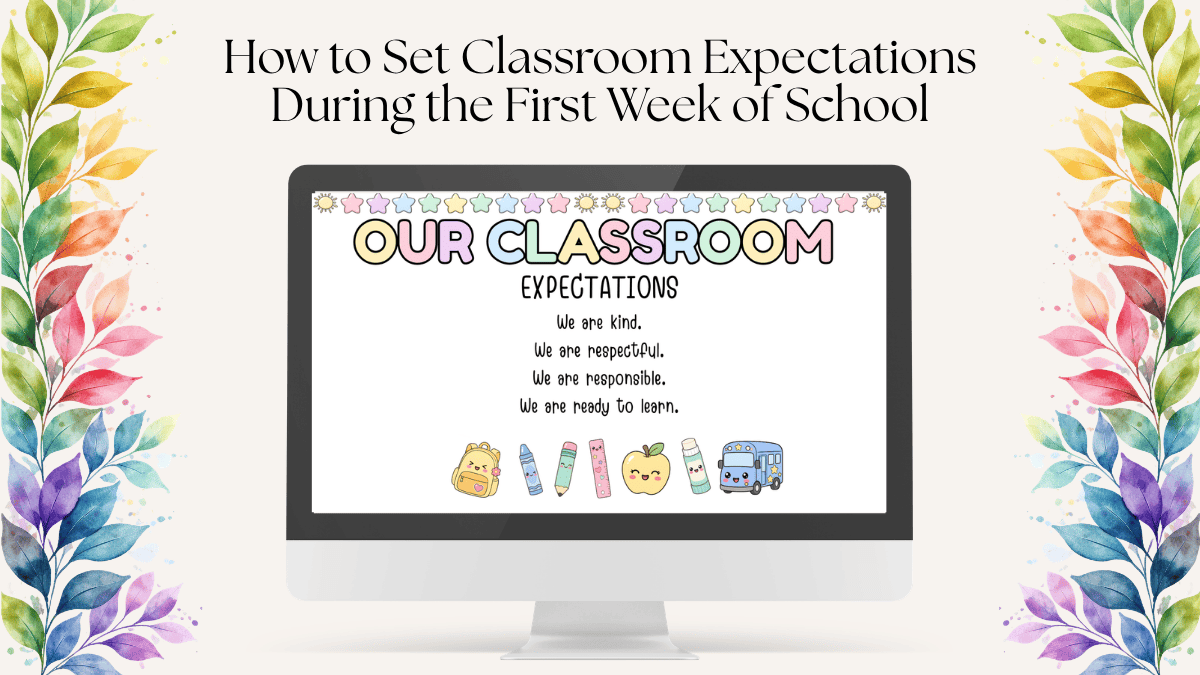
The first week of school sets the tone for everything that follows. Long before academic content takes center stage, students are watching closely to understand what is expected of them, how the classroom works, and what happens when things go smoothly or don’t. Establishing clear classroom expectations during those early days is one of the most valuable investments a teacher — or a homeschool parent building a learning routine at home — can make. It isn’t about being strict or rigid. It’s about giving children the clarity they need to feel safe, capable, and ready to learn.
This article walks through practical strategies for introducing classroom expectations in a way that sticks. Whether you’re a brand-new teacher building your first classroom culture, a student teacher preparing for your first placement, or a homeschool parent looking to bring more structure to your learning space, the ideas here are meant to be adapted, not followed rigidly. There’s no single “correct” way to run a classroom, but there are patterns that tend to work well across many different settings.
Table of Contents
- Why Classroom Expectations Matter
- Teach Expectations One Routine at a Time
- Model the Behaviors You Want to See
- Practice Expectations Every Day
- Use Visual Classroom Supports
- Create Consistent Classroom Routines
- Common Mistakes
- Frequently Asked Questions
- Final Thoughts
Why Classroom Expectations Matter
Clear classroom expectations do more than keep a room quiet or orderly. They create a shared understanding between the adult in charge and the children in the room about how the space works, what respect looks like, and what success looks like on any given day. When expectations are vague or inconsistent, children spend mental energy trying to guess what’s allowed, which pulls focus away from learning. When expectations are clear, that same mental energy can go toward the actual lesson.
Many teachers find that the first few days of school are less about content and more about culture-building. A first-grade classroom that spends extra time in September establishing how to line up, how to ask for help, and how to transition between activities often runs more smoothly in October, November, and beyond. The time invested early tends to pay off across the rest of the year.
There’s also a developmental piece worth understanding. Young children are still building the self-regulation skills that adults often take for granted. A five- or six-year-old isn’t being defiant when they forget to raise their hand for the third time in one afternoon — they’re still learning to hold a new expectation in mind while also managing excitement, curiosity, and the general chaos of being a small person in a room full of other small people. Classroom expectations elementary teachers set should account for this. Expectations that are age-appropriate, clearly explained, and repeated often are far more effective than expectations that are simply announced once and assumed to stick.
Homeschool families sometimes assume that classroom expectations are only relevant in a traditional school setting, but the same principles apply at home. Even with one or two children, having agreed-upon expectations for how the learning table works, how materials are used, and how questions get asked can transform a chaotic morning into a predictable, calmer one. Structure isn’t the enemy of a warm, flexible learning environment — it’s often what makes that warmth possible, because everyone knows what to expect.
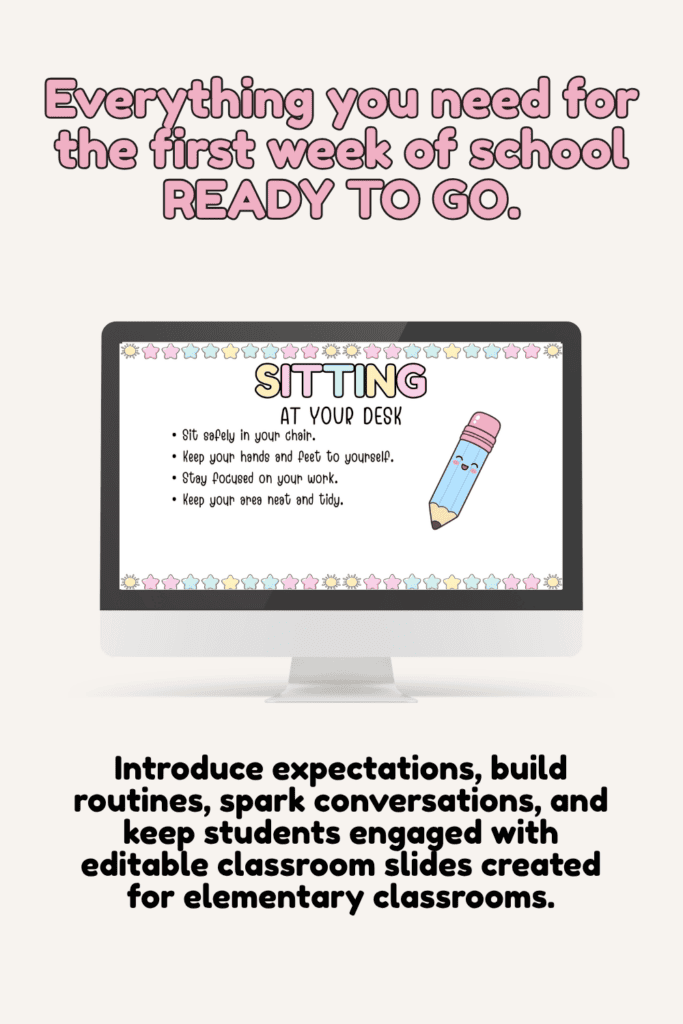
Children often thrive when expectations and routines are predictable. Clear structure gives them a sense of security, making it easier to focus on learning and participate confidently throughout the day.
Setting expectations early also reduces the amount of reactive discipline needed later. Instead of correcting behavior after it happens, a classroom or homeschool space with strong expectations spends more time preventing problems before they start. This proactive approach tends to feel better for everyone involved — the adult isn’t constantly redirecting, and the children aren’t constantly being told what they did wrong.
Teach Expectations One Routine at a Time
One of the most common mistakes in the first week of school is trying to introduce too much at once. A teacher might walk through ten different rules and procedures in a single morning, hoping that repetition alone will make them stick. In practice, this often backfires. Young children can only absorb so much new information at a time, and when everything is introduced simultaneously, very little of it is retained.
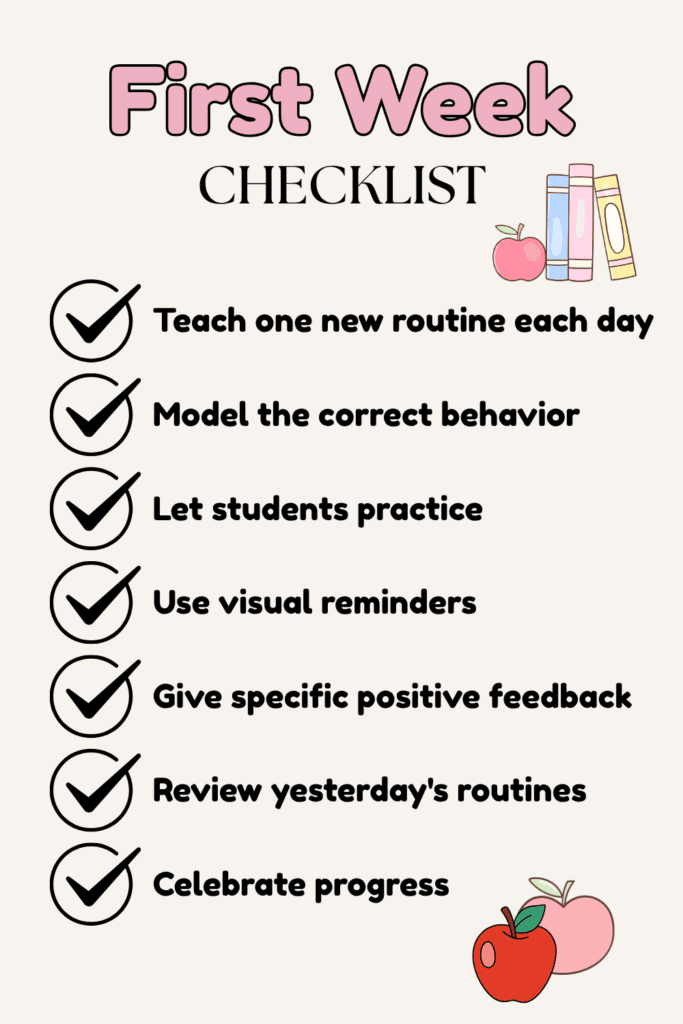
A more effective approach is to slow down and teach one routine at a time, giving each one room to be practiced and reinforced before moving to the next. On day one, that might mean focusing entirely on how to enter the classroom, hang up a backpack, and find a seat. Day two might add how to ask to use the restroom. Day three might introduce how transitions between subjects work. This gradual build allows each expectation to become familiar before the next one is layered on top.
This approach mirrors how new skills are taught in almost any other context. Nobody teaches a child to ride a bike by explaining balance, pedaling, braking, and steering all in the same sentence and expecting mastery by the end of the day. Skills are broken down, taught individually, and practiced repeatedly. Classroom expectations work the same way — they are skills, not just rules, and skills take repeated, structured practice to become automatic.
It can help to think of the first two weeks of school as a dedicated “routines unit,” even if it isn’t labeled that way on a lesson plan. Just as a teacher wouldn’t expect a student to master multiplication after one lesson, it’s unrealistic to expect a full set of classroom procedures to be internalized after a single explanation. Building in that time upfront, even though it can feel slow, tends to save far more time later in the year.
For homeschool parents, this same principle applies to structuring a school-at-home routine. Rather than announcing an entire daily schedule on the first morning, introducing one new routine every few days — how independent work time works, how to signal needing help, how transitions between subjects happen — gives children the chance to actually absorb each expectation rather than feeling overwhelmed by all of them at once.
A Simple Sequence for the First Week
While every classroom is different, a general sequence that many teachers find useful looks something like this:
- Day 1: Entering the room, unpacking, morning routine
- Day 2: Getting the teacher’s attention, asking for help
- Day 3: Transitioning between activities and subjects
- Day 4: Working independently and using quiet voices
- Day 5: Reviewing and combining routines learned so far
This is only a starting framework. Some classrooms move faster, others slower, and that’s completely normal. The goal isn’t to rush through a checklist — it’s to make sure each routine has been genuinely taught, not just mentioned.
Model the Behaviors You Want to See
Explaining an expectation out loud is a start, but young children learn far more effectively by watching than by listening to instructions alone. Modeling — physically demonstrating what an expectation looks like — is one of the most powerful tools available during the first week of school, and it’s often underused simply because it takes more time than a verbal explanation.
Modeling works best when it’s specific and visual. Rather than telling students to “line up nicely,” it’s far more effective to show exactly what that looks like: standing at a certain spot, facing forward, keeping hands to oneself, and using a quiet voice. A common approach is to physically walk through the routine while narrating each step, almost like a play-by-play. This gives children a concrete picture to hold onto rather than an abstract instruction to interpret on their own.
It also helps to model what the expectation does not look like, in a lighthearted way. Many teachers find success in demonstrating an exaggerated “wrong way” first — shuffling into the room with a backpack dragging on the floor, for example — followed by the “right way.” Children often find this funny, which helps the lesson stick, and the contrast makes the correct behavior easier to remember.
Peer modeling is another effective strategy. Once a routine has been introduced, inviting a student (or a few students) to demonstrate it for the rest of the class reinforces the expectation from a different angle. Seeing a classmate succeed at a routine can be more motivating for young children than watching an adult do it, since it signals “this is something kids my age can do.”
Modeling isn’t a one-time event, either. Expectations often need to be re-modeled after a weekend, a holiday break, or any disruption to the normal schedule. Rather than assuming a routine taught in August will still be fully intact by the following Monday, many teachers build in quick refresher demonstrations throughout the first several weeks of school, and periodically throughout the year.
Homeschool parents can apply the same idea by walking through new routines together rather than simply explaining them. If independent reading time is a new expectation, sitting down and modeling exactly what that looks like — including how long it lasts and what to do if a question comes up — gives children a much clearer picture than a verbal description alone.
Practice Expectations Every Day
Teaching an expectation once is rarely enough. Like any new skill, classroom routines need repeated practice before they become automatic, and the first week of school is the ideal window for that repetition to happen intentionally, rather than hoping it happens naturally over time.
Daily practice doesn’t need to be elaborate. In fact, short, low-pressure repetition tends to work better than long, formal practice sessions. A quick run-through of the lineup procedure before recess, a thirty-second review of how to ask for help before independent work begins, or a brief recap of transition expectations before moving to the next subject — these small, consistent touches add up over the course of a week far more effectively than one long lecture on day one.
Students often benefit from practice that includes some element of feedback, even informally. After a routine is practiced, a quick acknowledgment of what went well — “I noticed everyone walked quietly to the carpet” — reinforces the behavior and helps children understand exactly what they did correctly. This kind of specific, immediate feedback tends to be more effective than general praise, because it clearly connects the behavior to the outcome.
It’s also worth normalizing the idea that mistakes during practice are expected and not a sign of failure. The first week of school is, by definition, a learning period for classroom routines, just as it is for academic content. When a student forgets a step or does something out of order, treating it as a normal part of learning — rather than a discipline issue — keeps the tone of the classroom supportive rather than punitive during this early stage.
One effective strategy some teachers use is a short daily “routine check-in” at the end of the day, where the class briefly reflects on how a particular expectation went. This doesn’t need to take more than a minute or two, but it reinforces the idea that routines are something the whole class is working on together, not rules being imposed from above.
For homeschool families, daily practice might look like a quick verbal or visual review each morning of what the day’s flow will be, especially during the first few weeks of a new school year or a new curriculum. Repetition, even brief repetition, builds the kind of familiarity that eventually allows routines to run with very little prompting at all.
Use Visual Classroom Supports
Verbal instructions fade quickly, especially for young children who are still developing their working memory. Visual supports give children something concrete to refer back to throughout the day, long after a spoken explanation has been forgotten. This is one of the reasons visual classroom management tools have remained a consistent staple in elementary classrooms for so many years — they simply work well with how young children process and retain information.
Anchor charts are a common example. Rather than simply telling students the expectations for quiet work time, many teachers create a chart with the class, listing out what quiet work time looks like and sounds like, often with simple icons or drawings alongside the words for younger or emerging readers. Because the chart was built collaboratively, students tend to feel more ownership over it, which can make them more likely to follow it.
Visual reminders such as classroom hand signal posters or routine cards can make expectations easier for young students to remember, particularly during moments of transition when verbal reminders might get lost in the noise and movement of the room. A hand signal system, for instance, gives students a quiet, non-disruptive way to communicate needs like using the restroom or getting a tissue, without interrupting the flow of a lesson. For a closer look at how these systems work in practice, this guide to Classroom Hand Signals walks through several practical options.
Visual schedules are another valuable tool, especially during the first week of school when the daily flow is still new to everyone. A simple picture or word schedule posted where students can see it throughout the day reduces anxiety by helping children know what’s coming next, which in turn reduces the number of “what are we doing now?” questions and gives students a greater sense of control over their day.
Visual supports are equally valuable in a homeschool setting. A posted daily routine chart, even a simple one drawn by hand, can help children — especially younger ones — understand the shape of their day without needing constant verbal reminders from a parent. Over time, many families find that children start referencing the chart independently, which reduces the mental load of constantly narrating what comes next.
Types of Visual Supports Worth Considering
- Anchor charts for specific routines (lining up, quiet voices, asking for help)
- Visual daily or weekly schedules
- Hand signal or communication cards
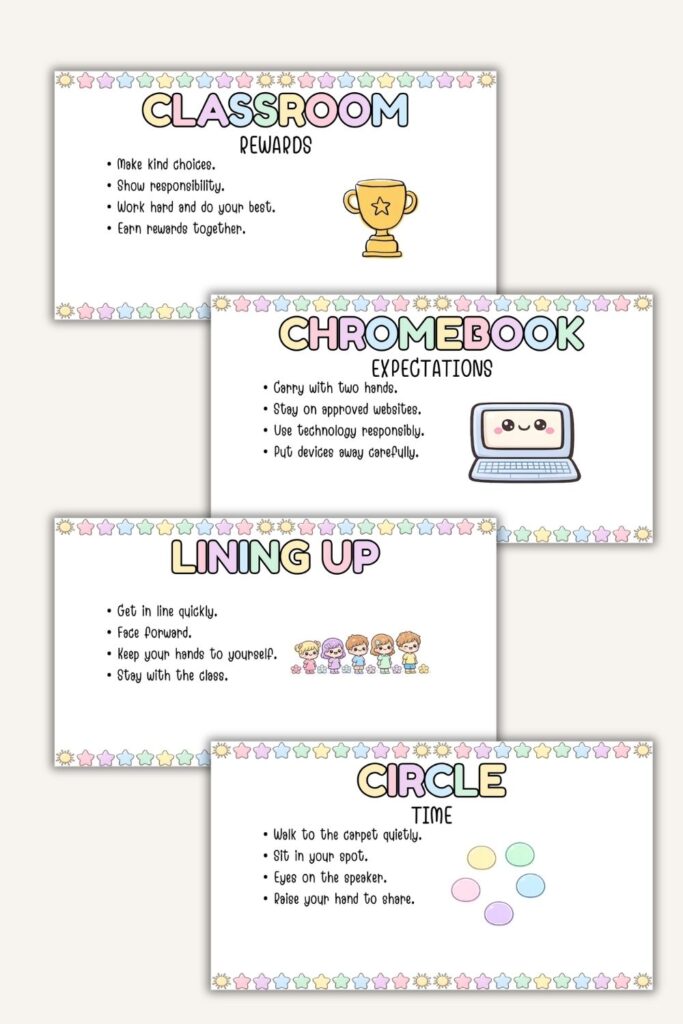
- Behavior expectation posters with simple icons
- Independent work systems, such as Must Do, May Do, Catch Up, Pick boards
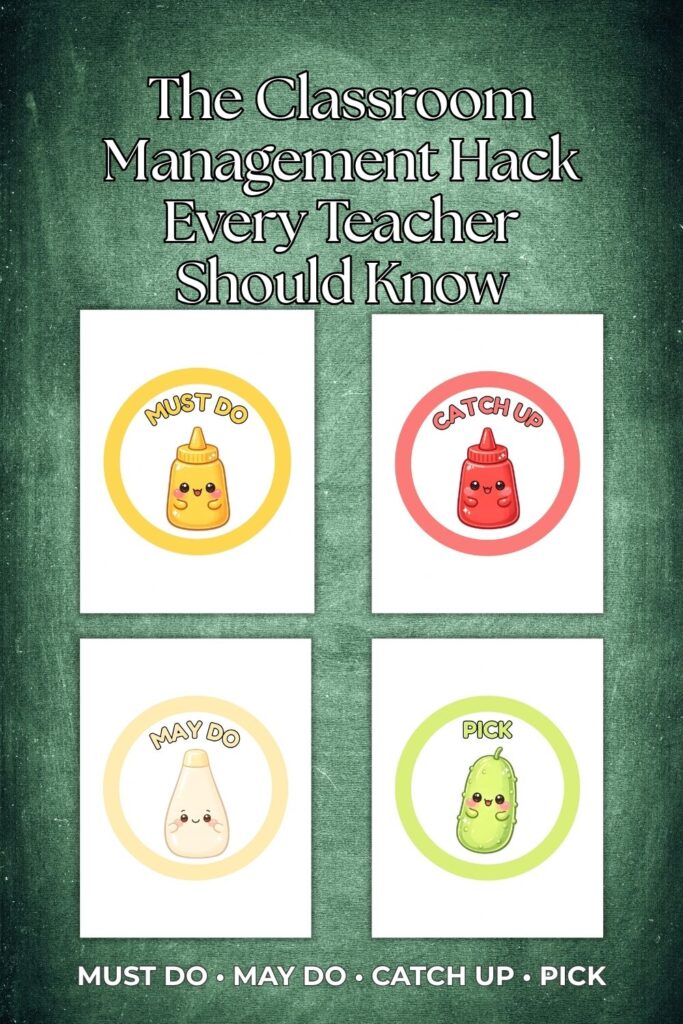
The goal with any visual support isn’t decoration — it’s function. A well-designed visual reminder should answer a question a child might have during the day without requiring them to interrupt the teacher or wait for an adult to notice they’re unsure. When visuals are placed at a child’s eye level and referenced regularly, they tend to become a genuinely useful tool rather than background classroom decor.
Create Consistent Classroom Routines
Expectations and routines are closely related, but they aren’t quite the same thing. An expectation describes the standard — for example, “we listen when someone else is speaking.” A routine is the specific, repeatable sequence of steps that helps students meet that expectation consistently — for example, the exact process for transitioning from the carpet back to desks. Classroom routines give expectations a concrete shape, and without them, even well-explained expectations can feel abstract and hard to follow consistently.
Consistency is the operative word here. A routine that changes slightly every day — sometimes students line up by table, sometimes by name, sometimes whoever finishes first — creates confusion, because the underlying pattern is never stable enough to become automatic. First week classroom routines in particular benefit from being kept simple and unchanging, even if a more efficient system might exist. It’s often better to start with a routine that’s easy to remember and gradually refine it later, once it’s already familiar, rather than starting with something complex.
Morning routines tend to set the tone for the entire day, which makes them worth particular attention during the first week. A predictable sequence for entering the room, putting belongings away, and settling into a starting activity gives children an anchor point at the very beginning of the day, before academics even begin. For ideas on structuring this part of the day, many teachers find it helpful to look at Morning Meeting Ideas as a starting point, since a strong morning meeting routine often becomes the backbone of the rest of the day’s structure.
Transition routines deserve equal attention, since transitions are often where classroom management challenges are most likely to appear. Moving from one activity to another — carpet to desks, math to reading, classroom to hallway — creates natural opportunities for students to become unfocused or overly excited. A consistent, well-practiced transition routine, complete with a clear signal for when the transition should begin and end, tends to significantly reduce the chaos that can otherwise accompany these moments.
Independent work routines are another area where consistency matters a great deal, particularly for classrooms that include any kind of workstation or center-based model. Students who finish an assignment early need a clear, well-established next step, rather than being left to decide on their own what to do. Systems that offer structured options for early finishers — sometimes paired with Early Finisher Activities — can prevent the kind of restlessness that often derails an otherwise productive work block.
Homeschool routines benefit from this same consistency, even in a much smaller setting. A predictable order of subjects, a consistent signal for transitions, and a clear routine for what happens when independent work is finished can make homeschool days feel calmer and more structured, even for families who value flexibility in other areas of their approach.
Common Mistakes
Even with the best intentions, it’s easy to fall into a few common traps when setting classroom expectations during the first week of school. Being aware of these pitfalls ahead of time can make it easier to avoid them.
Introducing too many expectations at once. As mentioned earlier, trying to cover every rule and procedure on day one tends to overwhelm students rather than prepare them. A slower, more layered approach almost always produces better long-term results, even though it can feel counterintuitive to “waste” instructional time on routines early in the year.
Assuming expectations only need to be taught once. A single explanation, even a clear one, is rarely enough for a routine to become automatic. Ongoing practice, especially in the first few weeks, is what actually makes an expectation stick.
Being inconsistent in enforcement. If an expectation is enforced strictly one day and loosely the next, students quickly learn that the expectation is negotiable, which undermines the entire system. Consistency doesn’t require harshness — it simply requires predictability.
Focusing only on rules, not routines. A list of rules tells students what not to do, but it doesn’t necessarily show them what to do instead. Pairing every expectation with a concrete routine gives students a clear path to success, rather than just a list of things to avoid.
Skipping the “why.” Even young children respond well to a brief, age-appropriate explanation of why an expectation exists. “We walk in the hallway so everyone stays safe” gives children a reason to buy into the expectation, rather than simply following it out of compliance.
Not revisiting expectations after breaks. Long weekends, holiday breaks, and even a single sick day can cause routines to slip. Many teachers find it useful to briefly re-teach or review key expectations after any extended time away from the regular schedule, rather than assuming everything picked up exactly where it left off.
Overcomplicating visual supports. A chart or poster that’s too busy or text-heavy can actually work against its purpose, especially for younger or emerging readers. Simple, clear visuals with plenty of white space tend to be far more effective than elaborate designs packed with information.
Frequently Asked Questions
How long should teaching classroom expectations take?
There’s no fixed timeline, but many teachers dedicate the first one to two weeks of school primarily to teaching and practicing routines, with academic content gradually increasing as those routines become more established. Some expectations, particularly more complex ones, may need ongoing reinforcement well beyond the first week.
What are some simple classroom expectations examples for young children?
Common, age-appropriate examples include using a quiet voice during independent work, raising a hand before speaking during group instruction, walking (not running) inside the classroom, keeping hands and feet to oneself, and putting materials away after use. Effective expectations tend to be stated positively — describing what to do rather than only what not to do.
How many classroom expectations should a teacher set?
Many educators find that a small number of broad, overarching expectations — often three to five — works better than a long list of specific rules. Broad expectations like “be respectful,” “be safe,” and “be responsible” can then be applied to many different specific situations, rather than needing a separate rule for every scenario.
How can homeschool parents set classroom-style expectations at home?
The same core principles apply: introduce routines gradually, model what each expectation looks like, practice consistently, and use visual supports where helpful. A homeschool setting has the advantage of flexibility, but children still benefit from the same kind of predictable structure that a traditional classroom provides.
What should happen when a student doesn’t meet an expectation?
During the first week especially, it helps to treat these moments as part of the learning process rather than as behavior problems. A calm reminder, a quick re-modeling of the expected behavior, and an opportunity to try again tend to be more effective than punitive responses, particularly while routines are still new.
Do classroom expectations need to change as the year goes on?
The core expectations usually stay fairly stable throughout the year, but the specific routines that support them can evolve as students demonstrate more independence. What starts as a highly structured routine in September might naturally become more flexible by the spring, once students have internalized the underlying expectation.
Final Thoughts
Setting strong classroom expectations during the first week of school isn’t about creating a rigid, rule-heavy environment. It’s about giving children the clarity, structure, and predictability they need to feel confident and ready to learn. The investment made in those early days — teaching routines gradually, modeling behaviors clearly, practicing consistently, and reinforcing everything with visual supports — tends to pay off in a calmer, more focused classroom for the rest of the year.
There’s no single right way to approach this process, and what works well in one classroom or homeschool setting might need adjustment in another. The underlying principles, though, tend to hold true across almost any elementary learning environment: start small, be consistent, model more than you explain, and give routines the time they need to become second nature. Classroom management built on this kind of foundation tends to feel less like constant correction and more like a genuinely supportive rhythm that both the adult and the children can rely on.
Whatever the setting — a full classroom of twenty-five students or a homeschool table with one or two — the first week of school is a genuine opportunity to build something that supports everything that comes after it. Taking the time to do it thoughtfully is rarely time wasted.
Leave a Reply
You must be logged in to post a comment.