
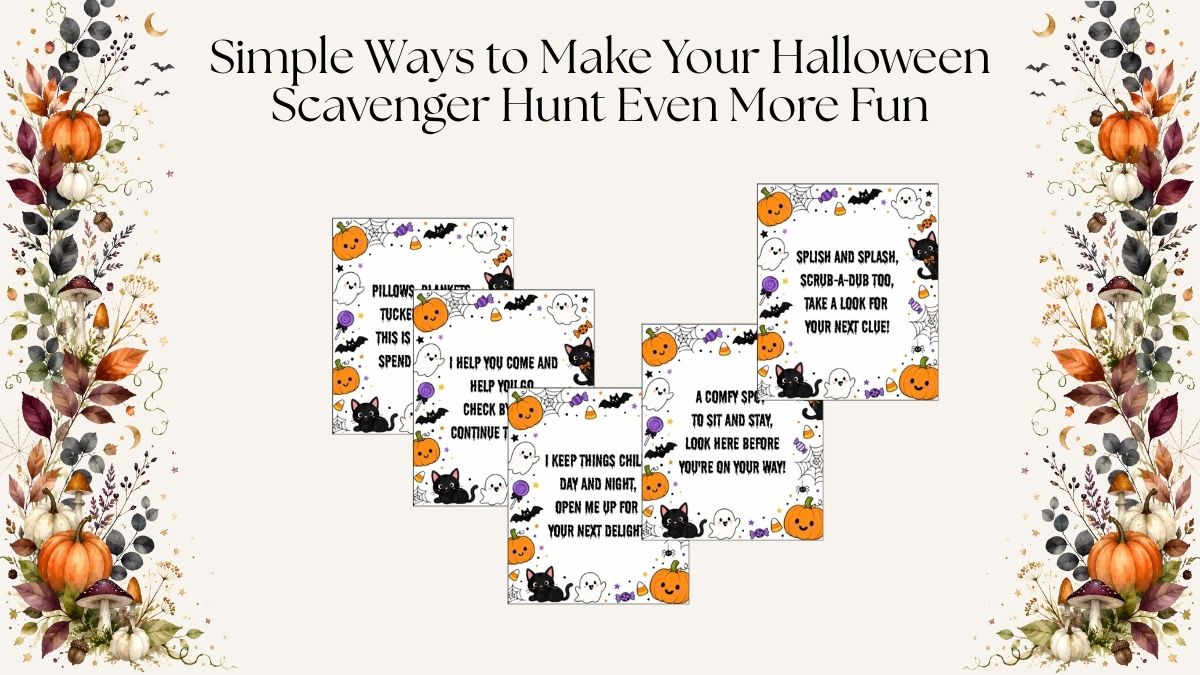
Rain on the calendar, a full week of school events, or just a house full of energy that needs somewhere to go — there are a lot of reasons an indoor Halloween scavenger hunt ends up saving the day. Trick-or-treating only lasts an hour or two, and Halloween itself tends to stretch across weeks of costumes, parties, and pumpkin patches. Somewhere in there, families need a low-effort activity that still feels like an event.
A scavenger hunt fits that gap perfectly. It turns a living room, a hallway, and a kitchen into a small adventure, and it works whether you’re filling a rainy Saturday afternoon, hosting a Halloween party, or looking for a family tradition that doesn’t involve a screen. This guide walks through why kids love the format, how to set one up from start to finish, and how a ready-made set of clues can take the planning off your plate entirely.
Last Halloween, I tested this scavenger hunt with a small group of six-year-olds. Before handing over the first clue, I lowered my voice and announced that I was pretty sure a little Halloween witch had visited the house overnight, leaving behind a trail of mysterious clues.
For just a second, I caught those wide-eyed expressions only young children can make. They looked around the room as if they weren’t entirely sure whether I might actually be right. Then someone giggled, everyone laughed, and they sprinted off to solve the first clue.
From that moment on, they were completely invested. Every clue felt important, every hiding place became a discovery, and by the time they reached the final prize, they were already asking if we could do another scavenger hunt next Halloween.
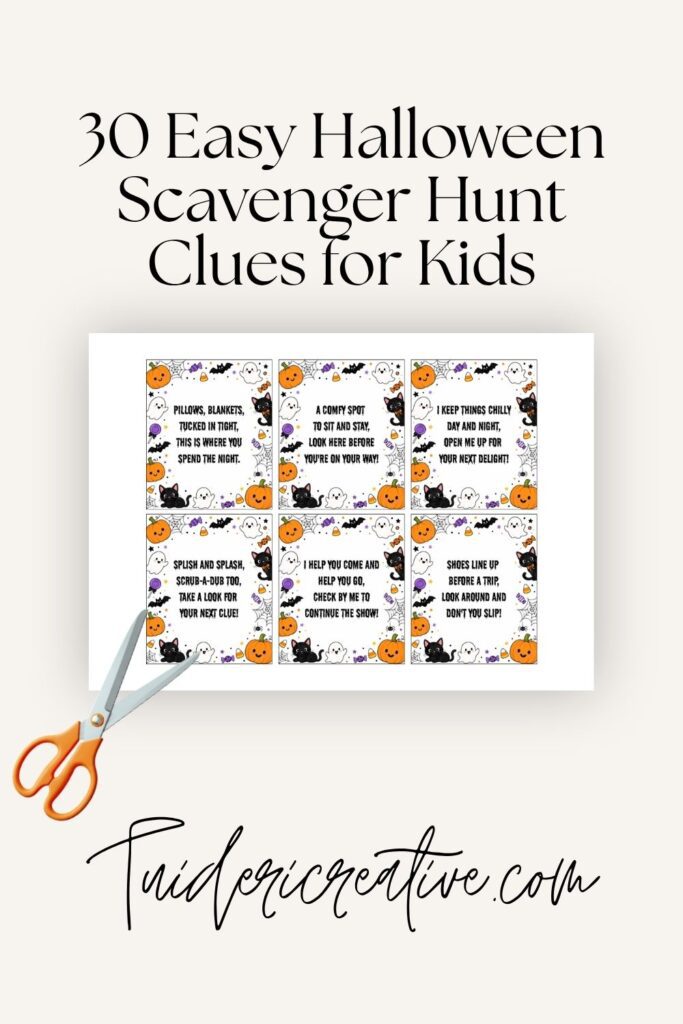
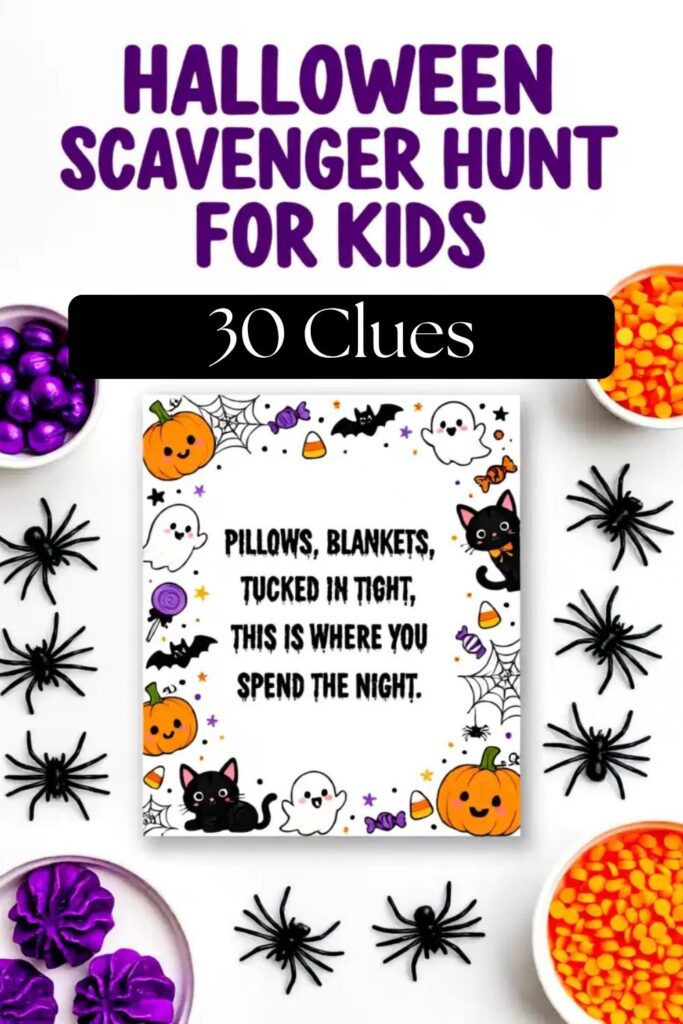
Throughout this guide, you’ll also find ideas inspired by our printable Halloween scavenger hunt, which includes 30 ready-made rhyming clues and editable cards for creating your own.
Why Kids Love Halloween Scavenger Hunts
Part of the appeal is simple: kids like solving things. A clue that rhymes or hints at a hiding spot gives them a small puzzle to chew on, and figuring it out feels like a real accomplishment, especially for younger children who don’t get many chances to be the one with the answer.
There’s also the physical side of it. A scavenger hunt gets kids up and moving through the house, checking under cushions, peeking into cabinets, and racing between rooms. That movement builds its own kind of excitement — each clue raises the stakes a little, and the pace naturally quickens as the finish line gets closer.
When more than one child is playing, the hunt becomes a shared project. Older kids read clues aloud to younger siblings, someone spots a hiding place first, and the group works out disagreements about where to look next. That kind of teamwork tends to happen on its own, without anyone having to organize it.
And then there’s the anticipation. Every clue is a small promise that something better is coming, right up until the final hiding spot reveals the prize. Families who do this more than once often find it becomes something kids ask for by name — “can we do the clue hunt again this year?” — which is really how a one-off activity turns into an actual tradition.
Halloween Scavenger Hunt vs Halloween Treasure Hunt
These two terms get used interchangeably most of the time, and for casual purposes, that’s fine — a Halloween scavenger hunt and a Halloween treasure hunt for kids usually describe the same basic activity.
If you want to split hairs, though, there’s a subtle difference. A scavenger hunt is generally about the search itself: kids follow a trail of clues, and each clue leads to the next one. A treasure hunt puts more weight on the destination — the entire point is reaching a final prize, with the clues acting as a path toward it rather than the main event.
In practice, most home and classroom versions blend the two. Clues lead from one hiding place to another, building a chain, and the chain ends at a treasure. So whether you call it a Halloween treasure hunt or a Halloween scavenger hunt, you’re likely setting up the same thing: a series of clues that finish with a reward.
How to Set Up an Indoor Halloween Scavenger Hunt
Setting one up sounds like more work than it actually is. Once you have your clues ready, the whole thing comes together in well under an hour.
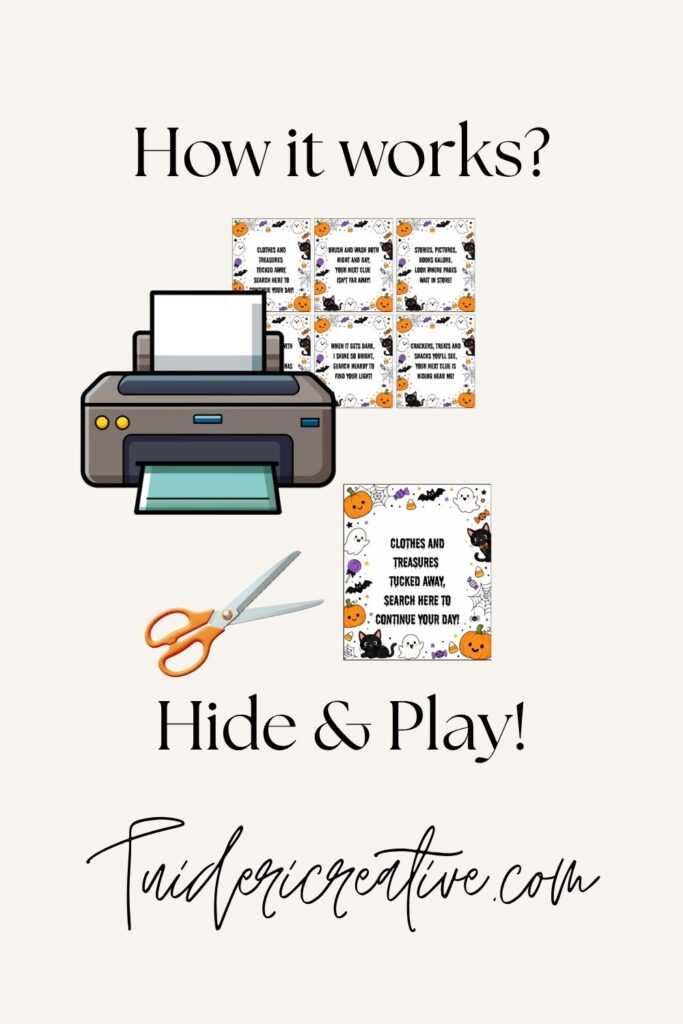
Print the clues. Whatever clue set you’re using, start by printing it on regular paper — cardstock holds up a little better if kids will be handling the cards more than once, but standard printer paper works fine for a single afternoon.
Cut the cards apart. Most printable sets fit several clues on a page, so a few minutes with scissors or a paper trimmer gets you a stack of individual cards, ready to hide.
Choose a starting clue. Hand the first clue directly to your child, or tape it somewhere obvious, like the front door or the breakfast table, so the hunt has a clear beginning.
Hide the rest in order. Each clue should point to where the next one is hidden. It helps to write out your hiding order on a scrap of paper first — a quick answer key — so you don’t forget where card twelve is supposed to go.
Plan the final surprise. The last clue should lead to the prize. This is the moment the whole hunt builds toward, so it’s worth putting a little more thought into where it’s hidden and what’s waiting there.
Keep younger children engaged. For preschoolers or early kindergartners, pair them with an older sibling or adult who can read the clue aloud, or simplify the wording as you go. Hiding clues in more obvious spots also helps smaller kids stay in the game without getting frustrated.
Make the hunt age-appropriate. Older kids can handle trickier hiding places and longer clue chains, while younger ones do better with fewer clues and shorter distances between hiding spots. It’s easy to adjust either direction once you have a full set of cards to pull from.
Write down your hiding places. Trust me on this one. One year I changed a hiding spot at the last minute, convinced I’d remember it. I didn’t. We ended up abandoning that clue completely because I couldn’t find it anywhere. About six months later, I opened a rarely used cabinet and there it was, still happily taped to the inside of the door, waiting for Halloween to come back around. Ever since then, I’ve kept a simple checklist of every hiding place.
30 Ready-to-Use Halloween Scavenger Hunt Clues
Writing thirty rhyming clues that actually make sense — and don’t give away the hiding spot too early or leave kids stuck — takes longer than most people expect. That’s the gap this printable is built to close.
The set includes 30 ready-made rhyming clue cards, each one written to point toward a specific spot around a typical home: a laundry basket, a bookshelf, a coat closet, a kitchen cabinet. Every card comes formatted six to a page, so a single sheet gives you a full round of clues to work with, and the whole set is available as an instant digital download in an easy-to-print PDF.
Because it’s ready to go, there’s no need to sit down and invent thirty different rhymes or second-guess whether a clue is too hard for a six-year-old. The pages print, cut, and go straight into hiding.
Editable Halloween Clues for Your Own Ideas
Along with the 30 pre-written clues, the set includes blank clue cards in the same design, so families can add their own hiding spots without clashing styles.
That flexibility opens up a lot of options. A blank card can point to a favorite hiding place that’s specific to your own house — behind a particular armchair, inside a certain toy bin — somewhere the pre-written clues wouldn’t know to mention. It can also work in an inside joke, something only your kids would understand, which tends to get a bigger laugh than any generic rhyme.
The blanks adapt well to specific occasions too. Swap in a clue about the birthday cake for a Halloween-themed birthday party, or write one pointing to a classroom reading corner for a school version. Parents have also used a blank card to build in a clue about the actual prize itself — a new book, a small toy — turning the last hiding spot into a bit of a reveal.
Halloween Scavenger Hunt Ideas to Make the Game Even More Fun
A solid set of clues is the foundation, but a few small additions can turn a good scavenger hunt into a memorable one.
Playing by flashlight after dark adds an instant layer of spookiness, especially for older kids who want a bit more of a thrill than a daytime hunt provides. Glow sticks work in a similar way — hand one to each player, or tuck a few into hiding spots as a bonus find along the way.
Bonus clues are worth keeping in your back pocket for kids who finish early or seem to be breezing through. A single extra card can stretch the hunt by five or ten minutes without any real prep. Mini challenges do something similar: ask kids to do five jumping jacks, say a silly Halloween word backward, or hop on one foot before they’re allowed to move to the next clue.
Costume clues work well if the hunt is happening on Halloween itself — write a clue that only makes sense once you notice something about what a sibling or parent is wearing. Splitting kids into teams turns the hunt into a light competition, which tends to add energy without much extra setup.
Photo challenges are an easy add for families with a phone handy: have kids snap a picture at each hiding spot before moving on, which doubles as a nice record of the whole hunt afterward. A pumpkin prize — literally hiding the final treasure inside or near a decorative pumpkin — ties the ending back to the holiday itself.
Halloween music playing in the background sets a mood without requiring any real effort, and a countdown clue near the very end (“only two more stops!”) builds anticipation right before the big finish. None of these need much preparation, but together they make a simple clue hunt feel like a full event.
Best Indoor Places to Hide Halloween Clues
Every house has a handful of spots that work especially well for hiding scavenger hunt clues — places kids naturally check but don’t spot instantly.
Under a pillow works because it’s an obvious hiding place once a child thinks of it, but not the first spot they’ll look. Inside a favorite book rewards a child who reads often, and it’s a spot that feels personal rather than random.
A shoe rack is at the perfect height for smaller kids and doesn’t require climbing or reaching. A laundry basket is similar — low to the ground, easy to search, and usually somewhere in every home.
The bathroom sink area (tucked near the soap dispenser or behind the faucet) sends kids into a different part of the house, which helps spread the hunt out. A toy box is a natural stop, since kids are already used to digging through it.
A kitchen cabinet, especially a lower one within reach, works well for younger hunters. The microwave is a fun surprise spot — kids rarely think to open it, which makes for a satisfying “aha” moment. Under couch cushions is a classic for a reason: quick to hide, quick to find, and it keeps kids moving through the main living space. A coat pocket rounds out the list nicely, especially with a Halloween costume or jacket hanging nearby.
Halloween Treasure Hunt Prize Ideas
Candy is the obvious choice for a Halloween prize, but it’s far from the only one, and plenty of families like to mix things up or skip it altogether.
Stickers are inexpensive and satisfying for younger kids, especially Halloween-themed ones. Glow sticks double as both a prize and a fun accessory for the rest of the evening. Mini toys — small figures, erasers, or trinkets — give kids something to keep long after the candy is gone.
Halloween books make a nice prize for families who want to end the hunt with some quiet time afterward, curled up with a new story. Craft supplies, like a small pack of markers or a pumpkin-decorating kit, keep the fun going once the hunt itself is over.
A movie night coupon — a homemade slip promising a specific movie and snack — builds anticipation for later in the evening. Hot chocolate works well as a prize for an evening hunt, especially once the weather turns cooler. A small LEGO set is a popular choice for kids who like to build, giving them a project to dig into right after the hunt wraps up.
Each of these appeals to kids for a slightly different reason — some want something to eat, some want something to build, and some are happy with anything that feels like it was chosen just for them.

Halloween Scavenger Hunt Ideas by Age
Preschool. Keep the hunt short, five or six clues at most, with very obvious hiding spots and an adult reading each clue aloud. Simple visual clues (a picture of a pumpkin instead of text) can work well alongside the rhymes.
Kindergarten. Kids this age can usually read short clues themselves or sound them out with a little help. Ten to fifteen clues is a good range, with hiding spots spread across just a couple of rooms.
Elementary School. This is where the full 30-clue set really shines. Kids can read independently, follow multi-step directions, and handle trickier hiding spots without much adult help.
Family Halloween Night. Mix ages by pairing an older child with a younger one, or split the full set of clues across two smaller teams so everyone finishes around the same time.
Halloween Party. With a group of kids, team-based hunts work best — split guests into small groups and give each team a different starting clue so they’re not all racing for the same hiding spot at once.
Homeschool. The rhyming clues double nicely as a reading exercise, and the blank cards make it easy to fold in a lesson-related hint alongside the Halloween ones.
Frequently Asked Questions
How many clues should a Halloween scavenger hunt have? It depends on the age group and how much time you want to fill, but somewhere between ten and twenty clues covers most situations well. A full 30-clue set gives plenty of room to pick and choose or split into two separate hunts.
How long should the scavenger hunt last? Most indoor hunts run somewhere between fifteen and forty-five minutes, depending on the number of clues and how spread out the hiding spots are.
Can preschoolers complete a scavenger hunt? Yes, with some adjustments — shorter clue chains, obvious hiding spots, and an adult or older sibling reading along tend to make it work well for this age.
Can I reuse the clues every year? Definitely. Since the clues describe general hiding spots rather than specific dates or events, most families keep using the same set year after year, sometimes rotating in new hiding spots for variety.
Do I need candy at the end? Not at all. Plenty of families prefer non-candy prizes, especially for younger kids or households already managing a lot of Halloween sugar.
Can I create my own clues? Yes — blank clue cards make this easy, letting you add hiding spots or prizes specific to your own home without needing to match the handwriting or style of the rest of the set.
Final Thoughts
An indoor Halloween scavenger hunt doesn’t need much to come together — a stack of clues, a few hiding spots, and a little time to set it up. What kids remember afterward isn’t the logistics, though. It’s the running from room to room, the moment a tricky clue finally clicks, and the reveal at the very end.
For anyone who’d rather skip the writing and get straight to hiding, this printable set includes 30 ready-made rhyming clues, editable blank cards for personal touches, and an instant download that’s ready to print the same day. However this Halloween season shapes up — rainy afternoon, family night, or full-blown party — a hunt like this is an easy way to turn an ordinary evening into one the kids will ask to repeat.
Leave a Reply
You must be logged in to post a comment.