
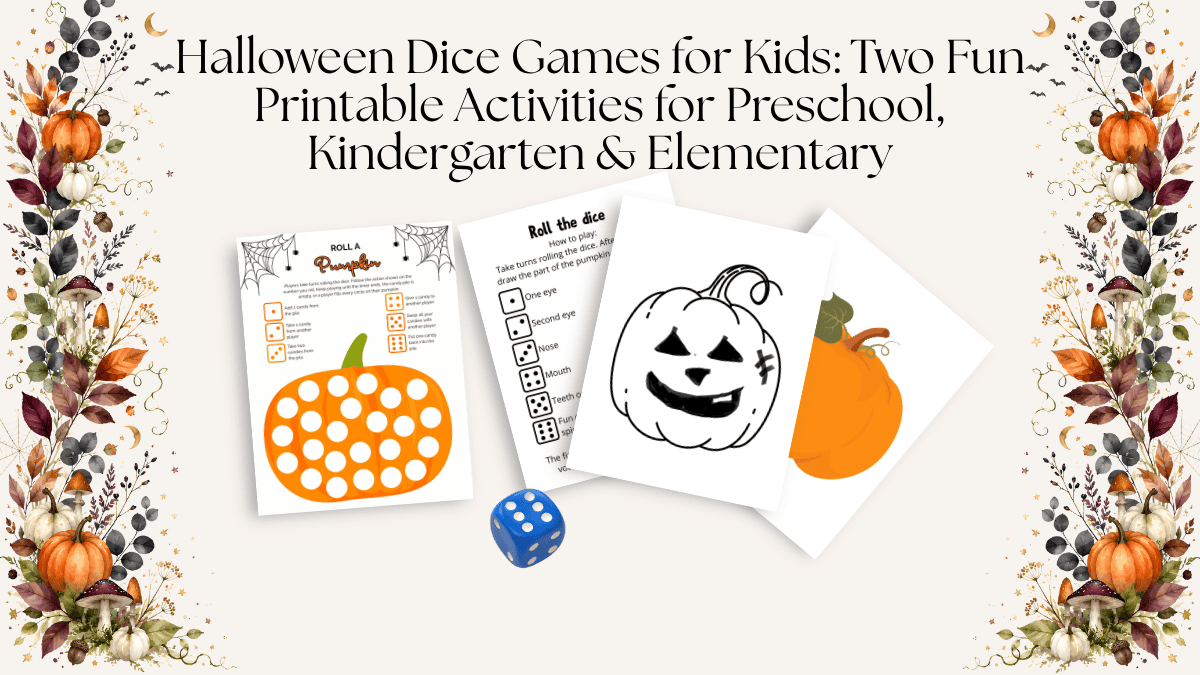
There’s something about the last week of October that turns even the calmest classroom into a swirl of excitement. Kids show up buzzing about costumes, candy, and whatever spooky craft is happening at the sensory table. As a teacher (and now as someone who spends her days designing resources for other teachers and homeschool parents), I’ve learned that Halloween is a wonderful teaching opportunity — if you have the right activities on hand.
The trouble is, October is also one of the busiest months of the school year. Between fall parties, picture day, and the general chaos of little ones on a sugar high, most of us don’t have time to plan elaborate lessons. What we need are activities that are:
- Easy to prepare
- Screen-free
- Genuinely educational
- Reusable year after year
- Affordable
- Fun for a wide range of ages
- Just as good for a home dining table as a classroom rug
That’s exactly why printable dice games have become one of my favorite go-to Halloween activities. They ask almost nothing of you in terms of setup, and they give kids almost everything they need in terms of engagement. Today I want to walk through why dice games work so well for this age group, and share two of my favorite printable Halloween dice games — a pumpkin-building game and a candy-counting game — that you can use in a classroom, a homeschool morning basket, or a family game night.
Why Dice Games Are Perfect for Halloween Learning
If you’ve ever handed a group of preschoolers a single die and told them to take turns, you already know the magic that happens. There’s a reason dice games show up again and again in early childhood classrooms, and it isn’t just tradition — it’s how young children are wired to learn.
Unpredictability keeps kids engaged. Nobody knows what number is coming next, and that little bit of suspense is enough to hold attention far longer than a static worksheet ever could. Children lean in, watch the die tumble, and cheer (or groan) at the result.
The rules are simple enough for almost any age. Roll, look at the number, do the matching thing. That’s it. A three-year-old can follow that structure just as easily as a second grader, which makes dice games one of the few activities that genuinely work across mixed-age groups — siblings, multi-grade homeschool co-ops, or a classroom with a wide developmental range.
Turn-taking builds social skills without a lecture. Waiting for your turn, cheering for a friend’s roll, and sharing the die are all quietly building patience and cooperation. Kids aren’t thinking “I am practicing social-emotional skills right now” — they’re just having fun, and the learning happens underneath that.
Rounds are quick, which means flexibility for you. A dice game can wrap up in five minutes or stretch to twenty, depending on how much time you have. That flexibility makes it perfect for those in-between moments: after a fire drill, while you’re waiting for the rest of the class to finish cleanup, or as a calm transition after recess.
And perhaps best of all, kids don’t realize they’re learning. Counting, number recognition, and fine motor skills sneak in through the back door while children are focused on building something silly, funny, or delicious-looking. That’s the sweet spot every teacher and parent is chasing this time of year — real learning disguised as pure fun.
Roll a Pumpkin: Create a Unique Jack-O’-Lantern Every Time
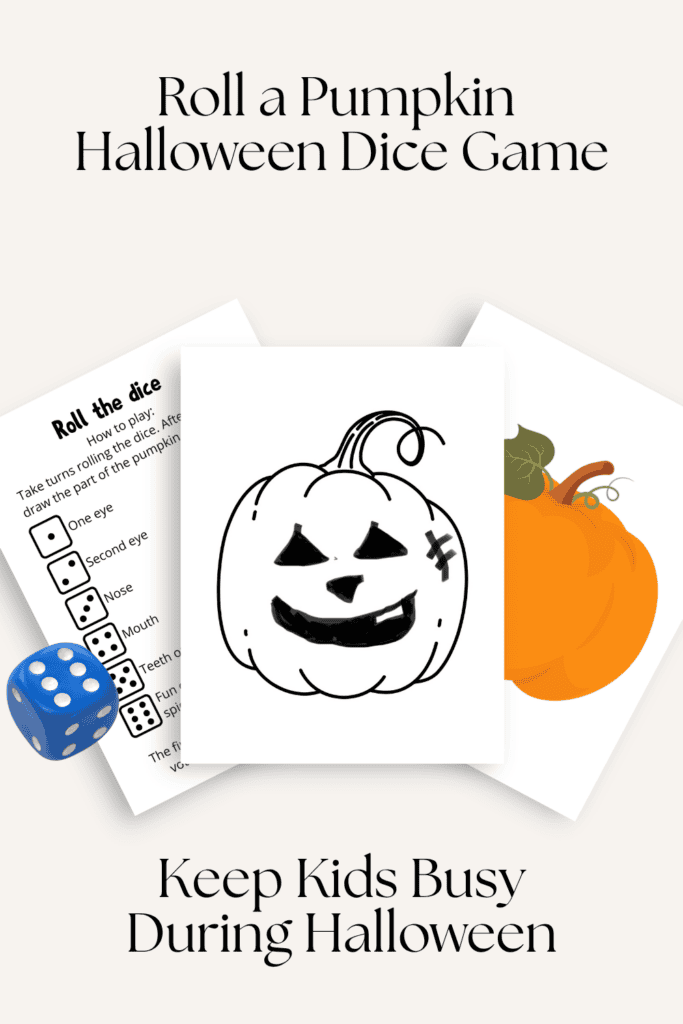
The first game I want to share is a personal favorite in my own classroom rotation: Roll a Pumpkin, sometimes called a pumpkin face dice game. The concept is simple and endlessly entertaining. Each child starts with a blank pumpkin outline. They take turns rolling a die, and each number corresponds to a different facial feature or decoration — eyes, a nose, a goofy mouth, a stem, maybe a silly hat or patch. Bit by bit, the pumpkin comes to life.
Because the order in which features appear is entirely up to the roll, no two pumpkins ever turn out the same. One child might end up with a pumpkin that has three eyes and no nose. Another might roll the same number four times in a row and end up with a very toothy grin. That randomness is exactly what makes it fun — kids love comparing their finished jack-o’-lanterns and laughing at how different they all look, even though everyone started with the same blank shape.
Beyond the giggles, there’s real learning packed into this activity:
- Fine motor practice as children color, draw, or glue on small pieces
- Visual discrimination as they match the number rolled to the correct feature on a key
- Following multi-step directions, since the game usually involves checking a chart before adding each piece
- Counting and number recognition, especially for younger players who are still connecting dots and digits
- Decision-making and creativity, particularly in versions where kids can choose colors or add extra details
- Turn-taking and classroom discussion, since kids naturally start narrating and comparing as they play
- A confidence boost, because there’s no “wrong” way to end up with a silly, unique pumpkin
This game earns its keep in a lot of different settings. I’ve used it as morning work while I take attendance, tucked it into a Halloween-themed center, and pulled it out for indoor recess on a rainy October afternoon. Homeschool families often use it as a lighter alternative to a formal art lesson, and it’s an easy option for early finishers who need something quiet and self-directed. At a classroom Halloween party, it also works beautifully as a rotating station — kids can play a quick round and move on to the next activity without any real supervision needed.
Halloween Candy Dice Game
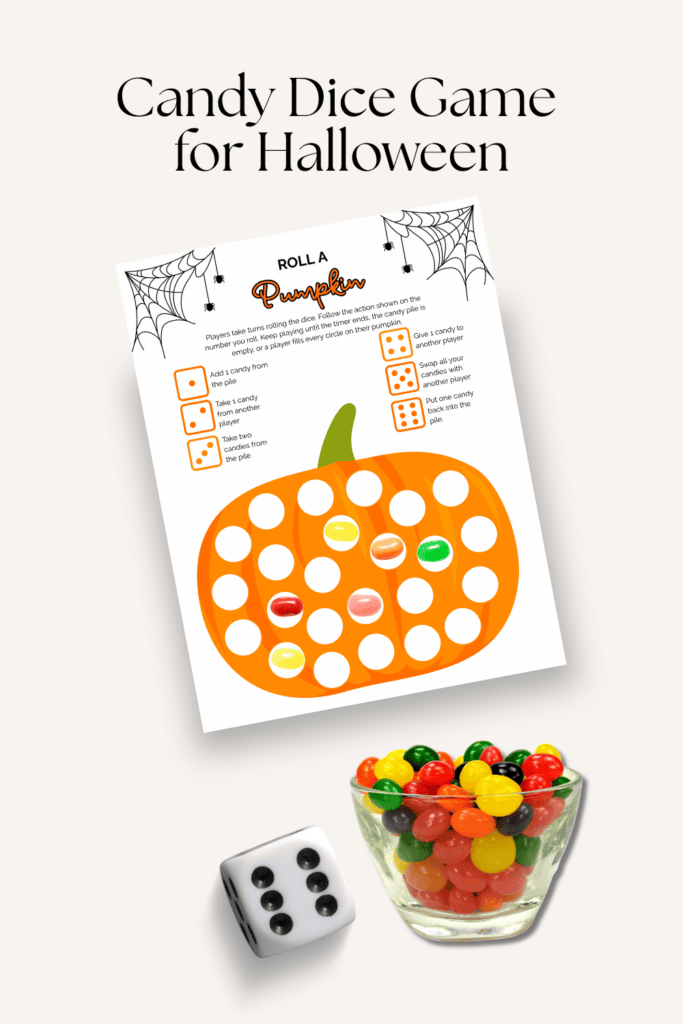
The second activity I want to highlight is our Halloween Candy Dice Game, and if your students (or your own kids at home) have any interest in candy — which, let’s be honest, is all of them in October — this one is a hit.
The setup mirrors the pumpkin game in its simplicity: children roll the die, and whatever number comes up tells them how many pieces of candy to add to their pumpkin. Maybe a roll of four means adding four candy corn pieces; a roll of two means two lollipops. Round by round, the pumpkin fills up with a colorful pile of Halloween treats, and just like with the jack-o’-lantern game, every finished pumpkin looks a little different depending on the luck of the roll.
What makes this version especially valuable is how directly it supports early math skills:
- Counting as kids track how many pieces they’ve added
- One-to-one correspondence, since each dot on the die needs to match an actual candy piece placed on the page
- Number recognition, connecting the dots on the die to a written numeral
- Visual tracking, following along as the pumpkin gradually fills with candy
- Patience, especially for kids who are eager to get to a “full” pumpkin
- Fine motor skills, through coloring, cutting, or placing small candy pieces
- Cooperative play, when kids play in pairs or small groups and compare totals
This is one of those rare activities that feels like a treat but functions like a math lesson. It’s a natural fit for math centers, and it scales nicely across preschool, kindergarten, and first grade classrooms since you can adjust expectations based on age — younger kids might just count and place candy, while older kids can add up totals or compare who ended with the most pieces. It also shines during Halloween classroom celebrations, when you want something festive that still ties back to your curriculum, and it makes a fun, low-mess option for family game night at home.
Skills Children Practice While Playing
Zooming out from these two specific games, it’s worth pausing on just how much is happening developmentally during a simple round of dice play. Between the two activities above, children are practicing:
- Counting and number recognition
- One-to-one correspondence
- Fine motor skills through coloring, gluing, and placing small pieces
- Creativity and self-expression
- Communication, as they narrate their choices and compare results with friends
- Taking turns and sharing materials
- Patience while waiting for a turn or a specific roll
- Listening skills, especially when directions are given as a group
- Following multi-step directions
- Confidence, since there’s no way to “fail” a silly pumpkin face
- Problem-solving, when a game includes any kind of choice or strategy
What I love most about this list is that none of it requires a worksheet or a drill. Kids tend to stay far more motivated when they’re focused on having fun rather than completing an assignment, and educational games take full advantage of that. The learning is real, but it doesn’t feel like “school work” — which, especially in the lead-up to a big, exciting holiday, is exactly the balance most of us are looking for.
Ways to Use Halloween Dice Games
One of the biggest advantages of printable dice games is how many different settings they fit into. A few ideas to consider:
- Classroom Halloween parties, as a rotating station alongside crafts and snacks
- Preschool centers, where kids can play independently or in small groups
- Kindergarten math stations, tying directly into counting standards
- Homeschool mornings, as a fun warm-up before more structured lessons
- Family game nights, especially with siblings of different ages
- Substitute teacher plans, since the rules are simple enough to explain in one sentence
- Library or community programs, for a quick, low-prep seasonal activity
- Indoor recess, when weather keeps everyone inside
- Early finisher activities, for kids who need something quiet and self-directed while classmates catch up
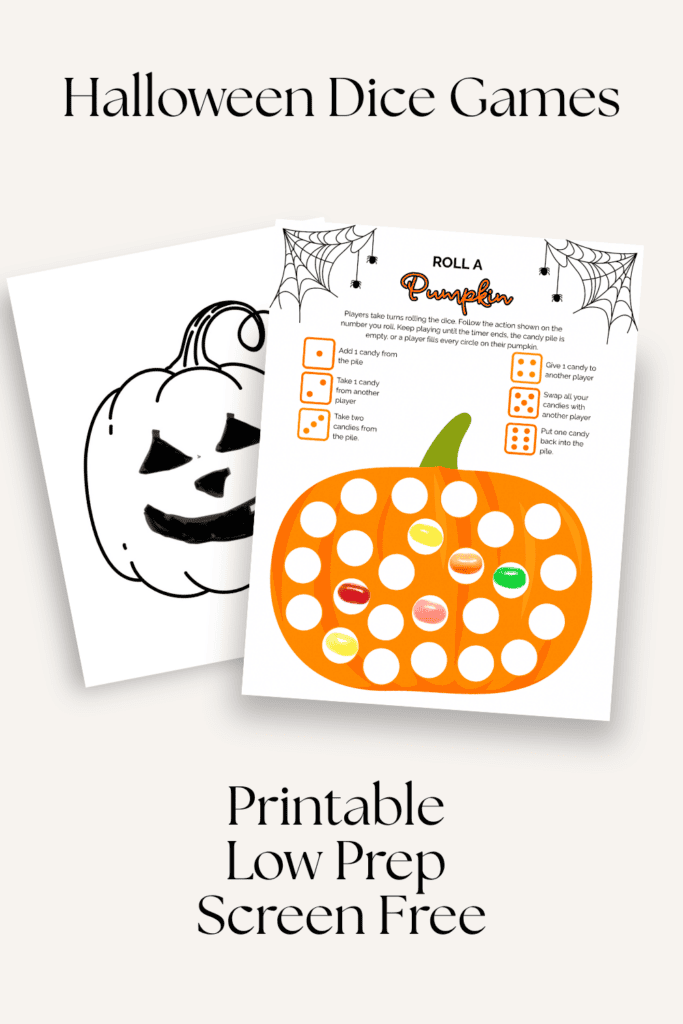
Because both games are print-and-play, you really can pull them out anywhere you have a table, a die, and a few coloring supplies.
Printing Tips
A few small choices at the printing stage can make these games last a lot longer and save you from reprinting every year.
- Print on cardstock rather than regular paper. It holds up much better to little hands, especially with repeated coloring or gluing.
- Laminate the pages if you plan to reuse them, and pair with a dry-erase marker so kids can play, wipe, and play again.
- Slide pages into page protectors as a quicker, no-laminator alternative — this works especially well for classroom centers.
- Print multiple copies if you’re using these with a full class, so several small groups can play at once instead of waiting for one shared set.
- Store the printed pages together with a die in a labeled zipper bag. This keeps everything in one place and makes the game genuinely grab-and-go for next year.
Frequently Asked Questions
Are these games suitable for preschoolers?
Yes. Both games are designed to be simple enough for preschoolers, especially with a little guidance from an adult or older sibling. Younger children may just focus on counting and placing pieces, while older kids can take on more of the game independently.
Can siblings or classmates of different ages play together?
Absolutely. Because the core mechanic — roll and match — stays the same regardless of age, these games work well in mixed-age settings like multi-grade homeschool groups or families with kids at different stages.
How long does each game take?
Most rounds take somewhere between five and fifteen minutes, depending on how many players are involved and how much they want to decorate or discuss their pumpkin along the way.
Can I laminate these printables?
Yes, and it’s a great idea if you want to reuse them across multiple classes or multiple years. Pair a laminated page with a dry-erase marker for an easy wipe-and-reuse setup.
Can these be used at a classroom Halloween party?
Definitely. They work well as a rotating station, since kids can hop in, play a quick round, and move on without much supervision needed.
Do I need any special supplies?
Not really. A single die, something to color or mark with, and the printed pages are enough to get started. If you’re using the candy version, small pom-poms or paper candy pieces can add a fun tactile element, but they aren’t required.
Are these games only for Halloween, or can they be used earlier in October?
They work well any time in October, not just on Halloween itself. Many teachers spread these out across the month as part of a broader fall or Halloween unit.
Is there a digital version, or are these print-only?
These are printable PDFs designed for print-and-play use, which keeps them screen-free and easy to prep with just a home or classroom printer.
Bringing Playful Learning into Your Halloween Season
At the end of the day, printable Halloween dice games hit a sweet spot that’s hard to find this time of year: they’re low-prep for the adult in the room and high-engagement for the kids playing. Roll a Pumpkin turns a blank jack-o’-lantern into a silly, one-of-a-kind creation, while the Halloween Candy Dice Game sneaks real counting practice into a game that feels more like a treat than a task.
Whether you’re a classroom teacher looking for a five-minute filler, a homeschool parent building out your October morning basket, or a parent hoping for a screen-free option on a chilly afternoon, these two games are worth keeping in your back pocket. They’re simple enough to pull out on short notice, flexible enough to grow with your kids, and — most importantly — genuinely fun.
If you’re looking for even more seasonal activities, there are plenty of other printable Halloween games and resources out there to round out your plans, from scavenger hunts to hands-on classroom activities. But if you only have time for one or two new things this October, these dice games are a wonderful place to start. Here’s to a playful, memorable, and refreshingly stress-free Halloween season.
Looking for an easy Halloween activity that’s ready in minutes? Both of these printable dice games are designed to be low-prep, reusable, and fun for preschool, kindergarten, homeschool, and elementary classrooms. Simply print, grab a die, and you’re ready to play.
If you’re planning an entire month of Halloween fun, printable dice games pair perfectly with Halloween scavenger hunts, finger puppets, and other hands-on seasonal activities.
Leave a Reply
You must be logged in to post a comment.