
Planning Halloween activities for a group of kids has a way of sneaking up on the calendar. Between costumes, candy, and classroom parties, coming up with enough games to fill an afternoon can feel like one more task on an already long October to-do list.
The good news is that Halloween games for kids don’t need to be complicated. You don’t need elaborate props, a stack of expensive decorations, or hours of setup the night before. A handful of simple, well-chosen games can carry a classroom party, a family Halloween night, a homeschool day, or a neighborhood get-together just fine.
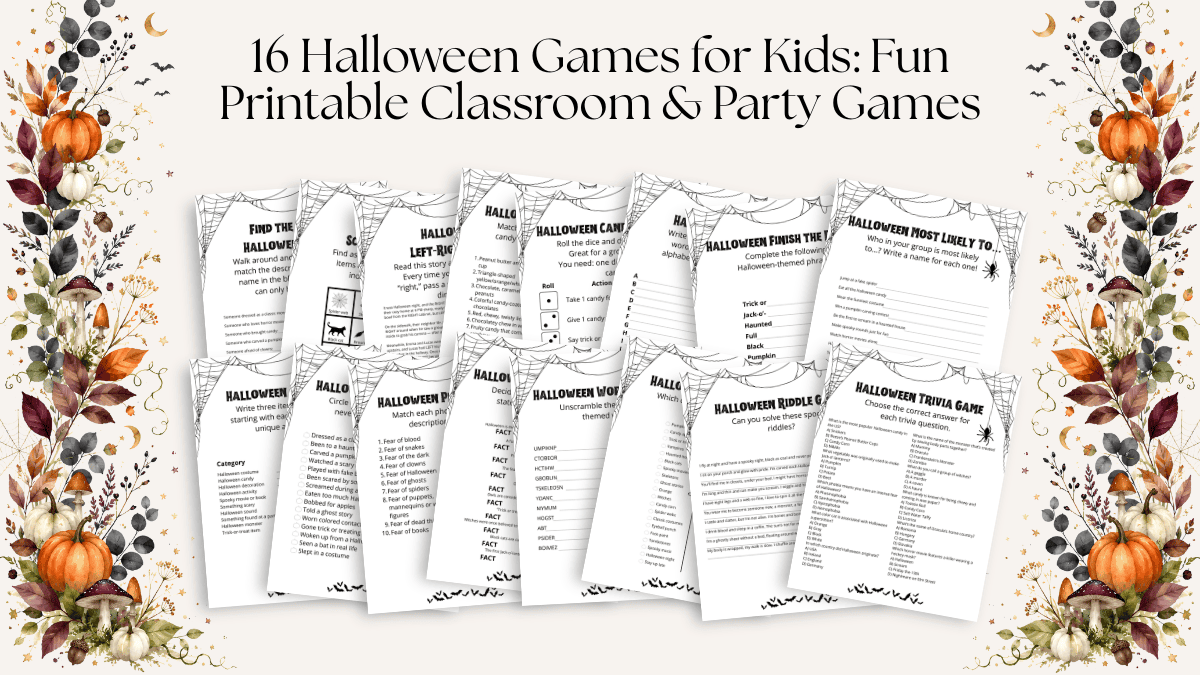
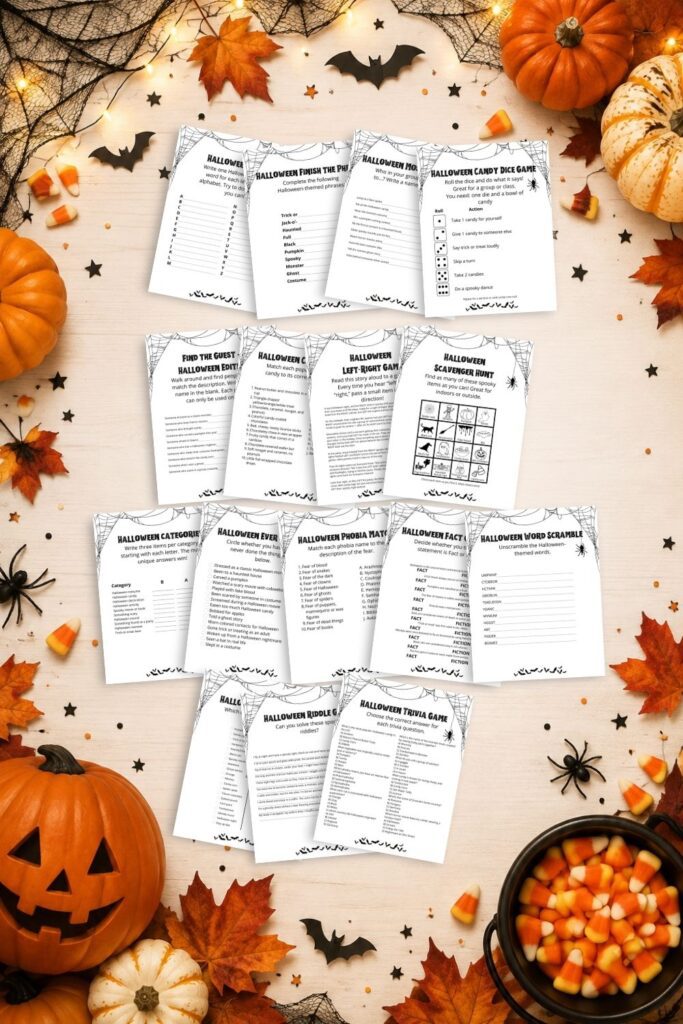
This guide walks through 16 Halloween games, including icebreakers, trivia and riddles, word games, scavenger hunts, matching activities, and a few creative options for kids who like to make up their own spooky stories. Some are quiet and work well at a table. Others get kids up and moving. All of them can be played with things you likely already have on hand, or with printable versions if you’d rather skip the prep work.
Easy Halloween Icebreaker Games
Icebreakers are especially useful anytime kids are gathered but don’t all know each other well — think classroom parties, youth group meetings, community events, or family gatherings where cousins and friends are mixing for the first time in a while. A short icebreaker at the start of a party gives kids something easy to do together before diving into bigger activities.
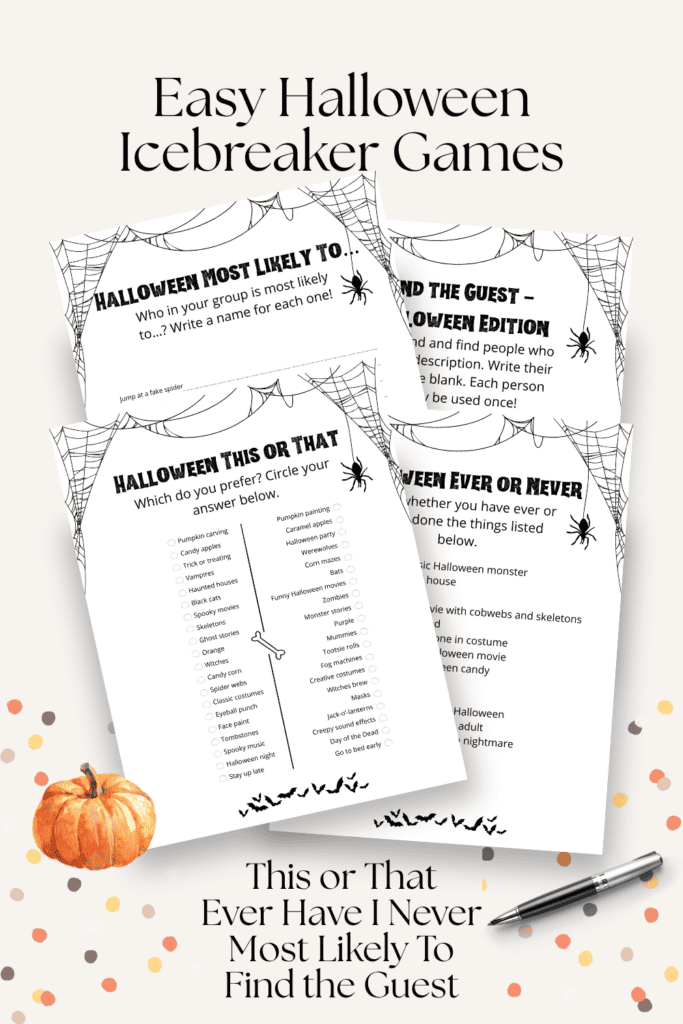
Halloween This or That
This or That is about as simple as party games get. Kids are given two Halloween-themed options and have to pick one. A few examples:
- Would you rather visit a pumpkin patch or a haunted house?
- Candy corn or chocolate?
- Friendly ghost or silly monster?
- Trick-or-treating in the rain or trick-or-treating in the cold?
- Carve a pumpkin or paint one?
This or That can be played several ways. Kids can raise their hands for each option, physically move to different sides of the room based on their answer, mark their choices on a printed answer sheet, or talk through their picks in small groups. Because there’s no wrong answer, it’s a low-pressure way to get kids talking and making quick decisions, and it works whether you have five kids or thirty.
Ever Have I Never – Halloween Edition
This is a gentle, kid-friendly twist on the classic “never have I ever” format, built around Halloween experiences instead. A leader reads a statement, and kids respond based on whether it applies to them — for example, by holding up a finger, standing up, or simply raising a hand. A few examples:
- Ever have I never carved a pumpkin.
- Ever have I never worn a homemade Halloween costume.
- Ever have I never visited a corn maze.
- Ever have I never gone trick-or-treating in the rain.
- Ever have I never tried a caramel apple.
Because the statements are all everyday Halloween experiences rather than anything personal or embarrassing, this works well as a low-pressure way for a group to find out what they have in common. It’s an easy game to lead with no materials beyond a list of prompts.
Most Likely To… Halloween Game
In this game, players decide who among the group is “most likely” to do something funny and Halloween-related — for example, who’s most likely to trip over their own costume, who’s most likely to eat all their candy on the first night, or who’s most likely to jump at a fake spider. Kids can point to their answer, vote by show of hands, or write a name on a small card.
The key to keeping this game fun rather than awkward is sticking to lighthearted, silly prompts rather than anything that could single a child out in a negative way. Framed that way, it works well for families, groups of friends, and older elementary kids who enjoy a little friendly ribbing.
Find the Guest
Find the Guest is a mingling activity, similar to a bingo-style “find someone who” game. Kids are given a card with several Halloween-related statements — things like “has a black cat” or “has been to a haunted house” — and they walk around asking each other questions to find a match for each one.
Because it requires kids to get up, talk to multiple people, and actively search for answers, it’s a great choice for encouraging movement and conversation at the start of a party. It works particularly well for larger groups, where there are plenty of people to talk to and compare notes with.
Halloween Brain Games, Riddles & Trivia
For kids who enjoy puzzles, facts, and a bit of friendly competition, this next set of games leans more toward thinking than moving. They’re a natural way to slow the pace down after a high-energy icebreaker.
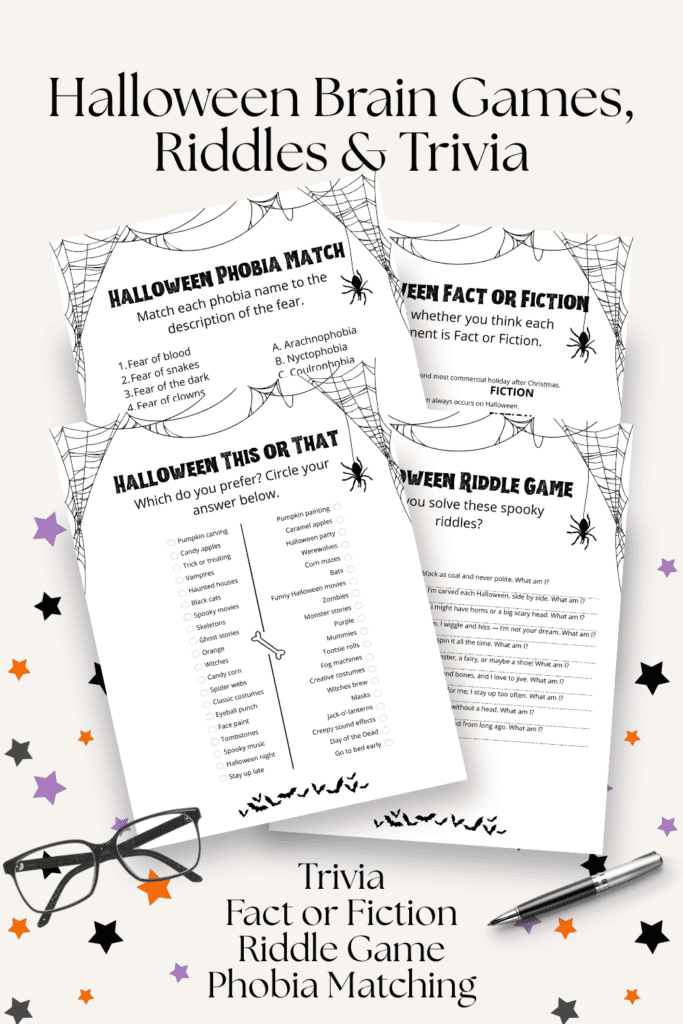
Halloween Trivia Game
Trivia can be played individually, in small teams, or as one big group answering together out loud. Questions might cover pumpkins, Halloween traditions, nocturnal animals, autumn facts, costumes, candy history, or spooky-but-kid-friendly topics like bats and spiders. Teams can keep score if you want a competitive element, or you can simply read questions aloud for fun with no scorekeeping at all.
Trivia is flexible enough to stretch or shrink depending on how much time you have — a few rounds can fill five minutes, or you can build out a longer set of questions for a full party station.
Halloween Fact or Fiction
This game takes trivia a step further by asking kids to decide whether a Halloween-themed statement is true or false. A leader reads a statement, kids vote (often by standing for “true” and sitting for “false,” or holding up colored cards), and then the answer is revealed.
Having kids commit to an answer before finding out if they’re right adds a little suspense and combines guessing with learning in a way that keeps interest up, especially for a mixed-age group.
Halloween Riddle Game
Riddles are a good fit for elementary-age kids because they ask children to use vocabulary, inference, and problem-solving all at once — skills that are worth practicing in a way that still feels like play. A couple of simple, original examples:
I have a round orange body and a curly green stem, and in October you might see me sitting on a porch. What am I?
I fly at night, I sleep upside down, and some people think I look a little like a mouse with wings. What am I?
Riddles can be read aloud one at a time to a group, printed on cards for kids to work through at their own pace, or used as a quick brain break between other activities.
Phobia Matching
Phobia Matching is a vocabulary-style matching game where kids match the names for common fears with what they actually mean — for instance, matching a fear’s name to a short definition or a related picture. It’s a fun way to introduce some slightly unusual vocabulary while keeping things educational rather than mocking.
Because it involves more reading and abstract matching, this game tends to work better with older elementary kids, tweens, or family groups than with very young children. Keeping the tone light and treating real fears with respect, rather than turning them into a joke, helps this stay a genuinely fun activity for everyone playing.
Halloween Word Games
Word games are some of the easiest Halloween classroom activities to pull off because they require almost no setup — often just paper and a pencil, or a printable sheet.
Halloween A to Z Game
In this game, players try to think of a Halloween or fall-related word for each letter of the alphabet — B for bat, C for candy, G for ghost, and so on. A few letters are trickier than others, which is part of the fun.
This one is easy to adjust depending on your group: kids can play individually, work with a partner, compete in teams, or race against a timer for an added challenge. It also works well as a quiet warm-up activity while kids are settling in.
Halloween Categories
Categories is similar to A to Z, but instead of working through the alphabet, players brainstorm words that fit a specific Halloween-themed category. A few examples:
- Halloween costumes
- Things that are orange
- Things you might see at night
- Fall foods
- Halloween characters
Players (or teams) try to come up with as many answers as they can in a set amount of time. It’s a good way to encourage vocabulary and quick thinking, and it naturally sparks some fun back-and-forth as kids compare their lists.
Halloween Word Scramble
A word scramble takes Halloween-related words and mixes up the letters, challenging kids to figure out the original word. Because it’s quiet and self-paced, it makes a genuinely useful early finisher activity, a station at a classroom party, a quiet seatwork option, or a bit of morning work during the weeks leading up to Halloween. It also gets in some natural spelling and vocabulary practice without feeling like a worksheet.
Interactive Halloween Party Games
This next group involves a bit more movement, interaction, or hands-on play — good for balancing out the quieter games above.
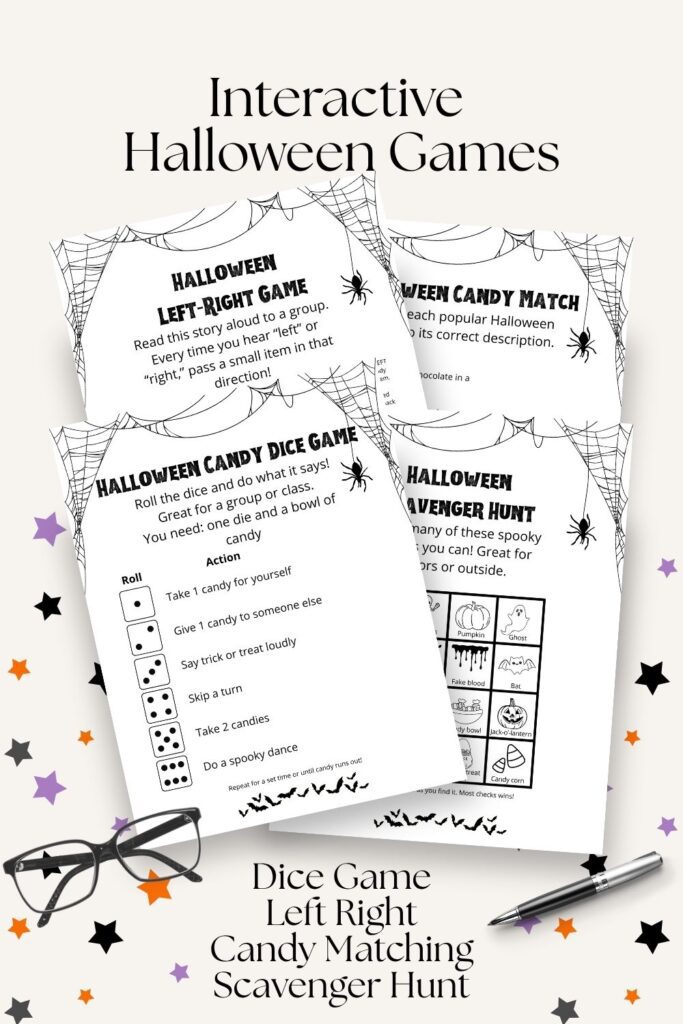
Halloween Candy Dice Game
This Halloween Candy Dice Game turns a bowl of candy and a single die into a simple group game. Each number on the die corresponds to a different action, so players never know quite what their next turn will bring.
Depending on the roll, a player might take a piece of candy, give one to someone else, skip a turn, say “trick or treat” out loud, or even do a spooky dance. The mix of candy and silly actions adds an element of surprise to every round and makes this game especially well suited to Halloween parties, classroom celebrations, and small groups.
Setup is simple: all you need is the game sheet, one die, and a bowl of candy. Players take turns rolling the die and following the matching instruction. You can decide in advance how long to play or simply keep going until the candy bowl is empty.
Because the rules are easy to follow and each turn is quick, this is a useful option when you want an interactive Halloween party game without a complicated setup. It also gives kids opportunities to practice taking turns, following directions, and interacting with the group while enjoying a few silly Halloween moments along the way.
If your kids especially enjoy roll-and-play activities, you can also explore my guide to Halloween Dice Games for Kids.
Halloween Scavenger Hunt
Scavenger hunts work especially well for Halloween because there are so many seasonal items to search for — pumpkins, spiders, black cats, candy corn, and more. A scavenger hunt can be set up indoors or outdoors, at home, at school, or as part of a larger party, and it can be adapted for a single child, a small group, or a whole class working in teams.
Beyond just being fun, scavenger hunts naturally build in teamwork, movement, observation skills, and a bit of problem-solving as kids figure out clues or search a space methodically.
Read also more about Halloween Scavenger Hunt Clues here.
Left-Right Halloween Game
This is a classic passing game with a Halloween twist. Kids sit in a circle while a leader reads a Halloween-themed story aloud. Whenever the story mentions “left,” players pass an object to the left; whenever it mentions “right,” they pass it to the right. A small prize, a Halloween trinket, or even just a plastic pumpkin can be the object being passed.
Because it only requires a story and something to pass around, it’s an easy game for parties, classrooms, or family gatherings, and it keeps kids listening closely since they never know when the next direction is coming.
Halloween Candy Matching Game
The Halloween Candy Matching Game puts a sweet twist on a classic guessing game. Instead of simply matching identical pictures, players read a series of clues and try to figure out which candy each clue is describing.
Each clue points toward a familiar type of candy, and players need to use the hints, think about the possibilities, and match each clue with the correct answer. Some may be easy to recognize right away, while others require a little more thought.
This makes the game a fun choice for kids who enjoy riddles, wordplay, and guessing games. Along the way, players practice reading comprehension, making connections, using context clues, and logical thinking without the activity feeling like a traditional worksheet.
The Candy Matching Game works especially well as a quiet Halloween party station, a small-group challenge, or an individual activity. Kids can work through the clues independently, compare answers with a partner, or play in teams and see how many candies they can correctly identify.
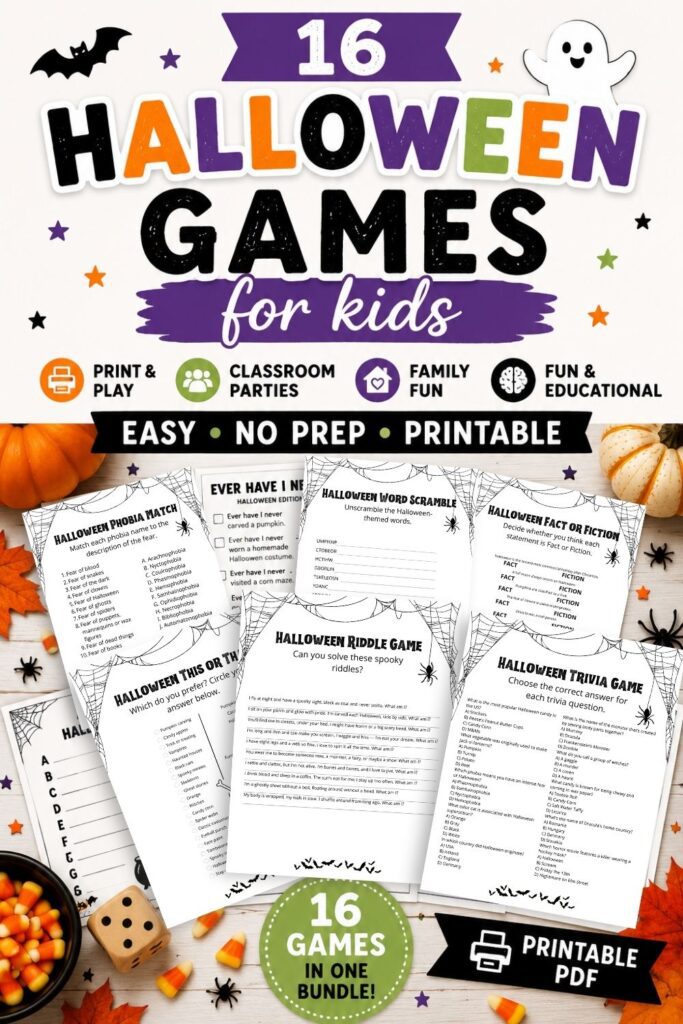
Want to keep Halloween prep simple? These games are also available together in one printable 16-game Halloween bundle, so you can choose a few favorites or set up several different party stations without creating each activity from scratch.
Creative Halloween Games
Spooky Story Game
Collaborative storytelling turns easily into a Halloween game. One common approach is round-robin storytelling, where each player adds a single sentence to build a story together. You can also give kids a set of Halloween story prompts to choose from, use dice to randomly select story elements like a character or setting, or have kids draw cards that determine who or what appears next in the tale.
The goal is to keep the stories fun and spooky rather than genuinely scary — silly ghosts and clumsy monsters tend to work better than anything too intense, especially for younger kids. Along the way, this kind of game builds imagination, storytelling skills, vocabulary, listening, and creativity, all through something that feels more like play than practice.
Quick Comparison: Which Halloween Game Should You Choose?
| Game | Best For | Group Size | Energy Level | Main Skill / Activity |
|---|---|---|---|---|
| This or That | Icebreaker | Small or large groups | Medium | Conversation |
| Ever Have I Never | Icebreaker | Small or large groups | Low | Conversation |
| Most Likely To | Icebreaker | Families, friend groups | Medium | Conversation |
| Find the Guest | Mingling activity | Larger groups | High | Movement, conversation |
| Trivia | Classroom party | Individuals or teams | Low | General knowledge |
| Fact or Fiction | Classroom or party | Whole group | Low | Guessing, learning |
| Riddle Game | Quiet or group activity | Individuals or groups | Low | Critical thinking, vocabulary |
| Phobia Matching | Older kids, families | Individuals or pairs | Low | Vocabulary, matching |
| A to Z Game | Quiet activity | Individual, partner, or team | Low | Vocabulary, quick thinking |
| Categories | Classroom or party | Individuals or teams | Low | Vocabulary, quick thinking |
| Word Scramble | Quiet activity | Individual | Low | Vocabulary, spelling |
| Dice Game | Roll-and-play activity | Individual or small group | Medium | Fine motor, following directions |
| Scavenger Hunt | Active party | Small or large groups | High | Observation, teamwork |
| Left-Right Game | Party or classroom | Circle/whole group | Medium | Listening |
| Candy Matching | Guessing game | Individual, pairs, or teams | Low | Reading comprehension, context clues |
| Spooky Story | Creative activity | Small or large groups | Low to medium | Imagination, storytelling |
How to Choose Halloween Games for Your Group
Age. Some activities, like This or That, Left-Right, and Candy Matching, are easy enough for younger children to jump into right away. Others — trivia, phobia matching, categories, and word games — tend to work better with confident readers or older kids who can process a bit more language and abstract thinking.
Group size. Games like the Riddle Game and Word Scramble work well for individuals or quiet pairs. This or That, Trivia, and Fact or Fiction adapt easily to whole-class or whole-party settings. Find the Guest and the Scavenger Hunt are especially good choices when you have a larger group to fill with activity.
Energy level. It helps to balance high-energy games with quieter table activities so kids (and adults) get a chance to catch their breath. A Scavenger Hunt followed by a Word Scramble or a round of Trivia is a natural way to alternate movement with calmer, seated time.
Time available. Not every game needs to fill twenty minutes. This or That and Ever Have I Never can work as quick five-minute fillers, while a Scavenger Hunt or Spooky Story session might stretch into a longer, more involved activity. Having a mix of short and long options makes it easier to fill whatever time slot you’re working with.
Preparation. However you plan to run things, having instructions and materials ready in advance makes a real difference on a busy day. Printable Halloween games can cut down on prep significantly, since the game cards, instructions, and any matching pieces are already put together for you.
How to Use These Games at a Halloween Classroom Party
One practical way to run a Halloween classroom party is to set up several rotating stations, giving small groups of kids a chance to try a few different activities over the course of the party instead of doing one big group game the whole time. For example:
- Station 1: Scavenger Hunt
- Station 2: Trivia
- Station 3: Word Game (Categories or Word Scramble)
- Station 4: Dice Game
- Station 5: Spooky Story
Rotating through stations in small groups can make a classroom party easier to manage than one large activity for the whole room, and it gives kids a mix of active, quiet, and creative experiences instead of just one type of game for the entire party.
More Ways to Use Printable Halloween Games
Classroom parties are only one use for this kind of game. The same activities can fit into:
- Family Halloween nights
- Homeschool days
- Library or community programs
- Youth group meetings
- Rainy October afternoons
- Early finisher time at school
- Indoor recess
- October brain breaks
- Multigenerational family gatherings
Because most of these games are flexible in group size and setup, the same set of printables can move from a classroom to a living room to a community center without much adjustment.
16 Printable Halloween Games for Kids in One Bundle
If these ideas sound useful but you’d rather not spend time creating each game from scratch, I’ve put all 16 activities together in one printable Halloween Games Bundle. It includes all of the games covered in this guide — Dice Game, Scavenger Hunt, Left-Right Game, This or That, Ever Have I Never, Fact or Fiction, A to Z Game, Riddle Game, Trivia Game, Most Likely To, Candy Matching, Phobia Matching, Spooky Story, Halloween Categories, Find the Guest, and Word Scramble — designed to print easily and use right away.
Having a mix of quiet and interactive activities already prepared can be especially handy for classroom parties, family gatherings, or any group setting where you want variety without having to plan sixteen separate games yourself.
Frequently Asked Questions About Halloween Games for Kids
What are some easy Halloween games for kids?
This or That, Ever Have I Never, and Word Scramble are all good starting points. They require little to no setup and can be explained to a group in under a minute.
What Halloween games work well in a classroom?
Trivia, Fact or Fiction, Categories, and station-based activities like a Scavenger Hunt tend to work well in a classroom setting because they can involve the whole group and don’t need much space.
What are good Halloween games for large groups?
Find the Guest, Scavenger Hunt, and This or That all scale up nicely for bigger groups since they don’t rely on one-on-one turns.
What Halloween games require very little preparation?
Ever Have I Never, This or That, Most Likely To, and Left-Right Game can all be played with little more than a list of prompts or a short story to read aloud.
Can these games be used for a family Halloween party?
Yes. Most of the games in this guide adapt easily to smaller family groups and mixed ages, especially This or That, Trivia, Categories, and Spooky Story.
Which Halloween games are best for quiet time?
Word Scramble, Candy Matching, and the Riddle Game are all naturally quiet, table-friendly options.
What supplies do I need for printable Halloween games?
Most printable games only need paper, something to write with, and occasionally dice or small tokens. Printable versions typically include everything needed to play without much extra preparation.
Can I use Halloween games with mixed-age groups?
Yes, many of these games flex well across ages. Simpler games like This or That and Left-Right work for younger kids, while Trivia, Riddles, and Phobia Matching can be adjusted for older kids by changing the difficulty of the questions.
Final Thoughts
A memorable Halloween celebration doesn’t require complicated preparation. A mix of active games, quiet games, word games, and a bit of creative storytelling can carry a party or classroom celebration from start to finish without anyone running out of things to do.
You don’t need all 16 games for a single event — pick a few that fit your group and the time you have, or use several as rotating stations for a longer party. Either way, a little variety goes a long way toward keeping kids of different ages and interests engaged throughout the day.
Leave a Reply
You must be logged in to post a comment.