Halloween has a way of making young children pay attention. The vocabulary is vivid, the images are familiar, and the anticipation builds for weeks, which makes it an unusually good theme to build learning around. A single Halloween unit study can connect literacy, early math, fine motor practice, science vocabulary, and craft work under one seasonal thread, so a child who traces a pumpkin letter on Monday might count pumpkin seeds on Tuesday and talk about the pumpkin life cycle on Wednesday. Seeing the same handful of images and words show up across different subjects gives children a chance to build familiarity instead of starting from scratch with every new activity.
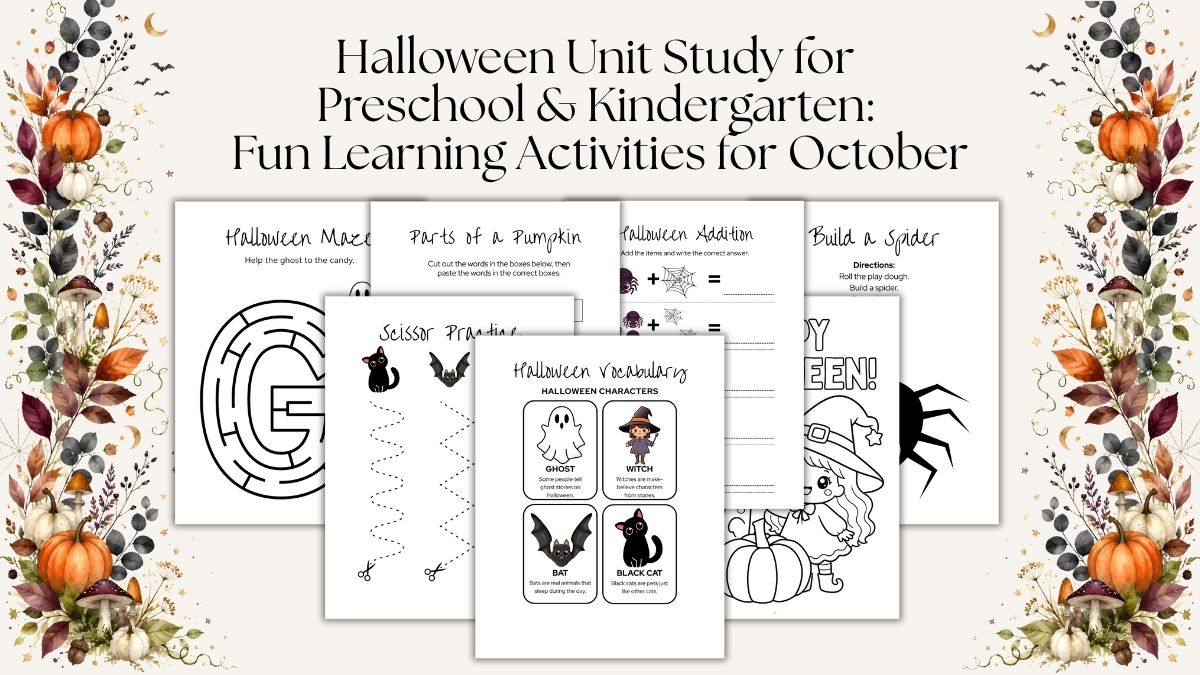
This guide walks through what a well-organized Halloween unit study can include for preschool and kindergarten, using a printable Halloween Unit Study as a concrete example of how the pieces fit together. Alongside that, you’ll find optional hands-on ideas — sensory bins, simple pumpkin experiments, dramatic play — that can extend the theme beyond the printed pages for anyone who wants to add more hands-on time to the week.
What Is a Halloween Unit Study?
A unit study is a way of organizing learning around one central theme instead of switching topics from one activity to the next. Rather than a math worksheet with no connection to the reading activity that came before it, everything ties back to the same seasonal idea. For young children, that repetition of vocabulary and imagery can help build confidence, since a word or picture introduced during a literacy activity might reappear later in a math or science activity the same day.
A Halloween unit study in particular gives children opportunities to practice a wide range of skills — tracing, counting, sequencing, sorting, simple science vocabulary — without needing a brand new context for each one. For teachers and homeschool parents, this can also make October lesson planning considerably simpler, since a single set of materials can cover several subjects instead of requiring separate planning for each one.
Halloween Literacy Activities for Preschool & Kindergarten
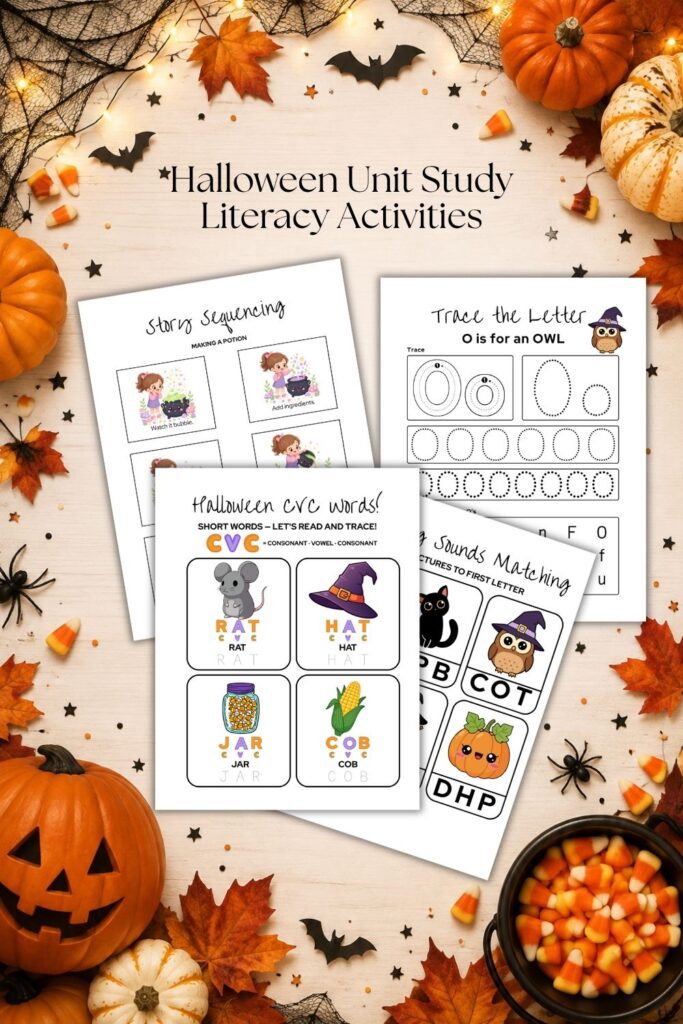
Literacy is usually where a Halloween unit study earns its keep, since seasonal vocabulary tends to be short, visual, and easy to illustrate. The printable Halloween Unit Study includes a set of literacy activities that move from letter recognition through early sentence work, which makes it easy to pick and choose based on where a child currently is.
Letter Tracing
The printable includes six Halloween-themed letter tracing pages: B is for Bat, C is for Cat, G is for Ghost, O is for Owl, P is for Pumpkin, and W is for Witch. Each page pairs uppercase and lowercase letter recognition with tracing practice and letter formation, and the seasonal picture on each page gives children a visual anchor for the sound. This isn’t a full alphabet set — it’s a focused group of six letters tied to Halloween vocabulary, which works well as a supplement to whatever letter work is already happening during the rest of the month.
Beginning Sounds
A beginning sounds matching activity asks children to match Halloween pictures to their first letter. Picture-based matching like this can support early phonemic awareness by asking children to isolate the initial sound of a word before connecting it to a letter, which is a useful step on the way toward blending sounds later on.
Halloween CVC Words
The unit includes simple consonant-vowel-consonant words with seasonal or fall imagery, including cat, web, pot, bat, rat, hat, jar, and cob. These short words give early readers a chance to trace, read, and practice recognizing the CVC pattern, which is often one of the first decoding patterns children work through as they move from letter sounds to full words.
Halloween Sentences
Short sentence tracing and writing pages give children practice connecting pictures, words, and independent writing. Predictable sentence structures — the kind that repeat familiar vocabulary from earlier in the unit — can make this an approachable next step for children who have already worked through the CVC words and beginning sounds activities.
Story Sequencing
Two sequencing activities are included: Getting Ready for Trick-or-Treat and Making a Potion. Children cut apart picture cards and put them in order, which builds sequencing vocabulary like first, next, and last alongside storytelling, comprehension, and oral language practice as they explain the order they chose.
Read and Draw
In this activity, children read a simple sentence and draw what it describes. It’s a small but useful check on reading comprehension, since drawing the scene requires actually understanding the sentence rather than just decoding the words on the page.
If you’re looking to round out literacy time beyond these pages, a themed read-aloud or two, paired with a simple word wall of Halloween vocabulary, can work well as an informal extension — though these aren’t part of the printable itself.
Halloween Math Activities
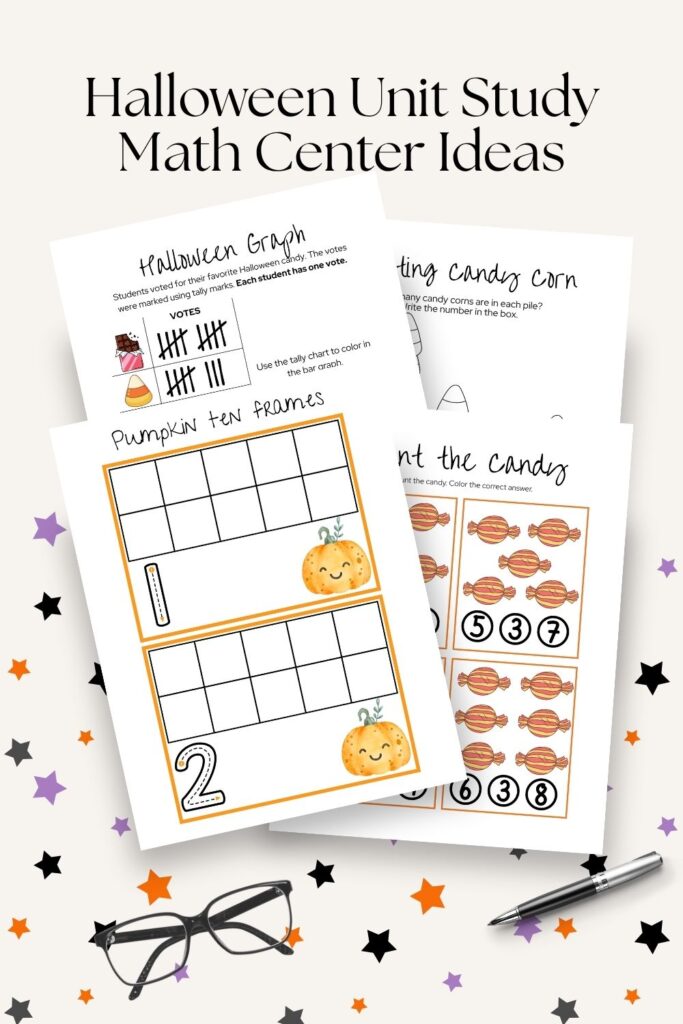
The math activities in the printable Halloween Unit Study cover number recognition, counting, and a few early operations, all dressed up in pumpkin, candy corn, and spider imagery.
Pumpkin Ten Frames
Pumpkin-themed ten frames support number recognition, counting, and one-to-one correspondence as children fill in or read the frames. Ten frames are a common early math tool because they give children a consistent visual structure for building number sense, and the pumpkin theme just makes that structure a little more inviting.
Counting Candy Corn
In this counting activity, children count groups of candy corn and record the number, which reinforces one-to-one correspondence and numeral writing at the same time.
Odd or Even
A cut-and-paste spider activity sorts numbers into odd and even groups. This concept tends to suit kindergartners or children who are already comfortable with counting and are ready to start noticing number patterns, so it may not be the first activity to reach for with younger preschoolers.
Halloween Addition
Picture-based addition problems let children combine visual objects — pumpkins, bats, candy — rather than working with abstract numbers alone, which can make early addition more concrete for children just starting to combine quantities.
Halloween Patterns
A cut-and-paste pattern activity asks children to complete a sequence, building visual reasoning and an early sense of what comes next in a repeating pattern.
Halloween Graph and Counting Activities
A simple Halloween graph introduces early data concepts, giving children practice reading and interpreting a basic visual chart, alongside additional counting pages that reinforce number recognition throughout the unit.
If you want to extend math time with something hands-on, measuring a real pumpkin’s circumference or comparing pumpkin weights with a simple scale can pair nicely with the ten frames and counting pages — more on that in the extension ideas below.
Halloween Fine Motor Activities
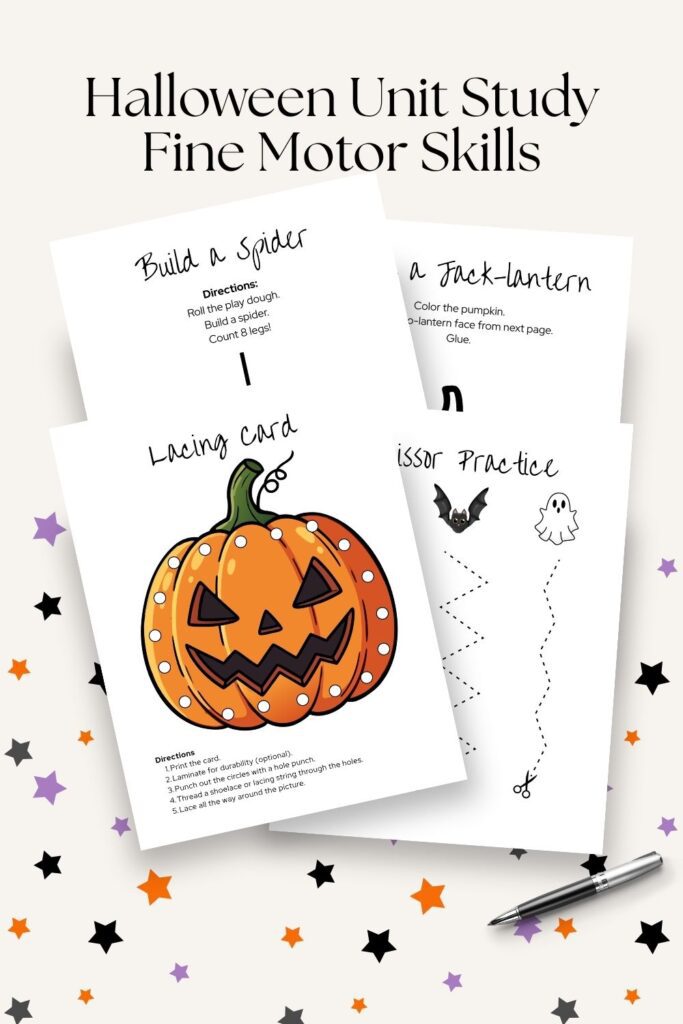
Fine motor practice supports the hand strength and control children will eventually need for handwriting, and the printable includes several seasonal activities built around that goal.
Scissor Practice
A seasonal cutting page gives children practice with controlled scissor movements, which is a skill that develops gradually and benefits from short, repeated practice sessions rather than one long one.
Lacing Card
A Halloween-themed lacing card builds hand-eye coordination and finger control as children thread string or yarn through the card.
Build a Spider
The Build a Spider activity is a Halloween-themed playdough mat that gives children a hands-on way to create their own spider while practicing fine motor control. Children can roll and shape playdough to add spider legs, body parts, or other details directly on the mat.
Halloween Maze
A maze activity supports pencil control, planning, and visual tracking as children follow a path from start to finish.
Build a Jack-O’-Lantern
Another cut-and-paste activity, this one lets children build their own jack-o’-lantern, combining creativity with the same fine motor skills used throughout the unit.
A playful face-building or drawing activity rounds out the fine motor section, giving children room to make creative choices while still practicing the same underlying hand control.
None of these activities are meant as therapeutic exercises — they’re simply everyday practice opportunities dressed up in a Halloween theme, the same way any preschool or kindergarten fine motor page would be.
Halloween Science & Theme Learning
The theme-learning section of the printable introduces a few simple science and vocabulary concepts connected to Halloween, kept appropriately light for preschool and kindergarten audiences.
What Is Halloween?
A short, age-appropriate introduction to Halloween gives children some basic context for the theme they’ve been working with throughout the unit.
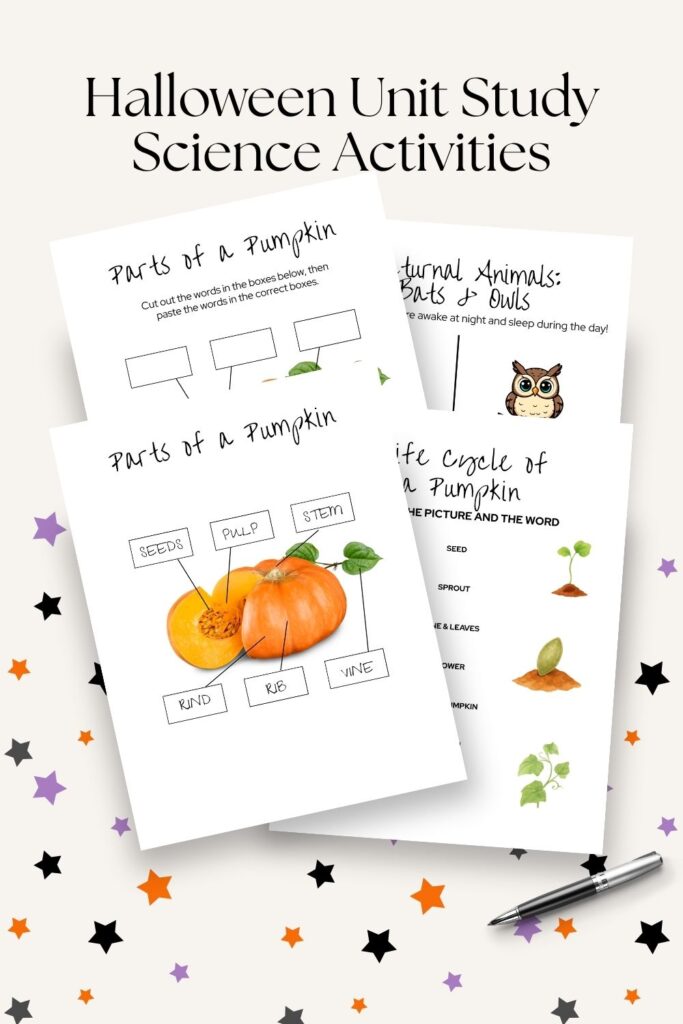
Life Cycle of a Pumpkin
This activity walks through the stages of a pumpkin’s growth — seed, growth, vine, flower, and pumpkin — connecting the Halloween theme to real seasonal science rather than treating the pumpkin as just a decoration.
Parts of a Pumpkin
Children explore basic plant vocabulary and observation skills by identifying the different parts of a pumpkin, building on the life cycle activity that comes before it.
Halloween Vocabulary Cards
A set of vocabulary cards supports discussion, matching, and word wall use, giving children repeated exposure to the seasonal words that show up throughout the rest of the unit.
Nocturnal Animals: Bats & Owls
Bats and owls are real animals that connect naturally to Halloween imagery, and this section introduces basic facts about them along with a True or False activity that checks understanding in a low-pressure way.
The science content here stays intentionally simple — this is theme learning and vocabulary building for preschool and kindergarten, not an in-depth science unit.
Halloween Craft & Coloring Activities
The printable rounds out with two craft and coloring pieces designed to give children a lower-pressure activity after the more structured literacy and math work.
Haunted House — Color by Instruction
This activity combines listening or reading with following directions, coloring, and visual attention, as children color a haunted house scene according to a set of instructions.
Happy Halloween Coloring Page
A simple coloring page offers a calm, low-prep activity that works well for morning work, quiet time, early finishers, or a relaxed way to close out the unit.
If you’d like to add more craft time beyond these two pages, handprint spiders, paper pumpkins, simple ghost cutouts, or basic collage work all pair naturally with the theme — these are optional extension ideas rather than part of the printable itself.
What’s Included in This Printable Halloween Unit Study?
Taken together, the activities above show how a Halloween unit study can organize a full range of preschool and kindergarten skills under one theme. Here’s how the printable breaks down by category:
- Literacy & Early Reading: six Halloween letter tracing activities, beginning sounds matching, Halloween CVC words, Halloween sentences, two story sequencing activities, and Read and Draw
- Early Math: pumpkin ten frames, counting candy corn, odd or even, Halloween addition, Halloween patterns, a Halloween graph, and additional counting activities
- Fine Motor & Hands-On Learning: scissor practice, a lacing card, build a spider, a Halloween maze, build a jack-o’-lantern, and jack-o’-lantern faces
- Science & Theme Learning: What Is Halloween?, the pumpkin life cycle, parts of a pumpkin, Halloween vocabulary cards, and a bats and owls section with a True or False activity
- Craft & Coloring: a haunted house color-by-instruction page and a Halloween coloring page
Having this range of activities organized under one theme makes it easier to choose based on a child’s age, current skill level, how much time is available, and whether you’re working in a classroom or a homeschool setting. You don’t need to use every page in one sitting — picking two or three activities a day, as outlined in the weekly plan below, tends to work better than trying to fit everything into a single afternoon.
If you’d rather have these activities already organized, the printable Halloween Unit Study brings the literacy, math, fine motor, science, and craft pieces together in one resource.
Optional Hands-On Activities to Extend the Unit
The ideas below aren’t part of the printable, but they pair naturally with the theme for anyone who wants to add more hands-on time to the week.
Pumpkin Investigation
Cutting open a real pumpkin gives children a chance to explore the outside and inside, the seeds, the texture, the smell, and the size, all through direct observation rather than a worksheet.
Pumpkin Sink or Float
A simple prediction-and-observation activity: will the pumpkin sink or float in a bucket of water? Children guess first, then test their prediction.
Halloween Sensory Bin
A bin filled with dry rice, black beans, pumpkin seeds, scoops, and small plastic Halloween objects gives children an open-ended sensory experience that also supports fine motor skills through scooping and pouring.
Play Dough
Halloween cookie cutters, or a simple build-a-spider or build-a-pumpkin challenge using play dough, adds another hands-on option that doesn’t require much setup.
Dramatic Play
A pretend potion shop, pumpkin market, or costume corner can extend the theme into imaginative play, giving children a chance to use Halloween vocabulary in a more open-ended, conversational way.
How to Use the Halloween Unit Study Across One Week
Here’s one way to spread the printable’s activities across a week, pairing a couple of activities each day rather than trying to fit everything in at once.
| Day | Focus | Sample Activities |
|---|---|---|
| Monday | Literacy + Fine Motor | Letter tracing, beginning sounds, scissor practice |
| Tuesday | Math + Craft | Pumpkin ten frames, counting candy corn, build a jack-o’-lantern |
| Wednesday | Science/Theme + Vocabulary | Pumpkin life cycle, parts of a pumpkin, Halloween vocabulary cards |
| Thursday | Literacy + Math Review | CVC words, Halloween sentences, patterns or addition |
| Friday | Games + Favorite Activities + Coloring | Story sequencing, maze, coloring page, optional Halloween game |
For younger preschoolers, it’s fine to choose just one or two activities per day rather than following the full plan — the point is to make the week manageable, not to check off every page.
How to Adapt the Unit for Preschool vs Kindergarten
The same set of activities can flex across a fairly wide age range with a few adjustments in focus.
Preschool
Younger children may be ready to focus more on tracing, picture matching, counting, fine motor pages, vocabulary exposure, coloring, and sequencing activities with some adult support along the way.
Kindergarten
Kindergartners can typically take on more of the CVC reading, sentence writing, independent sequencing, addition, odd and even sorting, graphing, and science vocabulary pieces, depending on where each child is developmentally.
These aren’t rigid age requirements — a given child may be ready for some kindergarten-level activities while still benefiting from preschool-level support on others, so it’s worth adjusting based on the individual child rather than the grade label alone.
More Halloween Activities to Pair With Your Unit Study
If you’re looking to round out the week with a few extra activities outside the core unit, a few options pair naturally with the theme: Halloween Dice Games for Kids for quick math practice, 16 Halloween Games for Kids for a wider mix of game-based learning, and a Halloween Scavenger Hunt for a movement-based break between quieter activities. Halloween Finger Puppets and Halloween Handprint Art are also worth exploring if you’d like to add more craft or dramatic play time to the week.
Frequently Asked Questions About Halloween Unit Studies
What age is this Halloween unit study for?
The activities are designed with preschool and kindergarten learners in mind, with some pages better suited to beginning learners and others offering more challenge for children who are ready for early reading and math skills.
Can I use a Halloween unit study in homeschool?
Yes. Homeschool families can move through the activities at whatever pace fits their child, spreading them across a few days or a full two weeks depending on how much time they want to spend on the theme.
How long should a Halloween unit study last?
A week is a common length and fits naturally into the lead-up to Halloween, though the activities can be condensed into a few days or stretched out further if you want to spend more time on each one.
What subjects are included?
The printable covers literacy, early math, fine motor skills, science and theme learning, and craft or coloring work.
Can I use only some of the pages?
Yes. You don’t need to complete every activity — choosing a handful that fit your child’s age and current skills works just as well as working through the entire set.
How do I adapt the activities for preschool?
Lean toward the tracing, matching, counting, and coloring activities, and offer more adult support for the sequencing and cut-and-paste pages.
How do I make the unit more challenging for kindergarten?
Focus more on the CVC words, sentence writing, addition, odd and even sorting, and graphing activities, and encourage independent completion where possible.
Do I need special supplies?
Most activities only require basic supplies such as scissors, glue, crayons, or pencils. For the lacing card, you’ll also need a piece of string or yarn.
Can printable activities be combined with hands-on learning?
Yes, and it often works well to pair them. A pumpkin life cycle page, for example, can be paired with a real pumpkin investigation for a more hands-on version of the same concept.
How can I use the unit in learning centers?
Each category — literacy, math, fine motor, science, and craft — can become its own center, letting children rotate through different activities over the course of a day or week.
Final Thoughts
A Halloween unit study doesn’t need elaborate preparation to be worthwhile. A mix of literacy, math, fine motor practice, science and theme learning, and a bit of craft time can create a varied, seasonally grounded learning experience for preschool and kindergarten, whether you’re working through every page or picking just a few each day. A prepared printable unit can take some of the planning off your plate while still leaving room to choose which activities fit your learners best, and pairing it with a few optional hands-on extensions can round out the week even further.
Leave a Reply
You must be logged in to post a comment.