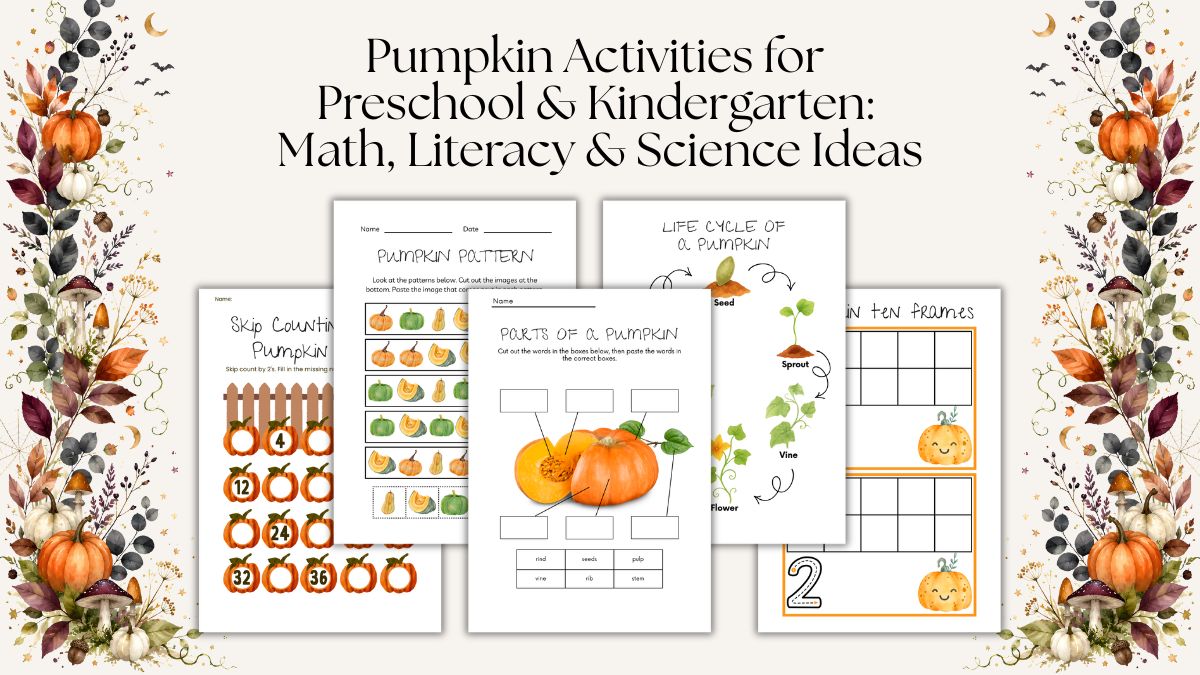
Pumpkin activities for preschool and kindergarten make it easy to touch several subjects with one familiar object. A single pumpkin theme can carry science vocabulary, counting practice, letter recognition, and fine motor work, which is part of why it shows up so often in fall lesson plans. Below are activity ideas organized by subject, along with notes on which ones tend to work better for younger preschoolers versus kindergarten and early elementary students.
Pumpkin Science Activities
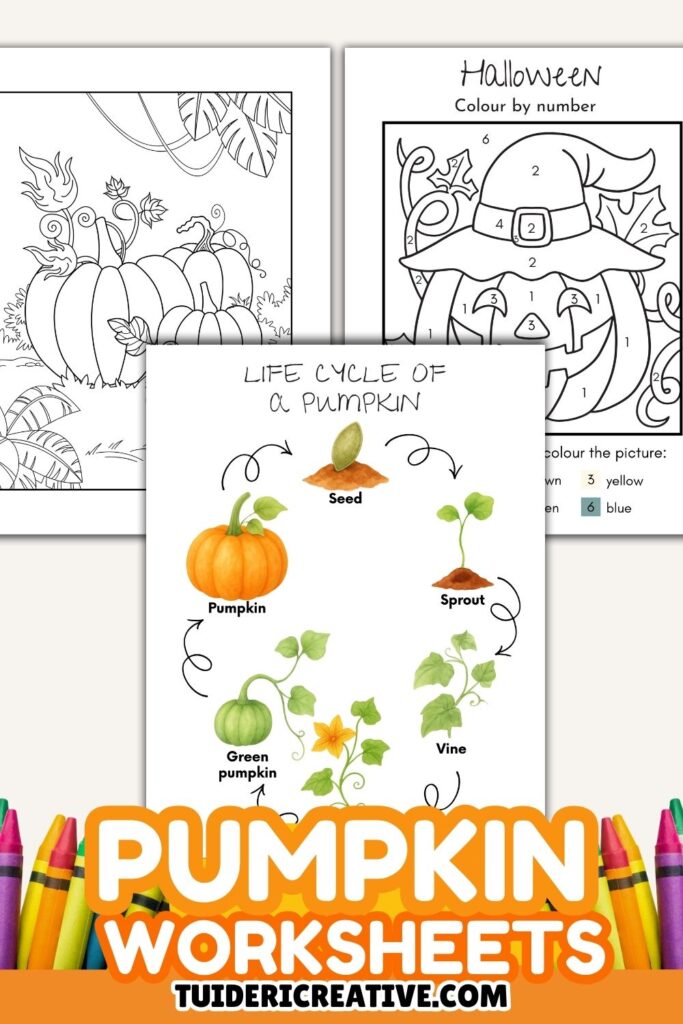
The life cycle of a pumpkin is a natural starting point for science. Children can sequence the stages — seed, sprout, vine, flower, green pumpkin, and pumpkin — using picture cards or a simple diagram. Pairing this with pumpkin life cycle vocabulary tracing gives children a chance to connect each stage’s name with its spelling, which reinforces both science content and handwriting at the same time.
Parts of a pumpkin is a second useful science activity. Children label or match terms such as rind, rib, vine, seeds, pulp, and stem to the correct part of a pumpkin. A cut-and-paste version works well for children who aren’t writing independently yet, while older students can label the diagram directly. This kind of activity supports basic anatomical vocabulary and gives children a reason to look closely at a pumpkin’s structure rather than just its color and shape.
For preschoolers, the life cycle sequencing and simple vocabulary matching are usually enough. Kindergarten and early elementary students can take on the full parts-of-a-pumpkin labeling and the handwriting components with more independence.
Pumpkin Math Activities
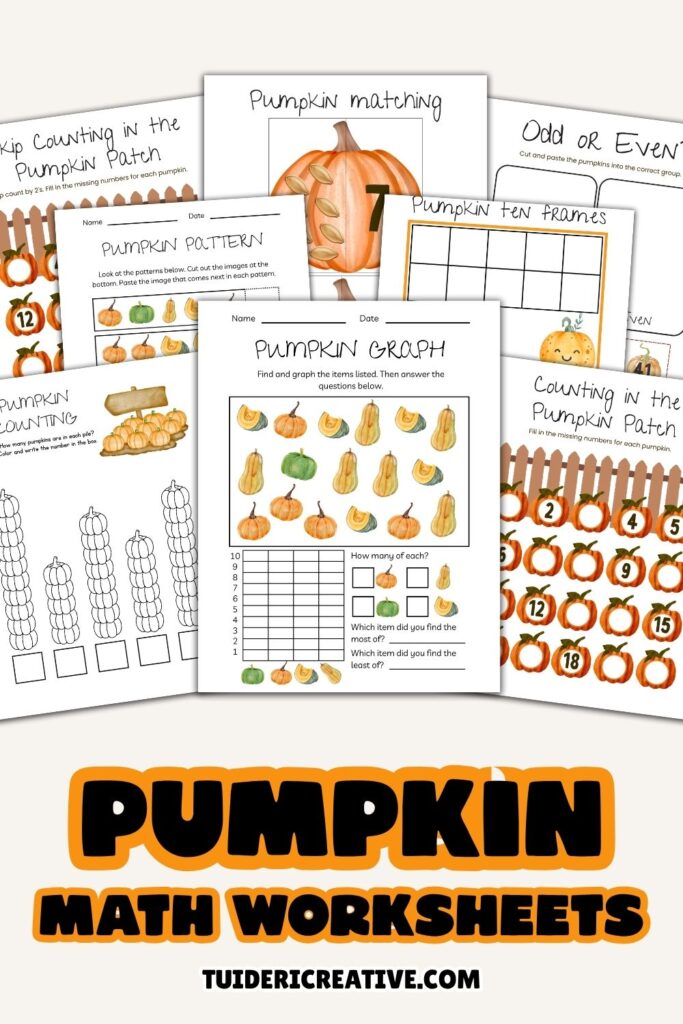
Counting and number sense. Counting activities can start with simple picture sets where children count pumpkins and choose the matching number, similar to a pumpkin counting worksheet with wagons full of pumpkins. Pumpkin seed number matching extends the same skill in a more hands-on format — children match a pumpkin showing a specific number of seeds to its corresponding numeral.
Ten frames and number recognition. Ten-frame activities pair a blank ten frame with a number to trace, then ask children to cut out small pumpkin pictures and glue the correct quantity into the frame. This is a solid preschool-through-kindergarten activity because it builds one-to-one correspondence alongside handwriting practice for the numeral itself.
Patterns and early algebra. Pumpkin pattern activities ask children to look at a repeating sequence of pumpkin images and figure out what comes next, then cut and paste the correct picture into place. This works well for preschoolers who are just starting to notice repeating sequences.
Missing numbers and skip counting. “Counting in the Pumpkin Patch” style worksheets ask children to fill in missing numbers along a sequence of pumpkins, which suits kindergarten students working on number order. A skip-counting version of the same format — counting by 2s or by 5s — moves into early elementary territory and supports place-value thinking.
Tens and ones. A “splitting pumpkins” activity gives children a two-digit number and asks them to break it into tens and ones, which is a kindergarten-to-first-grade skill.
Odd and even numbers. Children sort a set of numbered pumpkins into “odd” and “even” groups, which works as a cut-and-paste sorting task for early elementary learners.
Simple addition and fractions. An addition worksheet with pumpkin images to count and add suits kindergarten and early first grade. Fraction pumpkins — pumpkins divided into halves, thirds, fourths, fifths, and so on, with children shading in the correct portion — are better suited to early elementary students who have already been introduced to the concept of a fraction.
Graphing. A pumpkin graphing activity has children count and tally different pumpkin and squash images, then answer questions about which type appeared most and least. This blends counting practice with an introduction to reading simple data.
Pumpkin Literacy Activities
A pumpkin alphabet activity presents a set of pumpkins with some letters filled in and others left blank, asking children to fill in the missing letters — useful for reinforcing letter order and recognition. A beginning sounds activity shows a picture (a pumpkin, an apple, an acorn, a mushroom, a squirrel, a leaf) with several letter choices underneath, and children circle the letter that matches the picture’s starting sound. This supports early phonemic awareness.
A pumpkin word search using fall vocabulary — words like pumpkin, squash, seed, vine, and fall — gives children practice scanning for letter patterns, which works well once they’re comfortable with letter recognition.
Handwriting practice sheets built around short pumpkin facts (for example, that pumpkins are technically a fruit, or that a single pumpkin can hold hundreds of seeds) let children trace and then write full sentences independently. These suit kindergarten and early elementary learners who are building sentence-level handwriting stamina, while a simpler word-tracing version — tracing single words like “seed” or “vine” — fits earlier writers.
Pumpkin Social-Emotional Learning
A pumpkin emotions activity asks children to draw faces on blank pumpkins to show specific emotions — happy, sad, angry, and surprised. This is a quick way to bring in emotion vocabulary and open up a short classroom discussion about how those feelings look and what might cause them.
Pumpkin Fine Motor and Art Activities
Cutting, tracing, coloring, and matching all add fine motor practice alongside the academic content above. A pumpkin number-matching cut-and-paste activity doubles as a fine motor task since children are cutting out small pieces and gluing them in the right spot. Coloring pages, including a color-by-number pumpkin design, reinforce color words and number recognition while giving children practice with a crayon.
A symmetry activity — where children use a grid to draw and color the missing half of a pumpkin or jack-o’-lantern image — is a nice combination of visual-spatial skill and fine motor control, and works well for kindergarten and up.
Simple Jack-o’-Lantern Activities
A few activities in a pumpkin theme naturally lean toward Halloween without needing the whole unit to become a Halloween unit. Jack-o’-lantern matching has children draw lines connecting jack-o’-lantern faces to their gray, unfilled counterparts. A design-a-jack-o’-lantern page gives children a blank pumpkin outline to draw their own spooky or silly face on. These, along with the symmetry activity and a Halloween color-by-number page, are easy to save for closer to Halloween while keeping pumpkins as the main theme the rest of the time.
Parts of a Pumpkin Activities
Beyond the labeling diagram already mentioned above, a cut-and-paste version of the parts-of-a-pumpkin activity gives children word cards (rind, seeds, pulp, vine, rib, stem) to sort onto the correct spot on a pumpkin image. This is a good lower-prep option for centers, since it doesn’t require independent writing.
How to Build a Pumpkin Unit Study
Combining these activities into a short pumpkin unit study is mostly a matter of grouping by subject and spacing them across a few days. Why I Love Unit Studies goes into more detail on why a single theme across subjects tends to stick better than isolated worksheets, but a simple pumpkin version might look like this:
- Science: life cycle sequencing and vocabulary tracing, then parts-of-a-pumpkin labeling
- Math: counting and ten frames early in the week, moving into patterns, missing numbers, and — for older students — skip counting, addition, or fractions later on
- Literacy: alphabet and beginning sounds activities paired with handwriting practice
- Art/fine motor: coloring pages and cut-and-paste activities spread throughout, with jack-o’-lantern design and symmetry saved for the end of the week if it’s closer to Halloween
A single week is usually enough to get through the core activities. Stretching it to two weeks gives more room for review and repetition, especially in a mixed-age homeschool setting.
If you’re looking for more fall themes to structure the same way, Apple Activities for Preschool & Kindergarten follows a similar subject-by-subject approach.
If you prefer to keep the activities together in one printable resource, a pumpkin unit study can make it easier to move between math, literacy, science, and seasonal activities without planning each subject separately.
More Fall Learning Ideas
A pumpkin theme pairs naturally with other fall classroom staples. Fall Bulletin Board Ideas is a good next stop if you’re also setting up the physical classroom space to match the season.
Putting Together a Simple Pumpkin Theme
One familiar seasonal object can carry a surprising amount of learning once you break it down by subject. A pumpkin theme works because it doesn’t require novelty every day — the same visual shows up in a counting worksheet, a labeling diagram, and a handwriting page, which keeps things consistent for children while still covering different skills. Pick a handful of activities that match your students’ current level, whether that’s simple counting and matching for preschool or skip counting and fractions for early elementary, and build outward from there.
Leave a Reply
You must be logged in to post a comment.