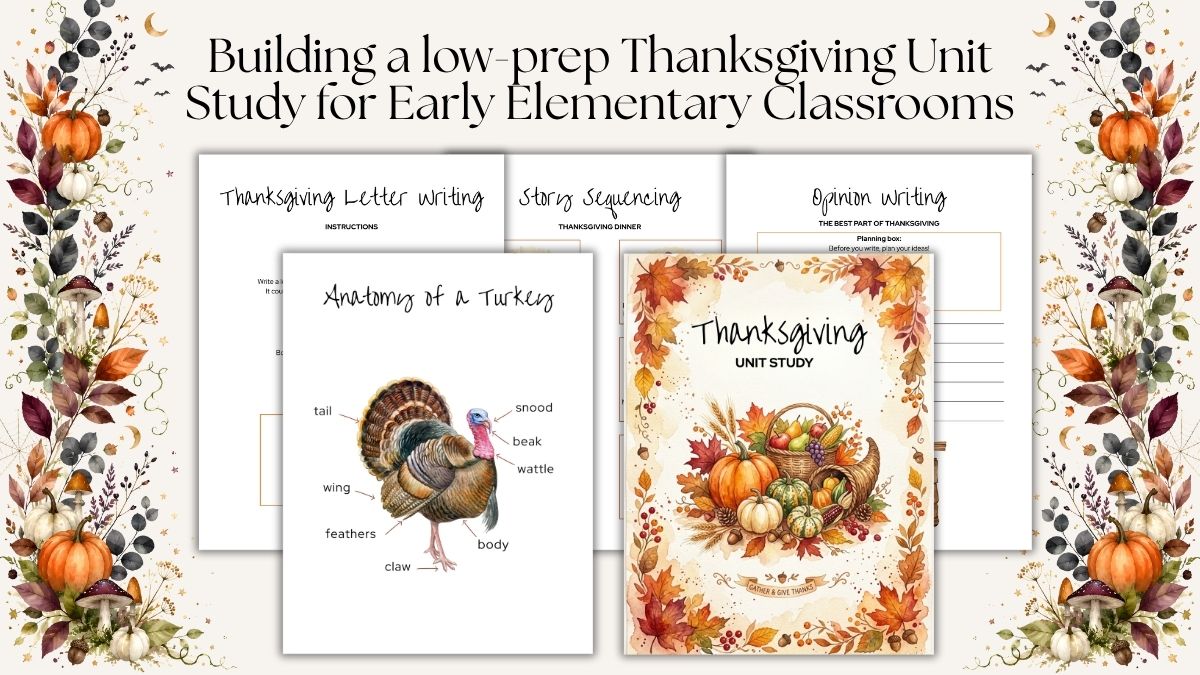
November has a way of pulling lesson plans in a dozen directions at once. There’s the usual reading and math instruction to keep up with, a school-wide feast or program to prepare for, and a holiday that most kids are already thinking about at home. One of the easiest ways to bring some order to that is a Thanksgiving unit study — a short stretch of lessons where a single theme carries across subjects instead of each one existing in its own little box.
For 1st through 3rd grade, this works especially well. Kids at this age can handle a real reading passage, a short research question, or a comprehension check, but they still benefit from hands-on tasks that break up the seatwork. A Thanksgiving theme happens to touch almost every subject a teacher needs to cover anyway: reading and writing, basic research skills, plant and animal science, and math practice that would otherwise feel repetitive. Instead of planning five unrelated lessons for the week, you plan one topic and let it flex across the school day.
Thanksgiving History and Social Studies
The history piece is usually where a Thanksgiving unit starts, and it’s worth taking a little care with. First and second graders can absolutely learn about the Pilgrims’ voyage, the hardships of that first winter, and the harvest feast that followed — but it helps to frame it as one important story about the holiday’s origins rather than the complete picture of Wampanoag history or of Indigenous and settler relations in general. A short read-aloud or a supplemental video with age-appropriate Indigenous perspectives can round out what a simple elementary passage leaves out, and it doesn’t take much extra time to include.
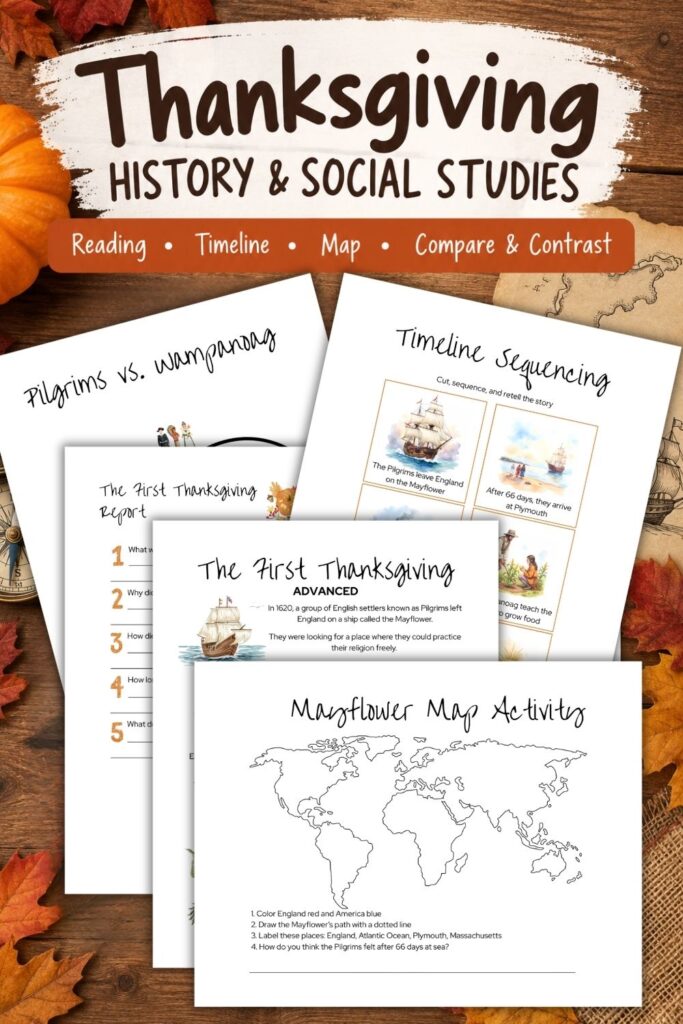
Within that, there’s a lot of room to differentiate. A reading passage on the First Thanksgiving works well in two versions — a shorter, simpler telling for students who need the support, and a longer version with more detail for kids ready to read independently. Following either one with comprehension questions (what was the ship called, why did the Pilgrims leave England, how did Squanto help them) gives you a quick check on whether the reading actually landed.
From there, a few other activities round out the unit nicely:
- A Venn diagram comparing what was true only of the Pilgrims, only of the Wampanoag, and what both groups shared
- A simple map activity tracing the Mayflower’s route from England to Plymouth
- Picture cards for building Thanksgiving vocabulary — words like pilgrim, harvest, and colony
- A cut-and-paste timeline that has kids put the major events of 1620–1621 in order
- A “then and now” comparison of Thanksgiving traditions, looking at how the first feast (three days, held outdoors, no forks) differs from a modern one
That last comparison tends to get good discussion going, since kids are usually surprised that the original feast looked so different from their own Thanksgiving table.
Thanksgiving Science and Nature Study
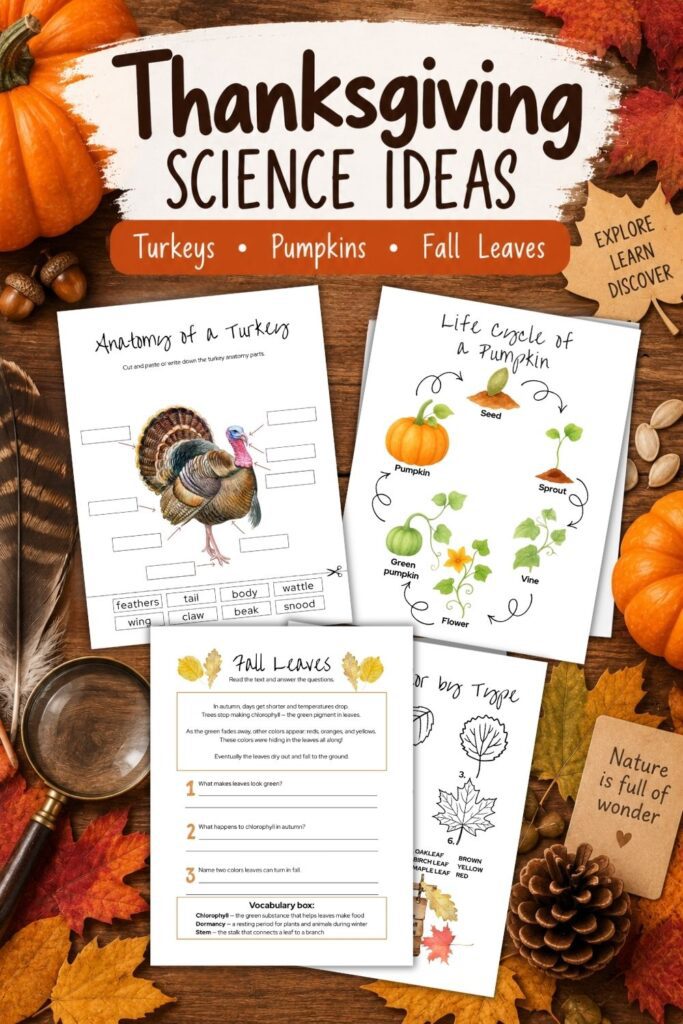
Once the historical piece is covered, the harvest season itself opens up a natural science unit. Turkey anatomy is a fun, low-stakes place to start — labeling the snood, wattle, and tail feathers gives young students new vocabulary without much pressure, and a “label it yourself” version afterward checks whether it stuck.
Harvest foods are another easy entry point. Sorting picture cards into fruits, vegetables, and grains reinforces a science concept while tying back to the feast itself. You can take the activity a step further by having students make predictions about which harvest foods might have been part of the 1621 feast, then research a few of their guesses together.
The pumpkin life cycle is worth its own block of time. Walking through seed, sprout, vine, flower, green pumpkin, and ripe pumpkin gives students a concrete example of a plant life cycle they can picture clearly, especially if they’ve carved or seen a pumpkin recently. Picture-matching activities and a short comprehension check afterward help cement the sequence.
If you want to spend more time on pumpkins before moving into Thanksgiving, my Pumpkin Unit Study goes deeper into the theme.
Fall itself is the other half of the science picture. A short passage on why leaves change color — chlorophyll fading and letting the reds, oranges, and yellows underneath show through — pairs well with a leaf-identification activity where students match a leaf shape to its color and name. A slightly more advanced reading extends the idea into why leaves actually fall and what happens to a tree during winter dormancy, which introduces vocabulary like dormancy and chlorophyll that shows up again in matching or fill-in-the-blank practice.
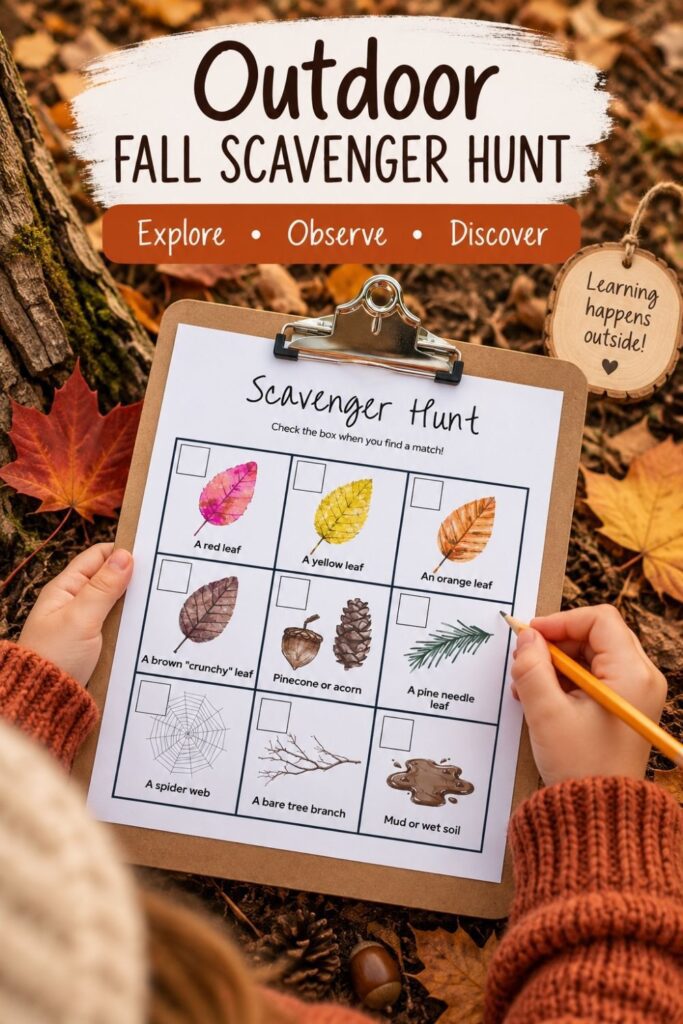
If weather allows, an outdoor scavenger hunt is a good way to get kids moving and looking closely at their surroundings — checking off a red leaf, an acorn, a spider web, or a bare branch, then coming back inside to draw and write about what they noticed. It’s a small activity, but it gets across that fall science doesn’t have to live only on a worksheet.
Thanksgiving Math
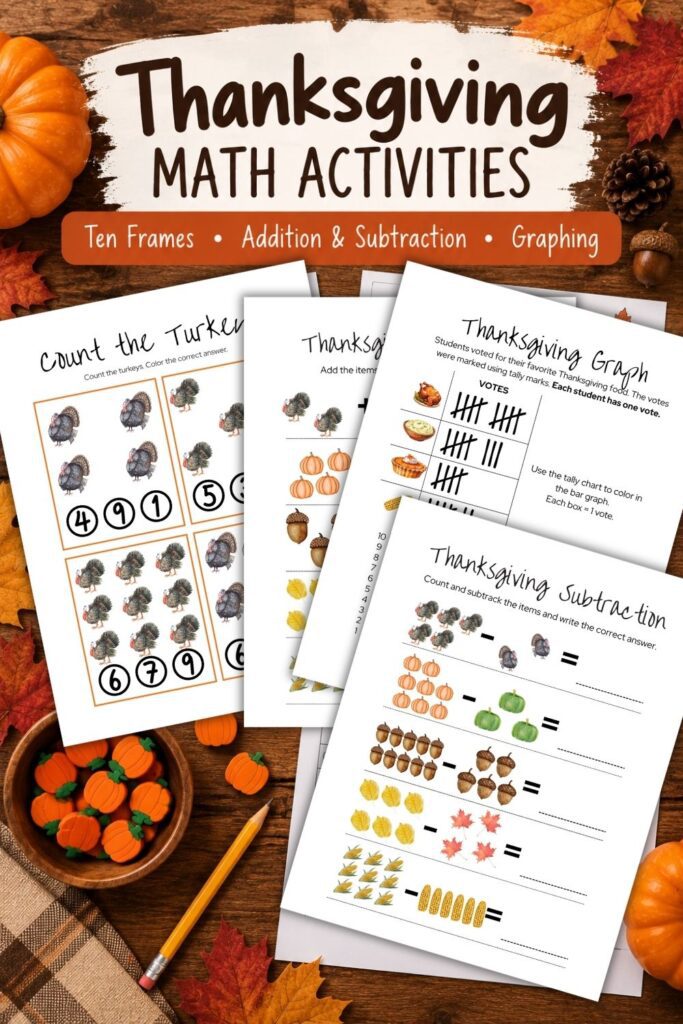
Themed math doesn’t need to introduce anything new — it’s mostly a chance to practice existing skills in a seasonal wrapper, which keeps math time from feeling like a break from the unit. Counting turkeys, filling in missing numbers on pumpkin ten frames, and solving simple picture-based addition and subtraction problems all work the skills students are already building, just with a fall backdrop instead of generic clip art.
A tally chart and bar graph activity is a nice addition here too. If students vote on their favorite Thanksgiving food and mark the results with tally marks, they get practice reading and transferring data onto a bar graph, then answering questions about which food won and by how much. It’s a good excuse to talk about data in a context kids actually care about. A cut-and-paste pattern activity rounds things out for students who need more practice recognizing and extending simple sequences.
Thanksgiving Literacy and Writing
This is where a Thanksgiving unit really earns its keep for 1st through 3rd grade, since there’s room to move from short, supported tasks toward more independent writing over the course of the week.
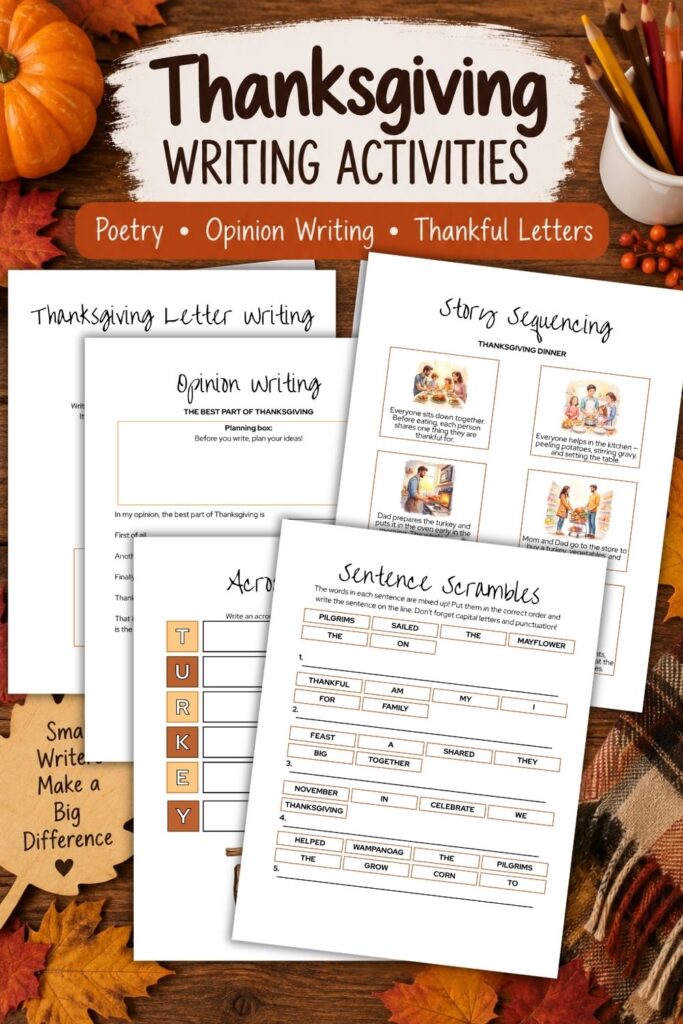
Vocabulary work is a natural starting point — matching words like harvest, gratitude, and Mayflower to their definitions gives students the language they’ll need for everything that follows. Sentence scrambles are a quick, low-pressure way to reinforce sentence structure and capitalization, since students just have to reorder words that are already given to them rather than generate a sentence from scratch. Story sequencing works similarly on the narrative side: cutting apart six pictures of a Thanksgiving Day (going to the store, cooking, guests arriving, sharing what everyone’s thankful for) and putting them in order gets kids thinking about sequence and cause and effect.
From there, it’s a short step to more independent writing. An acrostic poem using either “TURKEY” or “THANKFUL” is approachable for almost any 1st through 3rd grader, and having an easier and more advanced version on hand means the same activity can stretch across a wider range of writers. Opinion writing about the best part of Thanksgiving is a good formal writing exercise for 2nd and 3rd graders especially, since a simple planning box (first reason, second reason, closing statement) walks them through basic persuasive structure without overwhelming them. A letter-writing activity — where students write to someone they’re thankful for, whether a parent, a grandparent, or their teacher — tends to be the one kids remember, since it gives the writing an actual audience instead of just an assignment.
Hands-On Thanksgiving Activities
Not every part of a unit study needs to be a worksheet, and building in a few lower-pressure activities helps keep momentum, especially with younger or more restless students. A handprint turkey craft is the classic for a reason — tracing a hand, turning the fingers into feathers, and adding a face to the thumb is simple enough for kindergartners with some help, but still fun for 1st and 2nd graders as a quick creative break. A pilgrim hat craft (with a fun fact that real Pilgrims didn’t actually wear the tall buckled hats most people picture) gives another hands-on option, and a word search or coloring page works well for indoor recess or a few spare minutes before dismissal.
Also great for younger students: Fall Alphabet Activities.
Turning These Ideas Into a Simple Thanksgiving Unit
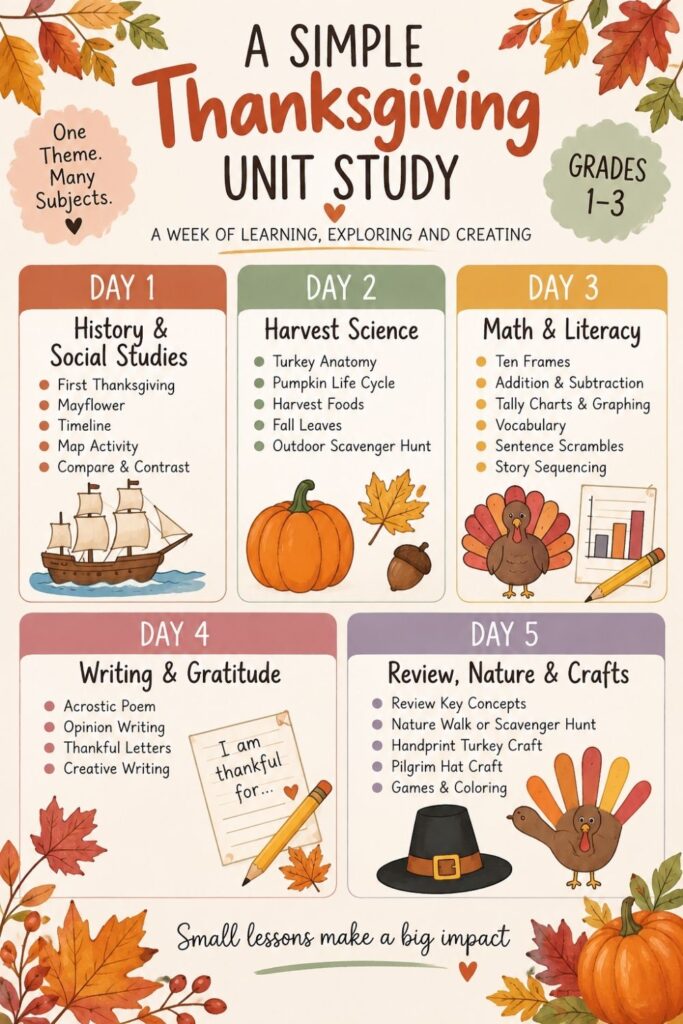
You don’t need a rigid schedule to make this work — most of it falls into place if you follow the logic of the theme itself. History and social studies make sense as a starting point, since they set up the “why” behind the holiday. From there, moving into harvest and fall science keeps the momentum going without repeating ground you’ve already covered. Math and literacy can run in parallel through the middle of the week, since neither depends on the other. Save the more reflective writing — the opinion piece or the thankful letter — for later in the week, once students have more context to draw from. Wrap up with a mix of review and one of the hands-on crafts, which gives the week a natural, lower-stress ending.
The real advantage of planning it this way is flexibility. A kindergarten class might stick to the turkey anatomy, the pumpkin life cycle, and the handprint craft, while a 3rd grade class might work through the advanced reading passage, the opinion writing, and the graphing activity. Nobody has to complete every single page for the unit to hold together — pick what fits your students and skip the rest.
Printable Thanksgiving Unit Study
If you’d rather have the activities ready to print, I’ve put many of these ideas together in my Thanksgiving Unit Study. The resource covers history and social studies, fall and harvest science, math, literacy and writing, crafts, and simple seasonal activities. It includes both easier and more advanced options for selected activities, so you can choose the pages that best fit your students.
Wrapping Up
Thanksgiving gives you more to work with than a week of turkey worksheets and a classroom feast. Treated as a real theme, it can carry history, science, math, and writing all at once, which makes November planning simpler rather than more crowded. Pick the pieces that fit your students, leave out what doesn’t, and let one topic do the work of several.
Looking for more ways to build seasonal units?
Check out Why I Love Unit Studies for the thinking behind this approach, Pumpkin Unit Study for a deeper dive into fall science, Fall Alphabet Activities for younger learners, and Thanksgiving Bulletin Board Ideas to display student work when the unit wraps up.
Leave a Reply
You must be logged in to post a comment.