
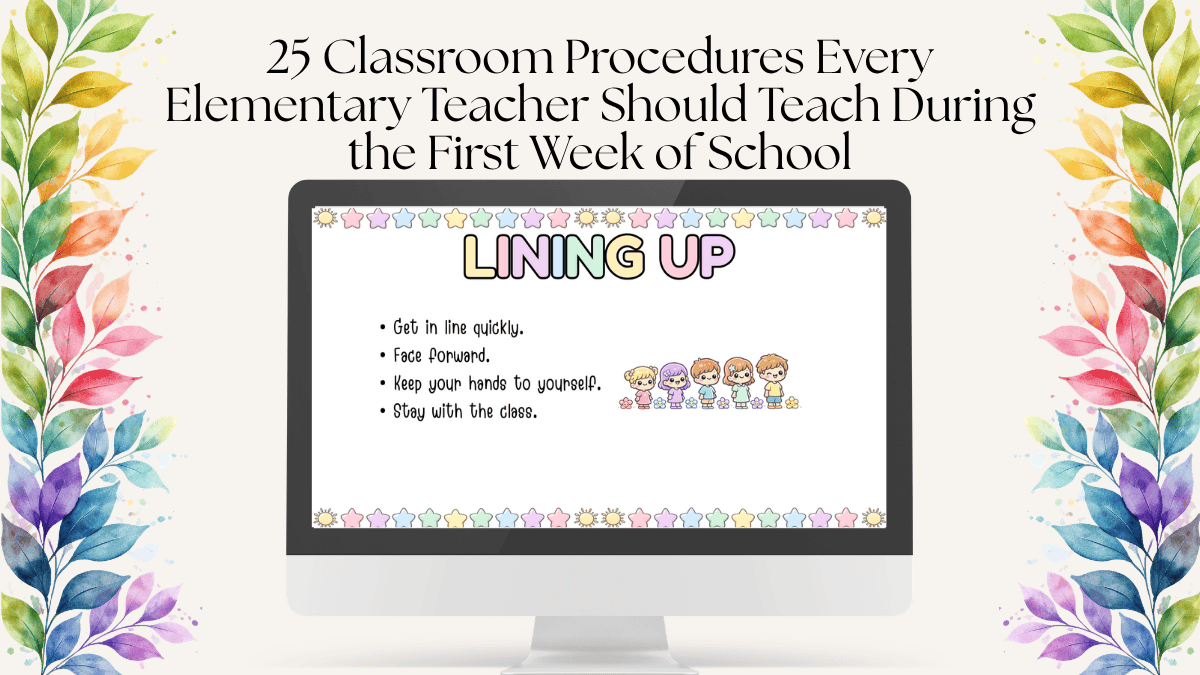
The first week of school sets the tone for everything that follows. Long before academic content takes center stage, the classrooms that run smoothly tend to share one thing in common: clear, well-taught classroom procedures. Getting students in and out of the room, moving from one activity to the next, and knowing what to do when they need help — these small, repeatable actions add up to a classroom that feels calm rather than chaotic.
This guide walks through 25 classroom procedures worth teaching in the first week, numbered and explained one by one, along with why each one matters and how to introduce it so it actually sticks. Whether you’re a brand-new teacher building your first classroom management plan, a student teacher preparing for a placement, or a homeschool parent setting up routines at home, the ideas here are meant to be adaptable rather than rigid.
Table of Contents
- Why Classroom Procedures Matter
- Teach Procedures Slowly During the First Week
- 25 Classroom Procedures to Teach
- How to Teach Classroom Procedures Effectively
- Classroom Procedures vs. Classroom Expectations
- Common Mistakes
- First Week Classroom Procedures Checklist
- Frequently Asked Questions
- Final Thoughts
Why Classroom Procedures Matter
Classroom procedures are the specific, step-by-step ways students are expected to do routine tasks — sharpening a pencil, lining up for lunch, turning in a worksheet. They’re different from classroom rules, which tend to be broader statements about behavior, like “be respectful” or “be safe.” They’re also different from classroom expectations, which describe the general standard of conduct a teacher hopes to see throughout the year. A procedure is narrower and more concrete than either: it answers the question “what exactly do I do, and in what order?”
This distinction matters more than it might seem at first glance. A rule like “be respectful” doesn’t tell a six-year-old what to do when they finish a worksheet early. A procedure does. When students know precisely what’s expected of them in a given moment, they spend less time guessing, less time waiting for direction, and less time in the kind of unstructured limbo where off-task behavior tends to creep in.
Many teachers find that the classrooms with the fewest behavior issues aren’t necessarily the ones with the strictest rules — they’re often the ones with the clearest procedures. This idea has long been emphasized in classroom management literature: procedures reduce the number of routine decisions students need to make throughout the day. Once lining up or turning in homework becomes automatic, students have more mental energy available for learning.
Did You Know? The routines introduced during the first weeks of school often become the patterns students rely on throughout the year. Teaching them carefully at the beginning can reduce the need for repeated corrections later.
There’s also a trust-building element here. Young students, especially, feel more secure in an environment where the expectations are predictable. First week classroom procedures aren’t just about efficiency — they help students feel like they know how their new classroom works, which in turn helps them feel safe enough to take academic risks later on.
Teach Procedures Slowly During the First Week
One of the most common first-week mistakes is trying to introduce every single procedure on day one. It’s an understandable impulse — there’s a lot to cover, and the urge to “get it all out of the way” is strong. In practice, though, students (and teachers) tend to retain far more when routines are introduced gradually, a few at a time, rather than all at once in a single overwhelming morning.
A common approach is to prioritize the procedures that will be used immediately and repeatedly: entering the room, whole-group signals, and the most basic transitions. These get taught and practiced on day one, since they’re needed within the first hour. Procedures that come up less frequently can be introduced over the following days as they become relevant.
Spacing procedures out also gives teachers room to actually practice each one, rather than just explaining it once and moving on. A procedure that’s explained but never practiced rarely becomes a habit. Many elementary classrooms build in short, low-stakes practice rounds — lining up and sitting back down two or three times, for example — so the routine gets rehearsed before it’s needed under real conditions.
Quick Tip: Teach three to five procedures a day during the first week rather than trying to cover all 25 at once. Students absorb routines far better in small, practiced doses.
It’s also worth remembering that the first week doesn’t have to be the only time procedures are taught. Re-teaching in week two or three, once the novelty of a new classroom has worn off and students’ true habits start to show, is a normal and expected part of the process — not a sign that the initial teaching failed.
25 Classroom Procedures to Teach
Below is a practical, numbered classroom procedures checklist, organized into five categories that roughly follow the shape of a school day. Each procedure includes a short explanation, why it matters, and a practical example. Not every procedure will apply to every classroom or grade level, and that’s fine — the goal is a comprehensive starting point to adapt, not a rigid script.
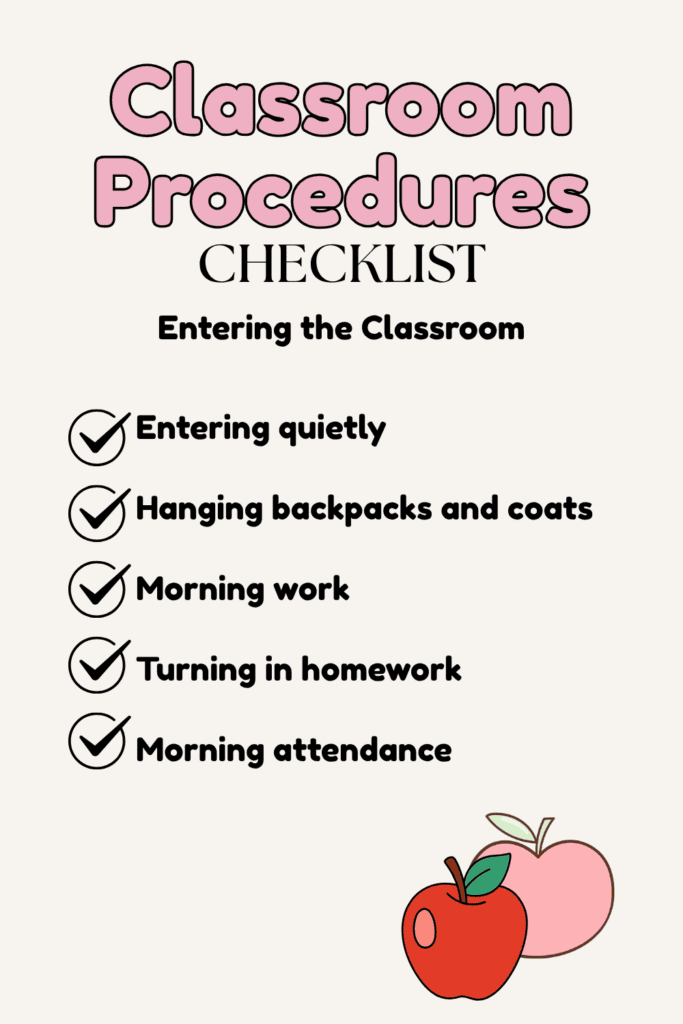
Entering the Classroom (Procedures 1–5)
1. Entering the Classroom Quietly
Students often benefit from a clear expectation for volume and pace as they walk in, rather than being told to “settle down” after the fact.
Why it matters: A calm entry sets the tone for the rest of the morning and prevents a scramble at the door.
Example: Students walk in, greet the teacher, and head straight to their morning work without stopping to chat in the doorway.
2. Hanging Backpacks and Coats
Assigning a specific hook, cubby, or bin removes the guesswork and prevents pile-ups by the door.
Why it matters: A designated spot for belongings keeps the entry area clear and speeds up the whole arrival process.
Example: Each student’s name is labeled above a hook, so there’s no hesitation about where things go.
3. Morning Work or Bell Work
Having a task ready at each desk or on the board gives students something purposeful to do the moment they sit down, instead of idle time that often turns into chatter.
Why it matters: A ready-made task bridges the gap between arrival and the official start of instruction.
Example: A short worksheet or a “morning message” is already waiting on each desk when students arrive.
4. Turning in Homework
A designated bin or folder system, taught explicitly, means the teacher isn’t collecting papers by hand every single morning.
Why it matters: A consistent system prevents lost assignments and saves valuable instructional minutes.
Example: A labeled bin near the door where students drop off homework as part of their entry routine.
5. Morning Attendance
A quiet, self-directed way for students to indicate they’ve arrived — moving a name magnet, flipping a card — keeps attendance from interrupting the flow of the morning.
Why it matters: It frees the teacher to greet students individually instead of calling a roll aloud.
Example: Students move their name clip from “home” to “school” on a pocket chart as they enter.
Whole-Group Instruction (Procedures 6–10)
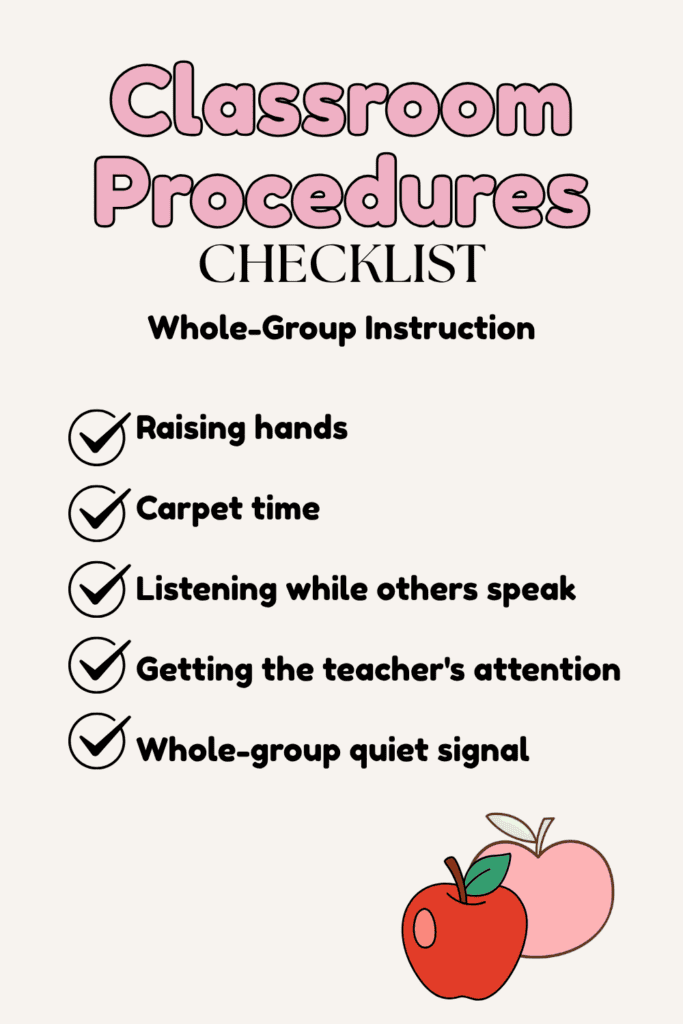
6. Raising Hands
A simple, consistent signal for wanting to speak or ask a question, taught and practiced before it’s actually needed.
Why it matters: It keeps discussions orderly and gives every student an equal chance to be heard.
Example: Hands stay raised and quiet until the teacher calls on a student, rather than calling out an answer.
7. Carpet Time
Where to sit, how to sit, and how to transition to and from the carpet as a group.
Why it matters: A defined routine for carpet time prevents the jostling and seat disputes that can eat up several minutes.
Example: Assigned carpet spots, marked with tape or a small rug square, remove any question about where to sit.
8. Listening While Others Speak
An explicit expectation, since “listening” isn’t always obvious to a young child in the abstract.
Why it matters: Naming what listening looks like — eyes on the speaker, hands still, mouth quiet — makes the expectation concrete.
Example: A simple acronym or hand motion reminds students what active listening looks like during group discussion.
9. Getting the Teacher’s Attention
A method for this that doesn’t involve calling out — a hand signal or a quiet check-in system works well for many classrooms.
Why it matters: It reduces interruptions during instruction while still giving students a way to be noticed.
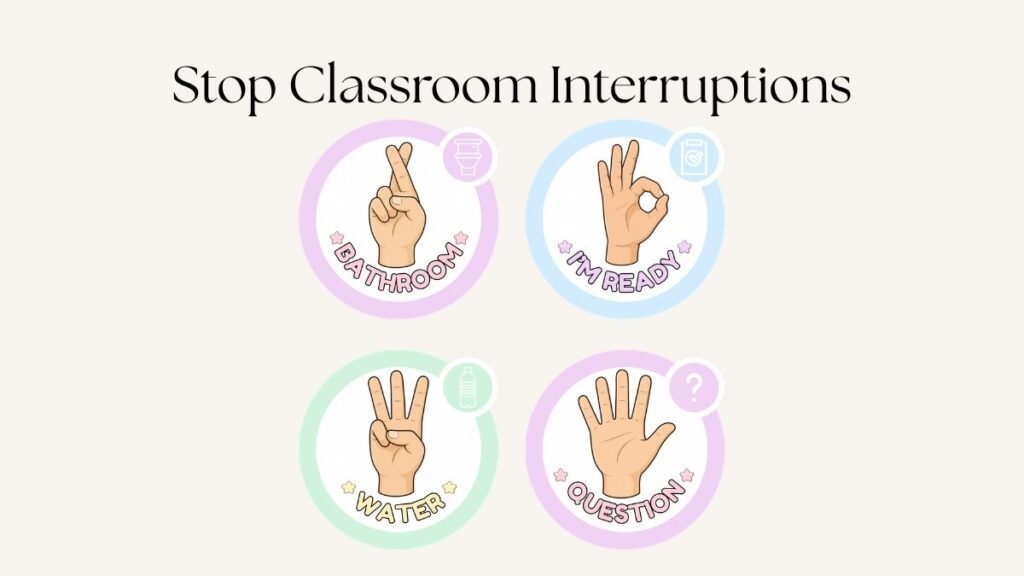
Example: A raised hand with two fingers crossed might mean “urgent,” while an open palm means “when you have a moment.”
10. Whole-Group Quiet Signal
A call-and-response phrase or a raised hand that means “stop and look this way,” practiced enough times that it becomes automatic.
Why it matters: A shared signal brings the group back to attention quickly without raising the teacher’s voice.
Example: The teacher says “1, 2, 3, eyes on me,” and students respond “1, 2, eyes on you.”
Independent Work (Procedures 11–15)
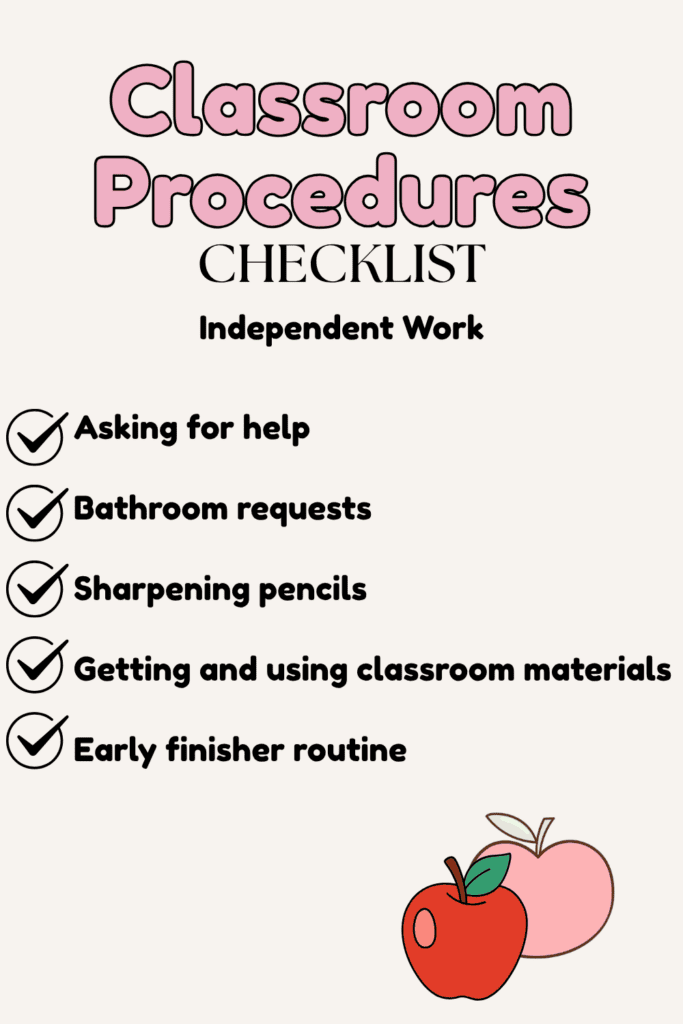
11. Asking for Help
A system — a cup flip, a sticky note, a small flag on the desk — that lets students signal they’re stuck without leaving their seat or interrupting the room.
Why it matters: It keeps independent work time quiet and gives the teacher a visual way to prioritize who needs help first.
Example: A red cup flipped upright on the desk means “I need help”; green means “I’m doing fine.”
12. Bathroom Requests
A quiet, non-disruptive signal, such as a hand gesture or a pass, that doesn’t require pausing instruction.
Why it matters: It respects students’ need for privacy while minimizing interruptions to the lesson.
Example: Crossed fingers held up silently signal a bathroom request, and the teacher nods approval without stopping the lesson.
13. Sharpening Pencils
When it’s allowed, and what to do if a pencil breaks during a lesson (a pencil cup with backups avoids a mid-lesson trip to the sharpener).
Why it matters: It prevents the sharpener from becoming a distraction during quiet work time.
Example: A cup of pre-sharpened pencils sits on each table, so a broken pencil just means a quick swap.
14. Getting and Using Classroom Materials
Where supplies live and how they’re accessed, so students aren’t wandering the room mid-task.
Why it matters: Clear material routines keep independent work time focused rather than turning into a search for scissors or glue.
Example: Shared supply bins are labeled and placed at each table, so materials never require a trip across the room.
15. Early Finisher Routine
One of the most important procedures on this list — students often benefit from a clear early finisher activity or a “must do, may do” system so downtime doesn’t turn into disruption.
Why it matters: Without a plan, early finishers are one of the most common sources of off-task behavior during independent work.
Example: A posted list of approved quiet activities — reading, drawing, a puzzle bin — gives students something purposeful to do once they’re done.
Classroom Transitions (Procedures 16–20)
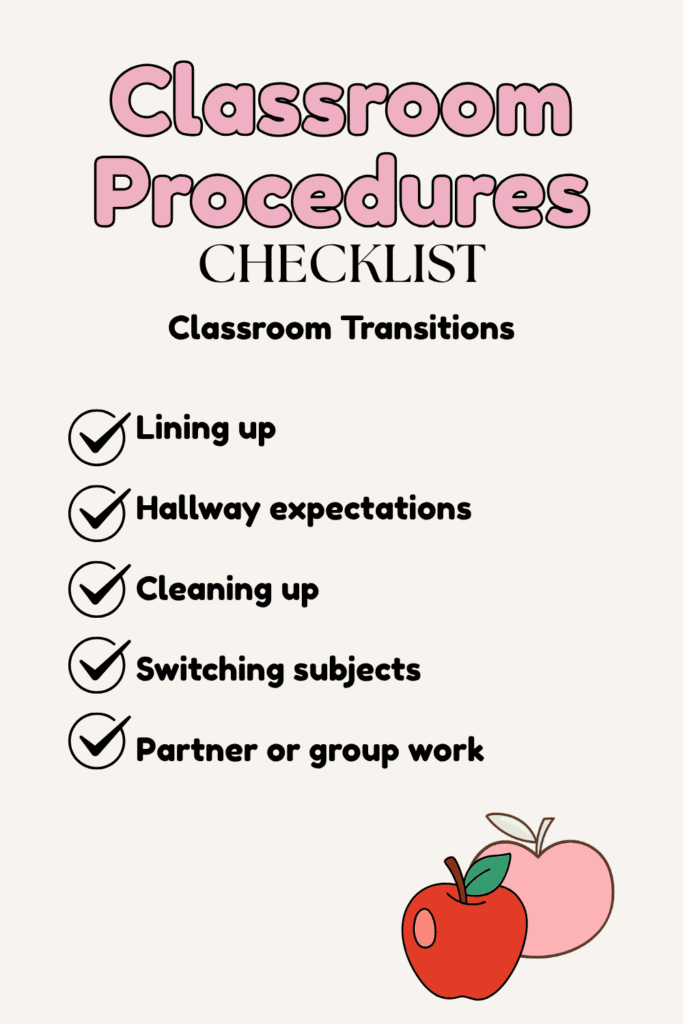
16. Lining Up
A consistent order (whether assigned or rotating) and a clear expectation for spacing and volume in line.
Why it matters: Lining up happens multiple times a day, so even small inefficiencies here add up to real lost time.
Example: Students are called to line up by table, one group at a time, rather than all standing up at once.
17. Hallway Expectations
Expectations for spacing, volume, and hands, since hallway behavior affects other classrooms too.
Why it matters: Consistent hallway behavior shows respect for other classes still in session.
Example: Walking in a single line, voices off, hands to themselves, is modeled and practiced before the first real hallway trip.
18. Cleaning Up
Where materials go and how much time is given, ideally practiced as its own mini-routine rather than assumed.
Why it matters: A defined clean-up routine prevents the last few minutes of an activity from turning into chaos.
Example: A two-minute clean-up song signals it’s time to put materials away before the next activity begins.
19. Switching Subjects
A signal — a countdown, a chime, a visual timer — that tells students it’s time to shift gears from one subject to the next.
Why it matters: A predictable transition signal reduces the confusion and downtime between activities.
Example: A chime means “finish your sentence, close your book, and get ready for math.”
20. Partner or Group Work
How students find a partner, move desks if needed, and return to their original seats afterward.
Why it matters: A clear routine for forming and dissolving groups keeps transitions into collaborative work efficient.
Example: Students are assigned “shoulder partners” ahead of time, so no one is left searching for a pair.
End-of-Day Procedures (Procedures 21–25)
21. Packing Up
A checklist or routine so students gather homework, folders, and belongings without last-minute searching.
Why it matters: A calm packing-up routine prevents the frantic rush that often happens right before dismissal.
Example: A posted checklist reminds students to pack their folder, water bottle, and any take-home items in that order.
22. Desk Cleanup
A quick tidy-up routine, whether that’s a wipe-down or simply straightening materials for the next day.
Why it matters: A clean desk at the end of the day makes the next morning’s start smoother.
Example: Students stack their books, straighten their chairs, and clear loose papers into their desk before lining up.
23. Homework Folders
A consistent spot where folders are picked up so nothing gets left behind.
Why it matters: A predictable folder system keeps important papers from getting lost between school and home.
Example: Folders are stored in a labeled bin and handed out as part of the packing-up routine each afternoon.
24. Dismissal Routine
How students are called to leave — by table, by bus number, by row — and what “ready to go” looks like.
Why it matters: A structured dismissal avoids a crowded rush at the door and helps students leave calmly.
Example: Students are dismissed by bus number first, followed by car riders, once they’re fully packed and seated quietly.
25. End-of-Day Room Reset
Chairs up, materials returned, and the room left ready for the next morning.
Why it matters: A quick room reset means the next day starts in an organized space rather than a leftover mess.
Example: A short classroom job chart assigns a few students to stack chairs or straighten supply bins before dismissal.
How to Teach Classroom Procedures Effectively
Teaching a procedure well involves more than simply announcing it once. Research and classroom experience suggest that procedures stick best when they’re modeled, practiced, and reinforced — not just explained.
Modeling comes first. Rather than only describing a routine in words, many teachers physically demonstrate it, sometimes even showing what it looks like when done incorrectly (“Watch what happens when we all try to line up at once”) before showing the correct version. Seeing procedure 16, lining up, acted out in both the right and wrong way tends to land more clearly than hearing it described.
Practice follows modeling. A single walkthrough rarely translates into a lasting habit. Having students rehearse a procedure two or three times, in a low-pressure moment rather than the first time it’s genuinely needed, builds the muscle memory that makes the routine automatic later on.
Example Classroom Procedure: For procedure 10, the whole-group quiet signal, a teacher might practice it during a fun moment first — right after a game, for instance — so students associate the signal with something positive before it’s used to manage behavior.
Positive feedback reinforces the routine once it’s underway. Naming specific things students are doing well — “I noticed everyone pushed their chairs in before lining up” — tends to be more effective than general praise, because it tells the whole class exactly what’s being reinforced.
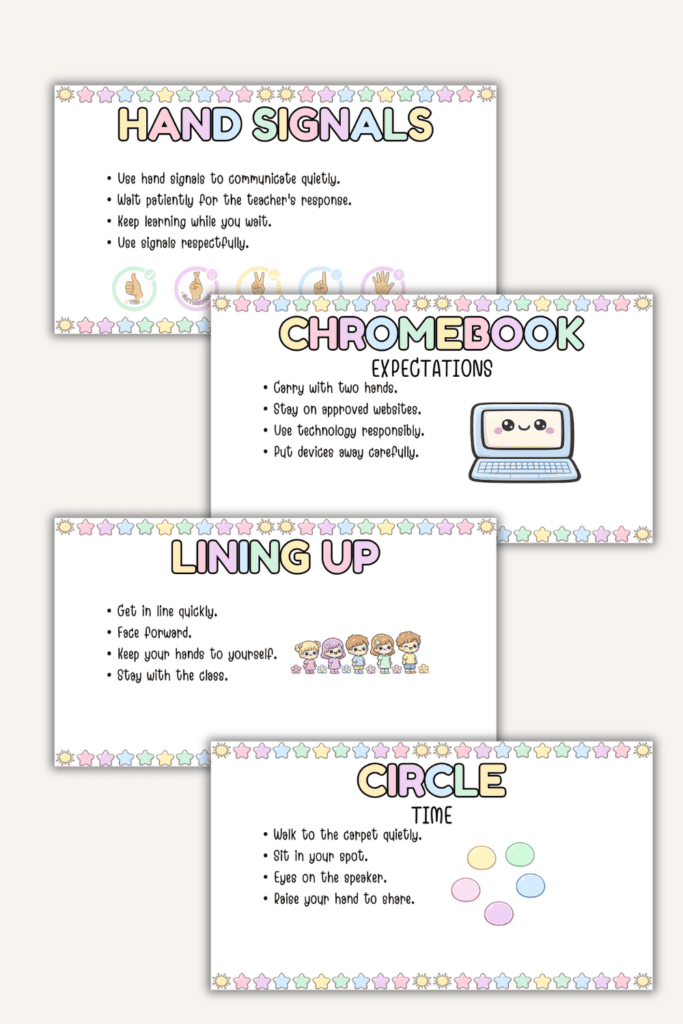
Visual reminders help procedures stay consistent even after the explicit teaching phase has ended. Visual reminders such as classroom procedure cards, editable classroom slides, classroom hand signal posters, or routine charts can make new procedures much easier for young learners to remember, especially in the first few weeks before a routine becomes second nature.
Looking for ready-to-use classroom visuals? Click the links below.
Re-teaching after breaks is often overlooked but genuinely important. Long weekends, holiday breaks, and the return from summer all tend to loosen routines that seemed solid before the break. A quick refresher — even just five minutes revisiting a procedure — usually restores it faster than letting things drift and correcting behavior after the fact.
Classroom Procedures vs. Classroom Expectations
It’s easy to use “rules,” “expectations,” and “procedures” interchangeably, but each one serves a different purpose in a well-managed classroom, and understanding the difference makes all three easier to teach.
Rules are the broadest of the three. They tend to be few in number and state general, non-negotiable standards, such as “keep hands and feet to yourself” or “be kind.” Rules usually apply across nearly every situation and rarely change throughout the year.
Expectations sit a level below rules. Classroom expectations describe the general character of behavior a teacher hopes to see — effort, respect, responsibility — often framed around specific contexts, like “how we treat classroom materials” or “how we work with a partner.” Expectations are broader than a single task but more specific than a rule.
Procedures are the most concrete of the three. A procedure is the literal, step-by-step sequence for completing a task — how to line up, how to ask for help, how to sharpen a pencil. Procedures are what turn an expectation like “be responsible with materials” into an actual, teachable set of steps.
| Term | What It Describes | Example |
|---|---|---|
| Rule | A broad, non-negotiable standard of behavior | “Be respectful.” |
| Expectation | A general standard of conduct within a context | “We take care of our classroom materials.” |
| Procedure | A specific, step-by-step routine for a task | “Return scissors to the labeled bin, tips down, after use.” |
Thinking of the three as layers — rules at the top, expectations in the middle, procedures at the ground level — makes it easier to plan a cohesive classroom management system rather than treating each one as a separate, unrelated list. For a deeper look at the middle layer, Classroom Expectations During the First Week of School covers how to introduce and reinforce expectations alongside the procedures in this guide.
Common Mistakes
Even with the best intentions, a few patterns tend to trip up first week classroom procedures. Knowing them ahead of time makes them easier to avoid.
Introducing too many procedures at once. As mentioned earlier, trying to cover everything on day one usually backfires. Students can only absorb so much in a single sitting, and procedures introduced in a rush are the ones most likely to be forgotten by week two.
Explaining without practicing. A procedure that’s only described in words, without a chance to rehearse it, rarely becomes a real habit. It’s easy to assume students understood because they nodded along — but understanding a description and actually performing the routine under real classroom conditions are two different skills.
Common Mistake: Teaching procedure 10 (the quiet signal) once on Monday and expecting it to hold through Friday without any practice in between. A quick reminder before each use, especially in the first two weeks, prevents the routine from slipping.
Assuming procedures are “set” after the first week. Classroom routines usually need reinforcement well beyond the first five days. Treating the first week as a one-time installation, rather than the start of an ongoing habit-building process, is one of the more common back to school classroom management mistakes.
Being inconsistent about enforcement. If a procedure is taught but not consistently expected afterward, students quickly learn that it’s optional. Consistency in the first few weeks — even when it feels repetitive — does more to cement a routine than almost anything else.
Skipping procedures that seem “obvious.” Adults often assume certain routines are self-evident — how to walk in a hallway, how to ask to use the bathroom — but young students frequently need these spelled out just as explicitly as anything else on this list.
First Week Classroom Procedures Checklist
This checklist summarizes all 25 procedures covered above, grouped by category, for a quick printable reference during first week planning.
Entering the Classroom
☐ 1. Entering quietly
☐ 2. Hanging backpacks and coats
☐ 3. Morning work
☐ 4. Turning in homework
☐ 5. Morning attendance
Whole-Group Instruction
☐ 6. Raising hands
☐ 7. Carpet time
☐ 8. Listening while others speak
☐ 9. Getting the teacher’s attention
☐ 10. Whole-group quiet signal
Independent Work
☐ 11. Asking for help
☐ 12. Bathroom requests
☐ 13. Sharpening pencils
☐ 14. Getting and using classroom materials
☐ 15. Early finisher routine
Classroom Transitions
☐ 16. Lining up
☐ 17. Hallway expectations
☐ 18. Cleaning up
☐ 19. Switching subjects
☐ 20. Partner or group work
End-of-Day Procedures
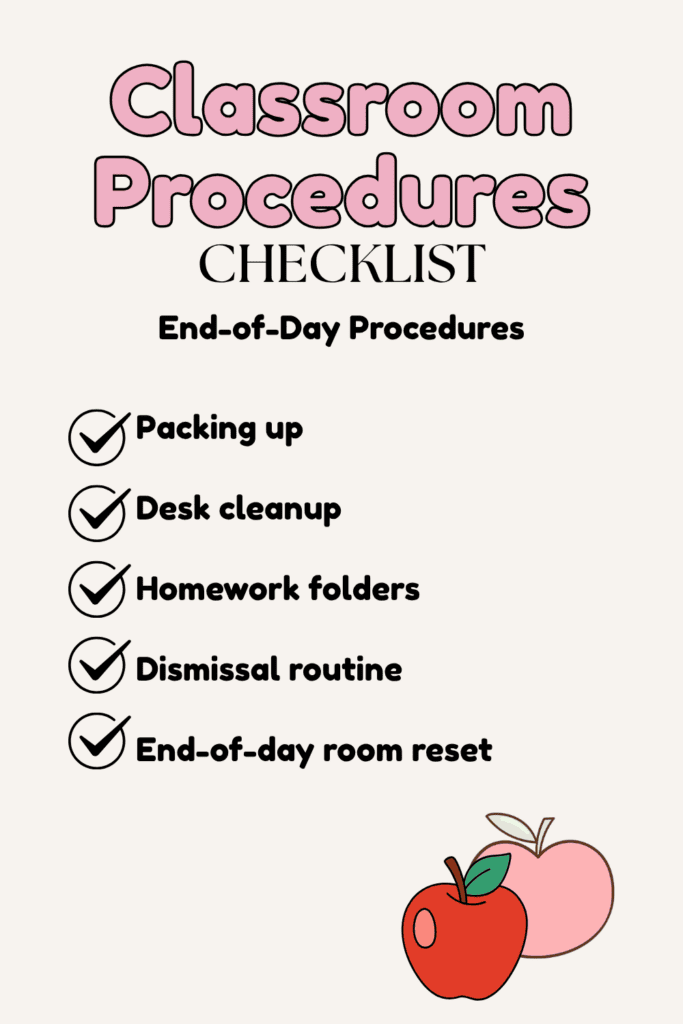
☐ 21. Packing up
☐ 22. Desk cleanup
☐ 23. Homework folders
☐ 24. Dismissal routine
☐ 25. End-of-day room reset
Frequently Asked Questions
How many classroom procedures should I teach?
There’s no fixed number, but many teachers find that somewhere between fifteen and thirty procedures covers most of a typical school day, spread out gradually rather than taught all at once. The 25 procedures above are a solid, comprehensive starting point for most elementary classrooms.
What’s the difference between procedures and expectations?
Classroom expectations describe the general standard of behavior a teacher hopes to see — respect, effort, kindness. Classroom procedures are the specific steps for completing routine tasks, like how to line up or turn in homework. Expectations set the tone; procedures explain how to act on it.
How long should teaching procedures take?
It varies by procedure and grade level, but most individual routines can be introduced and practiced in ten to fifteen minutes. The full process of establishing all first week classroom procedures typically continues, in smaller doses, through the first two to three weeks of school.
Should classroom procedures change during the year?
Sometimes, yes. A procedure that works well for a class of six-year-olds in September might need adjusting by spring as students mature, or if a particular routine simply isn’t working. Revisiting and refining procedures throughout the year is a normal part of classroom management.
When should procedures be re-taught?
After long breaks, following a noticeable dip in consistency, or any time a routine feels like it’s falling apart. Many teachers build in a light refresher after each holiday break as a preventive habit.
Which procedures are most important during the first week?
The ones used most frequently and immediately: entering the classroom, the whole-group quiet signal, lining up, and the early finisher routine. These come up multiple times a day and have an outsized effect on how smoothly the rest of the day runs.
Do classroom procedures work for homeschool settings too?
Yes. Even in a one-on-one or small-group homeschool setting, having clear routines for transitions, materials, and independent work time tends to reduce friction and helps children know what to expect from their day.
What’s the best way to introduce procedures to very young students?
Keep the language simple, model heavily, and rely on repetition and visual reminders rather than long verbal explanations. Younger students often learn a routine faster by watching and doing it themselves than by being told about it.
Final Thoughts
Classroom procedures aren’t the most exciting part of teaching, but they’re one of the most quietly powerful. A classroom where students know exactly what to do — how to enter, how to ask for help, how to transition between activities — tends to run more smoothly and leave more room for actual learning to happen. Teaching classroom procedures slowly, modeling them clearly, and reinforcing them consistently in the first week (and beyond) pays off for the rest of the year.
If you’re building out your own first week classroom procedures, it can help to pair this planning with related resources: Classroom Expectations During the First Week of School, Classroom Hand Signals, or Morning Meeting Ideas can all work alongside the routines covered here. Once early finishers become a regular occurrence, a system like Must Do, May Do, Catch Up, Pick or a set of Early Finisher Activities can round out the picture, and tools like Brain Breaks or a Question of the Day routine can help keep the rest of the day running just as smoothly.
Leave a Reply
You must be logged in to post a comment.